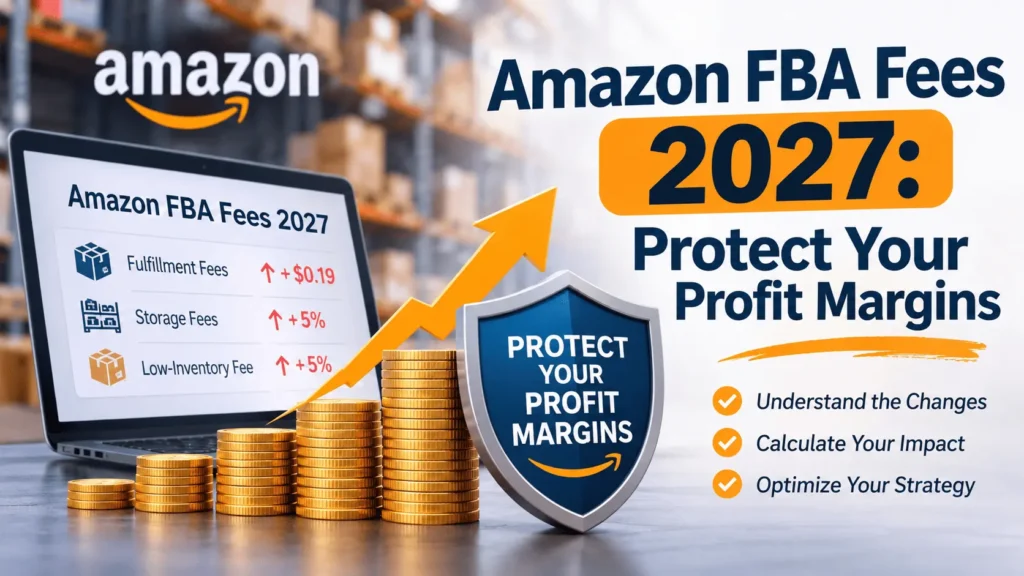



An average increase of $0.19 per unit sounds manageable. Until you multiply it across thousands of orders, add storage changes, and discover that the products carrying the most aged inventory are also the ones with the least room in their margins.
Amazon announced its 2027 US referral and Fulfillment by Amazon fee updates on November 5, 2026. Most fulfillment-fee changes take effect on January 15, 2027, while key storage and low-inventory changes begin on February 1. The headline average is useful, but it is not a forecast for your catalog: Amazon says some products will become cheaper to fulfill and others more expensive.
| THE KEY TAKEAWAY Do not apply the $0.19 average to every ASIN. Use the Fee Change Comparison dashboard in Seller Central and the Revenue Calculator to model each product using its own size, weight, price, and inventory profile. |
What is changing in Amazon FBA fees in 2027?
The update affects more than one line in a settlement report. Sellers should plan around three dates and two different types of exposure: the cost to ship a unit and the cost to keep inventory inside Amazon’s network.
| Change | What sellers should know | Effective date |
|---|---|---|
| FBA fulfillment fees | Average increase of $0.19 per unit sold, or about 0.8% of the average item selling price. Individual ASINs may rise or fall. | January 15, 2027 |
| Fuel and logistics surcharge | The existing 3.5% surcharge on eligible fulfillment fees remains in place; it is not a new 2027 surcharge. | No new change announced |
| Storage utilization surcharge | Amazon says it will eliminate this separate surcharge. | February 1, 2027 |
| Aged inventory surcharge | The separate surcharge will be removed and combined with monthly storage into one age-based rate. Older inventory will generally cost more. | February 1, 2027 |
| Low-inventory-level fee | The test will be based on actual shipments in the four weeks before and after assessment, and applies only when supply is below 28 days under the new method. | February 1, 2027 |
Amazon also says smaller and lighter items will generally see lower fulfillment fees, while larger and heavier items will generally see higher fees. The amount depends on the product’s size and dimensions. The update also changes handling treatment for irregular products and introduces flat product and overhang handling fees while removing the overmax handling fee. Sellers should use the official rate card for the exact treatment of each ASIN rather than estimating from a category average.
The January 15 change: why the average can mislead
The $0.19 figure is an average across units sold, not a flat fee increase for every product. A small accessory, a heavy appliance, and an irregularly shaped item can have very different outcomes. A product that becomes cheaper to fulfill can gain margin, while another product may need a price-floor adjustment or a packaging review.
For a simple illustration, if the Fee Change Comparison dashboard shows that one ASIN will cost $0.19 more per unit and you sell 1,000 units a month, the direct fulfillment-fee impact would be about $190 per month before any changes in storage, advertising, returns, or product costs. If the same ASIN instead receives a lower fee, that reduction should be reflected in the model too. The calculation must use the ASIN’s actual change, not the marketplace average.
Check the dimensions Amazon is using
A small measurement difference can move an item into a different size or weight band. Recheck packaged dimensions and shipping weight against the physical product, including inserts, protective packaging, and retail packaging. If Amazon’s recorded measurements are wrong, follow the Seller Central measurement investigation process and retain photographs or measurements that support the correction. Do not redesign packaging solely to chase a rate band if the new pack is less protective or violates product requirements.
Recalculate contribution margin, not just gross sales
A useful per-unit model starts with the selling price and subtracts referral fees, FBA fulfillment fees, storage allocation, inbound placement and shipping costs, landed product cost, prep, discounts, and expected return costs. Advertising should then be layered in to show contribution after PPC. This gives a more honest decision than tracking revenue or ACoS in isolation.
| A PRACTICAL MARGIN FORMULA Per-unit contribution before advertising = selling price − referral fee − FBA fulfillment fee − storage allocation − inbound and prep costs − landed product cost − expected return allowance. Then subtract ad cost and promotions to estimate contribution after marketing. |
The February 1 storage changes may matter more than the headline
Amazon says the storage utilization surcharge will be eliminated and the aged inventory surcharge will be folded into a single age-based monthly storage rate. The company expects flat or lower storage fees for inventory that turns in under six months, but higher rates for aged inventory. In other words, removing a separate surcharge does not mean slow-moving stock becomes cheap. Inventory age becomes a more direct cost driver.
Build an age report for every FNSKU or ASIN and sort it into practical groups: fast-moving stock, stock approaching six months, and older inventory that needs a decision. For the slowest products, compare the carrying cost of holding the units with the likely loss from a controlled price reduction, coupon, bundle, or removal order. The right choice depends on sell-through, seasonality, product life cycle, and replenishment lead time.
Do not confuse the new low-inventory test with a 28-day stock target
From February 1, Amazon says the low-inventory-level fee will apply only when inventory falls below 28 days of supply, using actual shipments in the four weeks before and after the assessment date. Looking at both periods is intended to reduce assessments caused by a short-lived demand spike or an end-of-life product. It does not mean every seller should keep exactly 28 days of stock. A healthy replenishment target must also account for supplier lead time, inbound transit, receiving delays, forecast error, and seasonal demand.
A five-step plan to protect your FBA margin
- 1. Export your highest-impact ASINs. Start with the products that drive the most units, revenue, storage volume, and advertising spend. Do not begin by trying to review every SKU at once.
- 2. Compare the actual fee change. Open the Fee Change Comparison dashboard in Profit Analytics and compare each ASIN’s current and future cost. Use the Revenue Calculator to validate scenarios and inspect the official 2027 rate details.
- 3. Update price floors selectively. Recalculate break-even price and minimum contribution for products whose costs rise. Do not apply one percentage increase across the whole catalog; a blanket price rise can damage conversion on products whose costs are unchanged or lower.
- 4. Make an aged-stock action list. Identify units likely to remain in storage beyond six months. Decide whether to promote, bundle, reprice, remove, or stop replenishing them. Record the reason and expected financial outcome for each action.
- 5. Rebuild replenishment around real lead times. Track days of supply, sales velocity, inbound shipment status, and supplier reliability. Keep a buffer for high-velocity products, but avoid buying extra inventory simply to avoid one fee when storage exposure could outweigh the benefit.
What should sellers do before January 15, 2027?
Use the period before the new rates begin to establish a clean baseline. Save current fee estimates, current dimensions, inventory age, average selling price, return rate, and contribution by ASIN. Then compare the first post-change settlement and Profit Analytics reports against that baseline. This will help separate a fee impact from changes in sales mix, advertising, or seasonality.
Keep the current holiday period in mind as well. Amazon’s 2026 holiday peak fulfillment fees run from October 15, 2026, through January 14, 2027, and the fuel and logistics surcharge applies to those fees. Do not mistake a seasonal peak charge for the permanent 2027 fee level when you compare reports.
For brands with a large catalog, changing demand, or several fulfillment models, fee work should sit alongside inventory and advertising decisions. Alpha Spikes connects those moving parts through its Full-Service Account Management service, which includes Seller Central oversight, inventory planning, account reporting, and FBA support.
Frequently asked questions
How much are Amazon FBA fees increasing in 2027?
Amazon says US FBA fulfillment fees will rise by an average of $0.19 per unit sold, roughly 0.8% of the average selling price. That is an average, not a guaranteed increase for every ASIN. Some products will see lower fulfillment fees.
When do the 2027 FBA fee changes start?
Most fulfillment-fee changes begin January 15, 2027. The storage structure and low-inventory-level fee changes begin February 1, 2027.
Is Amazon removing the aged inventory surcharge?
Amazon says it will remove the separate aged inventory surcharge and combine it with monthly storage fees into one age-based rate. Older inventory is expected to carry higher storage costs.
Is the 3.5% FBA fuel surcharge going away in 2027?
Amazon says the current fuel and logistics surcharge remains unchanged. Sellers should include it when modeling eligible fulfillment fees.
Are referral fees increasing too?
Amazon’s public announcement is titled as a referral and FBA fee update, but the announcement’s headline details do not specify a blanket referral-fee increase. Check the applicable category rate card in Seller Central before changing your assumptions.
Protect the profit behind every ASIN
The best response to a fee update is not to panic or raise every price. It is to identify which products are exposed, understand why, and choose a response that protects contribution without creating a new inventory or conversion problem. Start with your actual ASIN-level numbers, then connect pricing, stock, and advertising decisions.
If those decisions are spread across several people or spreadsheets, Alpha Spikes can review your Seller Central operation and help turn the fee update into a measurable margin plan.