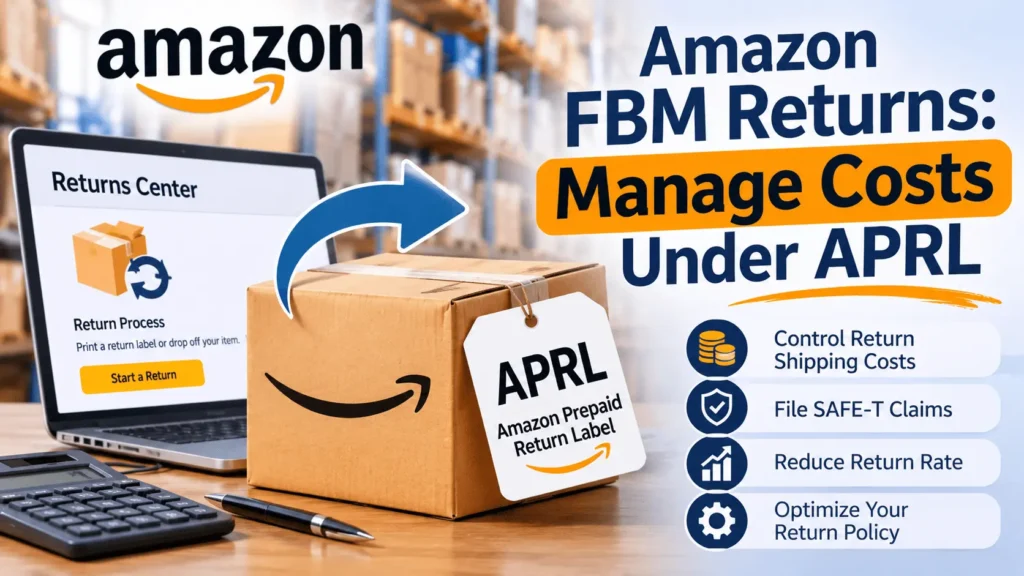



For years, sellers often treated high-value FBM returns differently from lower-priced returns. That changed on February 8, 2026. Amazon removed the previous high-value exemption from its US Prepaid Return Label program, so eligible seller-fulfilled customer returns are now routed through Amazon prepaid labels regardless of item value.
The change does not mean every return costs the seller the same amount. Return-shipping responsibility still depends on the return reason and the applicable program rules. Sellers also need to account for faster refund handling, the possibility of a refund before the item reaches the warehouse, and a shorter SAFE-T claim window.
| WHO THIS GUIDE APPLIES TO: This article focuses on US seller-fulfilled (FBM) orders. The February 8 APRL update is not a new FBA returns rule. Certain categories and items that are ineligible for prepaid labels remain exempt. |
What changed under Amazon APRL in 2026?
Amazon announced that, effective February 8, 2026, US sellers must use the Amazon Prepaid Return Label (APRL) program for seller-fulfilled customer returns regardless of item value. The previous high-value exemption was removed. Amazon provides the buyer with a prepaid label through Buy Shipping Services, and US sellers are automatically enrolled under the returns policy.
Amazon said the process is intended to reduce the refund cycle time from 14 days to 7 days and remove the need for buyer-seller messaging to arrange a label. In practice, sellers should prepare their return workflow around Amazon’s return authorization and label process rather than trying to manage every eligible request manually.
Which items may remain exempt?
Amazon says existing category exemptions continue, including Handmade, certified pre-owned watches, non-physical items, dangerous goods, and extra-large or heavy items. Other products that are ineligible for prepaid return labels remain exempt as well. Do not assume a product is exempt just because it is expensive, fragile, customized, or inconvenient to ship. Check the current ineligible-items and category rules for the specific ASIN.
Who pays for an Amazon prepaid return label?
This is one of the most important points for margin control: APRL does not automatically make every return-shipping charge the seller’s responsibility. Amazon’s rules generally assign costs according to the selected return reason.
| Return situation | Typical shipping-cost treatment | Seller action |
|---|---|---|
| Seller at fault: incorrect, damaged, or materially different item | Seller is responsible for return shipping; the buyer is generally entitled to a full refund under the applicable policy. | Fix the fulfilment, quality-control, packaging, or listing issue that caused the return. |
| Buyer at fault: accidental order or changed mind / better price | The return-shipping cost may be deducted from the buyer’s refund under the policy. | Check the return reason code and the transaction details rather than assuming the seller paid. |
| Free Returns or Seller Fulfilled Prime | Special program terms can change who carries the cost. For example, some Seller Fulfilled Prime items have separate return-cost rules. | Check the current program rules and the offer’s customer-facing Free Returns status. |
The cost treatment can differ for international returns and other special cases. The return reason recorded in Seller Central matters. Review the reason code, the label charge, and the refund before posting an assumed loss to a product’s return-cost report.
How the APRL return process works
- 1. The customer requests a return. For eligible US seller-fulfilled orders, Amazon can automatically authorize the request under its returns policy.
- 2. Amazon provides the prepaid label. The label is generated through Buy Shipping Services using the seller’s return address on file.
- 3. The carrier scans the package. Under Amazon’s refund-at-first-scan process, eligible returns can trigger a refund when the buyer drops the package at a designated carrier location and the return label receives its first scan. This can happen before the item arrives back at the seller’s warehouse.
- 4. The seller receives and inspects the return. Match the returned unit to the order, inspect condition and included parts, and save evidence if the item is damaged, incomplete, swapped, or materially different from what was shipped.
- 5. The seller reviews the settlement and claim eligibility. If Amazon refunded the buyer and the seller believes the refund or return created a reimbursable loss, check the SAFE-T eligibility path and file within the required deadline.
Amazon’s own seller-returns guide explains the prepaid return process and the refund-at-first-scan policy. A first carrier scan is therefore an operational trigger to watch; sellers should not wait until the parcel has been sitting in the returns area for weeks before checking the order and its reimbursement options.
Set up your account before the next return arrives
APRL depends on accurate account information. A missing or outdated return address can turn a routine return into a costly problem.
- Set a valid US domestic default return address and verify that the warehouse or 3PL can actually receive returns there.
- Check who has access to Manage Returns, Payments, and SAFE-T Claims. Assign a backup owner for weekends and holidays.
- Create a daily return queue that records order ID, SKU, ASIN, return reason, label cost, carrier scan, refund date, delivery date back to the warehouse, and item condition.
- For high-value products, record serial numbers or other identifying marks before dispatch where appropriate. Keep outbound pack-out photos, shipment weights, and condition records in a consistent location.
- Use protective packaging and tamper-evident methods that do not interfere with the product or customer experience. Document the condition of the return before altering or disposing of packaging.
How to protect an eligible SAFE-T claim
SAFE-T (Seller Assurance for E-Commerce Transactions) is one of the mechanisms Amazon identifies for sellers who believe they were wrongly charged or refunded in a seller-fulfilled return. It is not an automatic refund for every returned or damaged product. The order must be eligible, and the seller needs evidence that supports the specific claim reason.
A major 2026 change is the filing window. Effective February 16, 2026, the US SAFE-T claim window for seller-fulfilled orders changed from 60 days to 30 days. Amazon says the 30-day period starts from the later of the return delivery scan at the seller’s warehouse or the refund date. For lost shipments, the window starts from the last carrier scan event.
For an order where Amazon has issued a refund and the return has a valid RMA, Amazon’s current reimbursement instructions say to wait at least 15 days or until the item is received before filing, whichever applies to the case. The claim page checks eligibility before submission, so follow the live instructions for that order.
Build an evidence file as soon as the return arrives
- Photograph the unopened return package, shipping label, and tracking number before opening it.
- Record the unboxing process and photograph the item, serial number, accessories, and any visible damage or mismatch.
- Keep outbound proof such as shipment weight, pack-out photos, serial-number logs, and carrier acceptance scans.
- Save the return reason, refund notification, RMA, carrier tracking, and any customer or Amazon case correspondence.
To submit an eligible claim, go to Manage SAFE-T Claims, choose File a new SAFE-T Claim, enter the Order ID, RMA ID, or Tracking ID, and check eligibility. Select the claim reason and attach the evidence requested. File promptly: a strong claim that misses the deadline may not be reviewed.
Reduce the number of returns, not just the cost of labels
The cheapest return is often the one that never happens. Break return data down by child ASIN and reason code. A cluster of “not as described” returns may point to weak images or unclear dimensions; a cluster of defective-item returns may signal supplier quality or packaging issues; a high “does not fit” rate may require clearer sizing or compatibility information.
- Update titles, bullets, images, and A+ Content when shoppers regularly misunderstand what is included or which model fits.
- Check product quality and packaging for repeated defects, missing parts, or transit damage.
- Use accurate handling times and tracking so that delivery problems do not create avoidable claims or negative feedback.
- Review return rates and contribution after returns at the SKU level. A product with strong sales can still be unprofitable if refunds, replacement shipments, and damaged returns are not measured.
APRL management sits across customer returns, catalog quality, order operations, and account reporting. Alpha Spikes’ Full-Service Account Management service includes FBM support and connected Seller Central oversight for brands that need these workflows managed together.
Frequently asked questions
Does the 2026 APRL change apply to FBA orders?
No. The February 8 update discussed here applies to US seller-fulfilled customer returns. FBA returns are handled through Amazon’s FBA process.
Does every US FBM return need a prepaid label?
The requirement applies regardless of item value, but existing category exemptions and items that are ineligible for prepaid labels remain exempt. Check the current Amazon list for your product.
Does the seller always pay for return shipping?
No. Responsibility depends on the return reason and applicable program rules. Seller-at-fault returns generally put the cost on the seller; buyer-at-fault returns may allow the cost to be deducted from the buyer’s refund. Free Returns and Seller Fulfilled Prime can have special rules.
Can Amazon refund the buyer before the item reaches my warehouse?
Yes. Under the refund-at-first-scan process, eligible prepaid-label returns can trigger a refund when the carrier first scans the package after drop-off.
How long do I have to file a SAFE-T claim in the US?
For US seller-fulfilled orders, the filing window changed to 30 days on February 16, 2026. Amazon says the period starts from the later of the return delivery scan at the warehouse or the refund date. For lost shipments, it starts from the last scan event.
Make returns a managed process, not a surprise expense
APRL has made eligible US FBM returns more standardized, but it has not removed the seller’s responsibility to manage return reasons, inspect inventory, and protect valid reimbursement claims. A reliable process starts with an accurate return address, continues with order-level evidence, and ends with a review of the root cause.
When return issues are consuming time or eroding margin across multiple SKUs, Alpha Spikes can help coordinate FBM operations, listing quality, and account reporting as part of a broader Seller Central management plan.