


Amazon’s holiday selling season can bring more orders, but it can also expose expensive mistakes. Inventory that reaches a warehouse too late, discounts that reduce profit, and advertising campaigns that run out of budget can all hurt your fourth-quarter results.
That’s why following an Amazon Q4 2026 seller checklist matters, even after the major inventory deadlines have passed.
Amazon has published its Q4 2026 Peak Readiness Playbook to help sellers prepare for Black Friday, Cyber Monday, and the holiday shopping season. It covers Fulfillment by Amazon (FBA) inventory deadlines, warehouse capacity, promotional fees, and shipping preparation.
The most important dates are already behind us. Amazon’s final published Black Friday and Cyber Monday FBA arrival deadline was October 28, 2026. However, sellers can still improve their inventory planning, product listings, advertising, and pricing before the busiest shopping days.
This guide explains what Amazon sellers need to know about Q4 2026, what the deadlines mean, and which actions can still protect sales and profit.
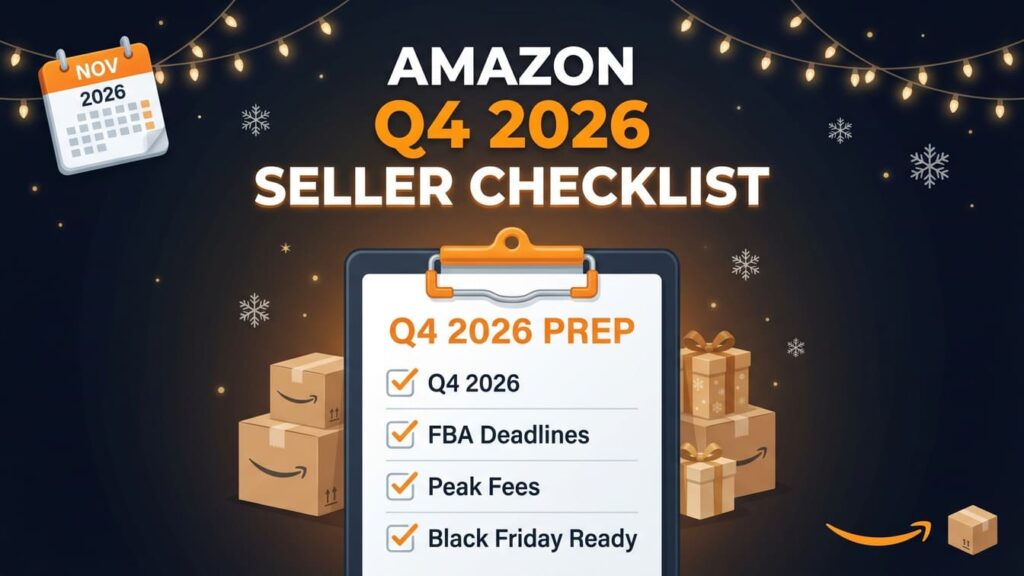
TL;DR: Amazon Q4 2026 Seller Checklist
Amazon’s fourth quarter runs from October 1 through December 31, covering several major US shopping events. The 2026 Black Friday and Cyber Monday event runs from November 19 through November 30.
- Inventory deadlines: Amazon’s Black Friday arrival deadlines were October 14 for AWD, October 21 for FBA minimal shipment splits, and October 28 for Amazon-optimized shipment splits.
- Holiday fulfillment fees: Seasonal peak fees apply from October 15, 2026, through January 14, 2027, with an average increase of $0.32 per unit over regular fulfillment rates.
- Deal submissions: Amazon initially set October 20 as the deadline for Black Friday and Cyber Monday deal submissions, then extended its deal sourcing window through November 13.
- Remaining priorities: Review available inventory, fix listing errors, check advertising budgets, calculate profit after fees, and prepare for December sales and January returns.
The goal now is to make better decisions with the stock and resources you already have, rather than rushing into expensive last-minute changes.
What Is Amazon Q4 Peak Season Readiness?
Amazon Q4 peak season readiness means preparing inventory, fulfillment, product listings, advertising, and customer service for the increased shopping activity during October, November, and December.
For sellers in the United States, this period includes Prime Big Deal Days, Black Friday, Cyber Monday, Christmas shopping, and other year-end purchases.
Amazon’s Q4 2026 Peak Readiness Playbook provides guidance on managing stock, shipping products to fulfillment centers, creating promotions, and understanding seasonal charges.
These areas are connected. For example, an advertising campaign may increase product visibility, but it cannot generate fulfilled orders if your product is out of stock.
Similarly, a discount may increase sales volume while reducing total profit if you don’t calculate fulfillment and promotional costs first.
Why Does Q4 Inventory Planning Matter So Much?
Inventory planning matters because demand can rise quickly during holiday promotions, while Amazon’s fulfillment network faces heavy inbound and outbound shipping activity.
A seller may have 500 units ready to ship, but those units cannot support immediate FBA sales until Amazon receives and processes them.
This difference between stock you own and stock available to customers is especially important during Black Friday Week.
Amazon states that its fulfillment centers focus on receiving holiday shipments during September and October before shifting more attention toward customer orders in November and December.
As a result, sellers who wait until the event begins may face longer receiving times and fewer inbound delivery options.
When Were Amazon’s Q4 2026 FBA Inventory Deadlines?
Amazon’s published Black Friday Week and Cyber Monday inventory arrival deadlines fell between October 14 and October 28, 2026. The exact date depended on the inventory destination and shipment-split option.
Fulfillment by Amazon (FBA) is Amazon’s service for storing seller inventory and handling eligible customer orders, including picking, packing, shipping, and certain customer-service tasks.
Amazon Warehousing and Distribution (AWD) is a separate bulk-storage and distribution service that can supply inventory to the FBA network.
Amazon announced the following 2026 arrival deadlines for US sellers:
| Shipping Method | 2026 Arrival Deadline |
|---|---|
| AWD shipments | October 14 |
| FBA with minimal shipment splits | October 21 |
| FBA with Amazon-optimized shipment splits | October 28 |
These were arrival deadlines, not dates for handing products to a shipping carrier.
For example, sending a shipment on October 28 would not satisfy the October 28 arrival target if the carrier delivered it several days later.
Amazon published these dates to support holiday inventory readiness and Prime-badge eligibility. Reaching a warehouse by the deadline also doesn’t mean every unit becomes immediately available for sale, because receiving and processing still take time.
What Happens If You Missed the October 28 FBA Deadline?
Missing the October 28 deadline does not automatically prevent you from selling products on Amazon. However, inventory arriving afterward may not be processed in time for the Black Friday and Cyber Monday events.
The first step is to check your shipment status in Seller Central.
Look at how many units are already sellable, how many are being received, and how many remain in transit.
If a shipment is delayed, review the carrier’s tracking information and your shipment details before planning additional promotional spending.
For products that are already running low, reduce advertising pressure rather than paying to attract more customers than your remaining inventory can support.
If you can fulfill orders yourself, consider whether Fulfilled by Merchant (FBM) is a practical option. FBM allows sellers to store, pack, and ship their own orders, but it requires reliable delivery operations and compliance with Amazon’s seller performance rules.
How Much Inventory Should Amazon Sellers Keep During Q4?
Amazon sellers should base Q4 inventory levels on expected daily demand, available units, and replenishment lead times rather than relying on a fixed number for every product.
Amazon’s 2026 guidance recommends having roughly four to six weeks of inventory available before major deal events and maintaining around 28 days of supply after the event.
The correct amount may be higher for products with strong holiday demand or long supplier lead times.
How Do You Calculate Your Inventory Coverage?
Inventory coverage, also called days of supply, measures how long your available stock can support expected sales.
The calculation is:
Days of Inventory Coverage = Sellable Units ÷ Forecast Daily Sales
Suppose you have 600 sellable units of a product and expect to sell 40 units per day during a promotion.
Your inventory coverage would be:
600 ÷ 40 = 15 days of supply
If that same product begins selling 60 units per day, your coverage falls to only 10 days.
This calculation helps you decide whether to increase advertising, reduce spending, or prioritize replenishment.
When forecasting demand, compare recent daily sales with previous holiday performance, where available. New products without sales history should use conservative estimates rather than assuming every item will experience a major seasonal increase.
How Can You Prevent Stockouts During Holiday Sales?
A stockout happens when a product becomes unavailable because there is not enough sellable inventory to meet customer demand.
Stockouts can interrupt sales and reduce the value of advertising traffic that you’ve already paid to attract.
To reduce the risk, focus on these four actions:
- Check FBA Inventory daily: Review sellable stock, inbound shipments, and products approaching low inventory.
- Forecast your strongest products: Use sales history to estimate how quickly each major ASIN could sell.
- Adjust advertising to stock levels: Avoid increasing traffic to products that may sell out before the next replenishment.
- Plan December demand: Remember that holiday shopping continues after Cyber Monday.
An ASIN, or Amazon Standard Identification Number, is the unique product identifier Amazon uses in its catalog. Reviewing inventory by ASIN helps you make decisions for individual products instead of treating your entire inventory as one group.
How Can AWD Help Amazon Sellers Manage Holiday Inventory?
Amazon Warehousing and Distribution can help sellers store bulk inventory outside the standard FBA fulfillment network and replenish fulfillment centers as needed.
This can be useful when sellers have more inventory than they want to keep directly in FBA.
For example, a seller might hold several months of stock in AWD while maintaining a smaller amount of inventory inside Amazon’s fulfillment centers.
When eligible, automatic replenishment from AWD can help move stock into FBA without requiring a separate manual shipment for every restock.
Amazon states that qualifying AWD auto-replenished inventory is not subject to normal FBA capacity limits during peak season.
However, AWD does not eliminate inventory planning. Sellers still need to monitor demand, storage costs, replenishment timing, and product availability.
If your inventory has already arrived in AWD, check the replenishment status before assuming those products can support immediate Black Friday sales.
What Are Amazon’s Q4 2026 Holiday Fulfillment Fees?
Amazon’s 2026 holiday peak fulfillment fees apply from October 15, 2026, through January 14, 2027.
These seasonal charges affect Fulfillment by Amazon, Remote Fulfillment with FBA, Multi-Channel Fulfillment, and Buy with Prime.
Amazon announced that the average holiday peak fulfillment increase is $0.32 per unit compared with non-peak fulfillment rates.
The company also applies a 3.5% fuel and logistics-related surcharge on top of the applicable peak fulfillment fees.
The $0.32 figure is an average, not a flat fee charged to every product. Actual costs depend on factors such as product size, weight, fulfillment service, and the applicable fee schedule.
How Do Peak Fees Affect Your Profit Margin?
Peak fulfillment fees matter because even a small increase per unit can become expensive when sales volume rises.
Consider a seller shipping 2,000 units during the holiday period.
At the announced average increase of $0.32 per unit, the additional fulfillment cost would be approximately:
2,000 × $0.32 = $640
This calculation illustrates the average seasonal increase only. It excludes the fuel surcharge and other selling, storage, advertising, and promotional costs.
Before setting a discount, calculate the actual cost for each product using Amazon’s Revenue Calculator or the fee information available in Seller Central.
A sale is only worthwhile when the revenue remaining after all relevant costs meets your profit target.
How Should Sellers Price Products for Black Friday and Cyber Monday?
Amazon sellers should set promotional prices based on profit margins, product demand, and available inventory rather than offering the largest possible discount.
A promotion can increase order volume while reducing total earnings if the product’s costs are too high.
For the 2026 holiday events, Amazon announced a $100 upfront promotional fee plus a variable fee equal to 1.5% of promotional sales, capped at $5,000, for specified event promotion types such as Best Deals, Lightning Deals, and Prime Exclusive Price Discounts.
Not every type of discount has the same fee structure, so sellers should review the actual charges shown when creating a promotion.
How Can You Calculate Profit Before Offering a Discount?
Start with your expected selling price and subtract all costs directly related to fulfilling the sale.
Consider this hypothetical example:
| Cost or Revenue | Amount |
|---|---|
| Discounted selling price | $27.00 |
| Product cost | $10.00 |
| Referral fee (example) | $4.05 |
| FBA fulfillment cost (example) | $5.32 |
| Advertising cost per order | $3.00 |
| Allocated promotional fee | $0.91 |
| Inbound shipping allocation | $1.00 |
| Estimated profit per order | $2.72 |
These are illustrative values, not Amazon’s universal fees.
The promotional fee example assumes 200 units sold, spreading a $100 upfront fee across those units, plus a 1.5% variable charge on the selling price.
Actual profit may be lower once additional costs, returns, and other applicable charges are included.
If a discount leaves too little profit, consider a smaller promotion or a different product. More orders are not always better when each order contributes very little to your business.
Can Amazon Sellers Still Create Black Friday and Cyber Monday Promotions?
Amazon’s published Black Friday and Cyber Monday deal sourcing window closed on November 13, 2026, following an extension from the original October 20 deadline.
As of November 19, sellers should not assume they can submit new event deals through the earlier submission process.
However, the availability of other promotional tools may differ by seller account, product, event, and eligibility.
Check the Deals Dashboard and Price Discounts section in Seller Central to see which options are currently available.
A seller who missed the event submission window can still review regular pricing, existing coupons, and other eligible promotions.
The important point is to avoid advertising a special event deal badge unless Amazon has actually approved it.
How Can Product Listing Optimization Improve Q4 Sales?
Product listing optimization helps shoppers understand what they’re buying and makes it easier for Amazon to match relevant products with customer searches.
A product listing includes the title, images, product details, description, and other information displayed on the Amazon product page.
For holiday shopping, customers often compare multiple products quickly. Missing specifications, unclear photos, or incorrect variations can discourage a purchase.
What Should Sellers Check Before Black Friday?
Start by reviewing your highest-selling ASINs rather than attempting major changes to every product.
Check whether the title clearly identifies the product, whether the main image follows Amazon’s requirements, and whether the description answers common buying questions.
For example, a seller offering a portable blender should clearly state the capacity, charging method, included accessories, and cleaning instructions.
These details help shoppers compare the product with alternatives.
Also check for suppressed listings, missing product attributes, pricing errors, and unavailable variations.
Fixing a suppressed listing is more urgent than making small wording changes to a product page that’s already performing well.
How Should Amazon Sellers Manage Advertising During Q4?
Amazon sellers should adjust advertising based on product profitability, inventory coverage, and campaign performance during the holiday shopping season.
Amazon Sponsored Products are cost-per-click advertisements that promote individual product listings in relevant shopping placements.
Higher holiday demand may create opportunities for more sales, but increased competition can also raise advertising costs.
A useful approach is to prioritize campaigns that generate profitable orders and reduce spending on products with weak margins or limited stock.
Which Advertising Metrics Matter Most?
Advertising cost of sales (ACoS) measures advertising spend as a percentage of sales attributed to ads.
For example, spending $100 on advertisements that generate $500 in attributed sales produces a 20% ACoS.
However, a low ACoS doesn’t automatically mean the product is profitable. Sellers must also account for product costs, fulfillment fees, promotions, and returns.
Another useful measure is total advertising cost of sales (TACoS), which compares advertising spend with total sales revenue.
During Q4, check advertising results alongside actual profit and available inventory.
If a product has only five days of stock remaining, increasing its advertising budget may cause it to sell out before Cyber Monday.
If another product has strong margins and healthy inventory, additional advertising may make better business sense.
What Should Amazon Sellers Do During the Final Days Before Black Friday?
With Amazon’s major 2026 inbound deadlines already passed, the final preparation period should focus on the products that are ready to sell.
Review your account daily and identify issues that could interrupt orders or reduce profit.
Use this short checklist before increasing promotional activity:
- Inventory: Confirm which products are sellable and which shipments are still being processed.
- Listings: Check for suppressed ASINs, incorrect pricing, missing variations, and product detail errors.
- Promotions and ads: Review approved deals, advertising budgets, product-level margins, and campaign performance.
- Customer operations: Check fulfillment settings, delivery promises, buyer messages, and return handling.
After November 30, shift attention toward December demand rather than assuming the holiday season is finished.
Products that perform well during Cyber Monday may continue selling as customers purchase Christmas gifts and year-end essentials.
How Should Sellers Prepare for Holiday Returns and January 2027?
Amazon sellers should plan for returns beyond December because the 2026 extended holiday return window continues into January 2027.
Amazon states that most eligible products purchased between November 1 and December 31, 2026, can be returned through January 31, 2027.
Eligible Apple-branded purchases have an earlier deadline of January 15, 2027.
The extended return policy applies to eligible FBA and seller-fulfilled orders, with existing product return conditions still applying.
This matters for cash flow because some December sales may result in refunds during January.
Sellers should review return trends by product and identify items with unusually high return rates.
For example, frequent returns due to incorrect sizing may indicate that a listing needs clearer measurements. Returns caused by damaged packaging may point to an issue with product preparation or shipping materials.
January is also a useful time to review unsold inventory, storage charges, advertising results, and products that need slower replenishment.
Holiday peak fulfillment fees continue through January 14, 2027, so the end of December does not immediately remove every seasonal cost.
Frequently Asked Questions About Amazon Q4 2026 Seller Readiness
What Is the Amazon Q4 2026 Peak Readiness Playbook?
The Amazon Q4 2026 Peak Readiness Playbook is an official Seller Central resource designed to help sellers prepare for major holiday shopping events. It covers inventory arrivals, fulfillment capacity, shipping preparation, promotions, and seasonal fees. Sellers can use it to understand Amazon’s requirements and plan stock availability during the busiest months of the year.
What Was the Last Amazon FBA Deadline for Black Friday 2026?
The final published FBA arrival deadline for Black Friday Week and Cyber Monday 2026 was October 28 for shipments using Amazon-optimized shipment splits. Sellers using minimal shipment splits had an October 21 deadline, while AWD shipments had an October 14 deadline. These dates refer to inventory arriving at Amazon facilities, not the date sellers shipped their products.
Can You Still Send FBA Inventory After October 28, 2026?
Yes. Sellers can still create eligible FBA shipments after October 28, subject to their capacity limits and shipment requirements. However, Amazon does not guarantee that inventory arriving after the holiday cutoff will be processed in time for Black Friday or Cyber Monday. Sellers should check shipment status and avoid planning immediate promotions around stock that isn’t yet sellable.
How Much Are Amazon’s Holiday Peak Fulfillment Fees in 2026?
Amazon’s 2026 holiday peak fulfillment fees apply from October 15, 2026, through January 14, 2027. The announced average increase is $0.32 per unit over regular fulfillment rates, with a 3.5% fuel and logistics-related surcharge applying on top. Actual fees depend on the product and fulfillment service, so sellers should calculate costs for each ASIN.
What Is Amazon AWD, and How Does It Help During Q4?
Amazon Warehousing and Distribution (AWD) is a bulk-storage and distribution service that can hold inventory and replenish Amazon’s FBA network. It can help sellers manage excess stock without placing all available inventory directly into fulfillment centers. Eligible automatic replenishment may also reduce FBA capacity concerns, although sellers must still manage storage costs and replenishment timing.
Can Amazon Sellers Still Run Promotions After the November 13 Deadline?
Some promotional options may remain available, but sellers should not assume that late submissions will qualify for official Black Friday or Cyber Monday event deals. Amazon extended the 2026 deal sourcing deadline to November 13. Sellers should review their Deals Dashboard, Price Discounts, and other eligible promotion tools to see what their account currently supports.
How Can Amazon Sellers Avoid Stockouts During Black Friday?
Amazon sellers can reduce stockout risk by comparing sellable inventory with expected daily sales and replenishment timing. Review FBA Inventory regularly, track units already in Amazon’s network, and monitor fast-selling ASINs. When stock is limited, reducing advertising or promotional pressure may help prevent products from selling out before the end of the event.
When Do Amazon’s 2026 Holiday Peak Fulfillment Fees End?
Amazon’s 2026 holiday peak fulfillment fee period ends January 14, 2027. The seasonal increases apply to several fulfillment services, including FBA and Multi-Channel Fulfillment. Other charges, such as regular fulfillment fees, storage costs, and applicable surcharges, may still apply afterward. Sellers should review the current fee schedule when planning January pricing and inventory.
Conclusion
Amazon Q4 2026 brings both sales opportunities and operational challenges for US sellers.
The major FBA inventory deadlines and event deal submission windows have already passed, but there are still important actions sellers can take before Black Friday and Cyber Monday.
Start by checking how much sellable inventory you have, which listings are performing well, and whether your advertising campaigns are producing profitable orders.
Review holiday fulfillment costs before offering additional discounts, and plan for continued demand throughout December.
Most importantly, prepare for January returns and storage costs before the holiday shopping rush ends.
Q4 success isn’t measured only by how many products you sell. It’s measured by how much profit you keep while meeting customer expectations.
Use the Amazon Q4 2026 Peak Readiness Playbook alongside your Seller Central reports to make your remaining holiday selling decisions with accurate inventory, cost, and performance data.