Two brands sell the same $40 product on Amazon. One receives the retail sale, pays Amazon’s selling fees, and manages its own inventory. The other sells that product wholesale to Amazon and lets Amazon handle the customer transaction.
The product page may look almost identical to shoppers. But behind the scenes, those brands operate two very different businesses.
One has more control over pricing and sales. The other depends on Amazon’s purchase orders, wholesale terms, and retail decisions.
So, which arrangement actually makes more money?
That’s the question behind Amazon Vendor Central vs Seller Central. Choosing between them affects your margins, inventory responsibilities, cash flow, advertising strategy, and even how much control you have over your brand.
This guide breaks down the differences between Amazon’s first-party (1P) and third-party (3P) models, including what they cost, where the risks lie, and how to decide which makes sense for your US business in 2026.
TL;DR: Amazon Vendor Central vs Seller Central
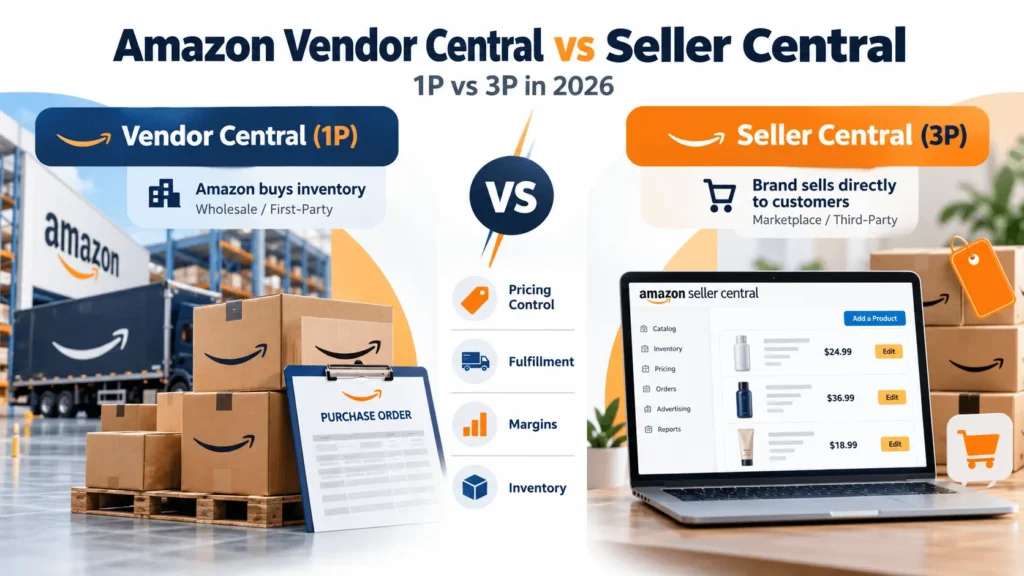
Amazon Seller Central is a third-party (3P) platform where businesses sell directly to customers. Amazon Vendor Central is a first-party (1P) wholesale platform where brands sell inventory to Amazon, which then resells it.
Here’s how to choose:
- Choose Seller Central if retail pricing control, flexible inventory management, and direct visibility into sales economics matter most.
- Consider Vendor Central if Amazon invites your brand, you have reliable wholesale operations, and the negotiated terms support healthy margins.
- Compare actual costs: Seller Central involves referral, fulfillment, storage, and other selling expenses. Vendor Central involves wholesale pricing, negotiated allowances, and possible operational deductions.
- Consider a hybrid strategy if different product lines benefit from different selling models, but plan carefully to avoid competing against your own offers.
- Don’t choose based on revenue alone. Compare contribution profit, cash flow, inventory risk, and the control each model gives your business.
Neither model guarantees higher sales or better profitability. Your product economics and operational capacity should drive the decision.
Amazon Vendor Central vs Seller Central: Key Differences
The main difference is who sells the product to the customer.
With Seller Central, your business is the third-party seller. With Vendor Central, Amazon purchases inventory from your business and becomes the retailer.
Amazon confirms these distinctions in its official Seller Central guide.
| Feature | Vendor Central (1P) | Seller Central (3P) |
|---|---|---|
| Business model | Wholesale to Amazon | Direct marketplace selling |
| Account access | Amazon invitation required | Registration available to eligible businesses |
| Retail pricing | Amazon controls retail prices | Seller sets offer prices, subject to marketplace policies |
| Revenue model | Negotiated wholesale price | Retail selling price minus costs |
| Inventory | Amazon purchases through POs | Seller manages inventory and replenishment |
| Fulfillment | Amazon handles customer fulfillment after purchasing inventory | Seller uses FBA or FBM |
| Main costs | Wholesale discounts, allowances, deductions, logistics | Referral fees, fulfillment, storage, advertising |
| Payment process | Contract-based invoicing and payment terms | Seller disbursements subject to Amazon’s payment policies |
| Advertising | Eligible Amazon advertising programs | Eligible Amazon advertising programs |
| Main operational risks | PO issues, chargebacks, shortages, margin pressure | Account health, stockouts, fees, competitive pricing |
The better choice depends on what your business can manage profitably, not simply which platform offers more features.
What Is Amazon Vendor Central?
Amazon Vendor Central is an invitation-only platform for manufacturers, distributors, and brands that sell products wholesale to Amazon.
Instead of managing individual customer orders, your business supplies inventory against purchase orders (POs) issued by Amazon.
The process generally works like this:
- Amazon invites your business into its vendor program.
- You review and negotiate the applicable commercial terms.
- Amazon issues purchase orders for specific products and quantities.
- Your business ships the agreed inventory according to Amazon’s requirements.
- Amazon sells those products to customers and manages retail fulfillment.
Products sold this way may display the familiar “Ships from and sold by Amazon.com” designation.
Benefits of Vendor Central
Vendor Central can make sense for brands that already operate a reliable wholesale supply chain.
Potential advantages include selling inventory in bulk, reducing direct-to-consumer fulfillment responsibilities, and working with Amazon as a retail customer.
But wholesale doesn’t mean hands-off.
Brands still need to manage PO confirmations, shipment requirements, invoices, deductions, product information, and advertising where appropriate.
The biggest limitation is that Amazon controls the shopper-facing retail price. You negotiate the price Amazon pays your business, not the price Amazon ultimately charges consumers.
What Is Amazon Seller Central?
Amazon Seller Central is the platform businesses use to sell products directly to customers through Amazon’s marketplace.
You manage your product offers, pricing, inventory, advertising, and account performance.
For fulfillment, you can choose between:
- Fulfillment by Amazon (FBA): Amazon stores inventory and handles eligible customer fulfillment, shipping, and related services.
- Fulfilled by Merchant (FBM): Your business manages storage, shipping, and applicable customer-service responsibilities.
Unlike Vendor Central, Seller Central is not restricted to invitation-only wholesale partners, although registration, category approvals, and selling policies still apply.
Benefits of Seller Central
The main advantage is control.
You can adjust retail prices, manage product availability, test promotions, and respond to changes in customer demand.
Seller Central also provides reporting tools that help businesses evaluate traffic, conversions, and sales performance.
However, you remain responsible for account health, inventory planning, product compliance, and the costs associated with selling.
According to Amazon’s official pricing page, the US Professional selling plan costs $39.99 per month, plus applicable selling fees.
For growing brands, that flexibility can be valuable—but only when the remaining retail margin justifies the extra responsibilities.
Vendor Central vs Seller Central: Which Is More Profitable?
This is where the comparison becomes interesting.
Seller Central lets you collect the retail selling price, but Amazon fees and operating expenses reduce your earnings.
Vendor Central pays you a wholesale price, which may sound simpler until negotiated deductions and fulfillment obligations are included.
Let’s compare both using one hypothetical product.
Example: Selling a $40 Product Through 1P vs 3P
Assume a US home-products brand sells an item with a $40 retail price and $12 product cost.
| Cost or revenue | Seller Central (3P) | Vendor Central (1P) |
|---|---|---|
| Revenue received per unit before listed costs | $40 retail | $26 wholesale |
| Product cost | -$12 | -$12 |
| Amazon referral fee | -$6 | — |
| Fulfillment and storage | -$5 | — |
| Inbound shipping/returns allowance | -$1 | — |
| Wholesale freight and compliance costs | — | -$2 |
| Vendor allowances | — | -$3 |
| Other deduction reserve | — | -$1 |
| Brand-funded advertising | -$4 | -$2 |
| Illustrative contribution per unit | $12 | $6 |
In this example, Seller Central generates $12 in contribution per unit, while Vendor Central generates $6.
But that doesn’t automatically make Seller Central the winner.
Vendor Central might support larger order quantities or reduce certain operational workloads. Seller Central may offer more margin per unit while requiring additional inventory investment and management.
A brand selling 1,000 units at $12 contribution generates $12,000 before unallocated costs. Another selling 3,000 units at $6 contribution generates $18,000.
The point isn’t that either volume will occur. It’s that profit per unit and realistic sales volume must be evaluated together.
All figures above are illustrative. Actual Amazon fees, wholesale agreements, advertising expenses, returns, taxes, overhead, and other costs will differ. Use your own contracts and Amazon’s Revenue Calculator when evaluating your business.
The Hidden Costs of Vendor Central
A vendor’s wholesale price isn’t always the final amount retained.
Depending on the agreement and operational performance, deductions may include:
- Co-op and promotional allowances: Negotiated contributions associated with marketing or retail programs.
- Chargebacks: Charges for certain shipment, labeling, routing, or compliance failures.
- Shortage claims: Disputes over quantities shipped and received.
- Freight and logistics costs: Expenses determined by shipment arrangements.
- Other contractual deductions: Terms specific to the vendor agreement.
A $26 wholesale invoice can therefore produce considerably less contribution than expected.
Before accepting an invitation, calculate your expected net receipts after all applicable deductions, then compare them with Seller Central profitability.
Pricing Control, Inventory, and Cash Flow: What Changes?
Profit matters, but it isn’t the only consideration.
1. Retail Pricing Control
Seller Central gives you more direct control over your listed selling price, although Amazon’s marketplace policies, competition, and Featured Offer eligibility can affect your results.
Vendor Central works differently. Amazon buys your inventory and independently determines the retail price.
That matters when your brand also sells through Walmart, independent retailers, or its own website.
If Amazon discounts a product aggressively, it can create tension with your broader pricing strategy.
Brands with important cross-channel pricing relationships should examine this risk before moving products into a 1P arrangement.
2. Inventory and Purchase Orders
On Seller Central, you decide how much inventory to send to FBA or hold for merchant fulfillment. You also take responsibility for forecasting demand and managing stockouts.
On Vendor Central, Amazon controls its purchasing decisions.
A large purchase order can be attractive, but future order quantities aren’t guaranteed.
If Amazon reduces replenishment or stops ordering a product, your brand may need another channel to sell its inventory.
Operational accuracy also matters. Missed PO confirmations, shipping errors, and documentation problems can increase costs.
3. Payment Terms and Cash Flow
Seller Central sellers generally receive disbursements according to Amazon’s payment schedule, subject to reserves and other adjustments.
Vendor Central payments follow negotiated terms and invoice processing requirements.
For brands paying manufacturers before receiving payment from Amazon, the timing can create working-capital pressure.
Before choosing a model, compare not only your projected profit but also how much cash your business needs to operate between inventory purchases and payments.
Can You Use Vendor Central and Seller Central Together?
Yes. Some brands operate a hybrid Amazon model, using Vendor Central for certain products and Seller Central for others.
For example, a home-products manufacturer might supply its established, high-volume items wholesale to Amazon while selling newer or seasonal products through Seller Central.
That approach can provide flexibility, but it needs careful management.
Problems arise when a brand and Amazon offer the same ASIN at competing prices. The brand can end up competing against its own inventory for the Featured Offer.
Hybrid businesses should consider:
- Which SKUs belong in each model.
- Whether both channels will offer the same ASIN.
- How prices and profitability differ across channels.
- How inventory and advertising budgets will be allocated.
- Who will monitor overlapping offers and operational issues.
A hybrid model works best when each channel has a defined purpose. Running both simply because both accounts are available can create unnecessary complexity.
Which Amazon Selling Model Is Right for Your Brand?
Instead of asking which platform is universally better, consider your current business needs.
Seller Central May Be a Better Fit If:
- You’re launching a new Amazon brand or product.
- You need direct control over retail pricing.
- You want to test product listings, offers, and advertising frequently.
- Your business can handle inventory management and account compliance.
- Your retail contribution margin supports Amazon’s selling costs.
Vendor Central May Be Worth Considering If:
- Amazon has invited your brand into its vendor program.
- You have established manufacturing and wholesale capabilities.
- Your business can reliably fulfill purchase orders.
- Your negotiated wholesale terms leave sufficient contribution profit.
- You’re comfortable allowing Amazon to control customer-facing retail prices.
Five Questions to Ask Before Accepting a Vendor Invitation
- What’s my net wholesale margin after every negotiated allowance and expected deduction?
- How would Amazon-controlled retail pricing affect my other sales channels?
- Can my operations team meet Amazon’s PO, labeling, shipping, and invoicing requirements?
- How would changes in Amazon’s purchasing volume affect cash flow and inventory?
- Would keeping certain products on Seller Central provide more flexibility?
An invitation is an opportunity to evaluate—not a reason to sign before understanding the economics.
How Alpha Spikes Supports Amazon Brands Across Both Models
Managing an Amazon business requires more than choosing the right account type.
Seller Central brands need to coordinate advertising, listings, inventory, and account performance. Vendor Central brands face additional challenges involving purchase orders, invoices, reporting, and wholesale deductions.
Alpha Spikes provides support across both platforms through its Amazon Vendor Central services and Seller Central management services.
Its publicly published Fire Sense and Balkene Home case study, categorized under Vendor Central, reports a 90-day engagement involving Brand Store redesign, PPC management, and listing improvements. Alpha Spikes reports that advertising ACoS declined from 34% to 24.8% during that work.
Those are agency-reported results, not independently verified outcomes. The case study demonstrates the types of marketplace improvements the agency reports working on; it doesn’t prove that one selling model is superior to the other.
If your brand is considering a Vendor Central invitation or struggling to manage an existing Amazon account, a review of your margins, account structure, and operational challenges can help clarify what deserves attention.
Frequently Asked Questions
Is Amazon Vendor Central better than Seller Central?
Neither is automatically better. Vendor Central can suit established wholesale brands with reliable supply chains and favorable agreements. Seller Central provides more direct pricing and inventory control. Compare costs, margins, operational responsibilities, and cash flow before deciding.
Can anyone register for Amazon Vendor Central?
No. Amazon Vendor Central is invitation-only. Businesses generally need an invitation from Amazon to establish a first-party vendor relationship. Seller Central registration is available to eligible businesses without a Vendor Central invitation.
Does Amazon Vendor Central charge referral fees?
Vendor Central operates through wholesale agreements rather than the standard third-party referral-fee model. Vendors may still face negotiated allowances, logistics expenses, chargebacks, and other contractual deductions.
Is Amazon FBA the same as Vendor Central?
No. FBA is a fulfillment service available to eligible third-party sellers. Vendor Central is a first-party wholesale relationship in which Amazon buys inventory from a vendor for resale.
Can a brand switch from Vendor Central to Seller Central?
A brand may establish or use a Seller Central account, subject to eligibility and Amazon policies. However, moving from a 1P arrangement requires planning around vendor contracts, inventory ownership, existing purchase orders, product offers, and account setup. It isn’t necessarily an automatic transfer.
Can I run both Seller Central and Vendor Central?
Yes, a hybrid approach is possible. However, brands need to coordinate pricing, inventory, and product offers carefully, especially when the same ASIN is sold through both channels.
Final Thoughts
The difference between Vendor Central and Seller Central goes well beyond who ships the product.
It changes how your business earns revenue, who controls retail pricing, how inventory moves, and which operating costs you carry.
Before choosing, build a realistic profit comparison using your own product costs, Amazon fees, wholesale terms, and expected sales volume.
A model that looks attractive on paper may be less appealing once deductions and inventory commitments are included. Another may offer lower margins per unit but fit your existing wholesale operations better.
Choose the arrangement your business can manage profitably—and revisit that decision as your brand grows.