
Definition
Amazon SEO is the process of improving a product listing’s relevance, discoverability, and conversion potential so it can appear for more valuable searches in Amazon’s store.
In 2026, Amazon SEO means more than placing keywords in a listing. Sellers now work with shorter title limits, searchable Item Highlights, conversational product discovery through Alexa for Shopping, and first-party performance data.
The goal is simple: make the product easy for Amazon to understand and easy for shoppers to choose.
TL;DR
Amazon SEO works best when you connect keyword research, listing quality, and shopper behavior.
- Find search terms that closely match the product and buyer intent.
- Place keywords in the title, Item Highlights, copy, and backend fields where they fit naturally.
- Improve images, pricing, reviews, and product information so more clicks become purchases.
- Measure impressions, clicks, cart adds, and purchases, then refine the listing.
Think of Amazon SEO as a cycle: research → optimize → measure → improve.
What is Amazon SEO?
Amazon SEO is the practice of improving a product’s visibility for relevant searches inside Amazon.
When a shopper searches for “32 oz insulated water bottle” or “standing desk converter for dual monitors,” Amazon must decide which products best match that request.
Keywords help establish relevance, but product attributes matter too. Brand, size, material, color, compatibility, use case, quantity, and other details give Amazon and the shopper more context.
A strong listing must match the search, earn the click, and persuade the shopper to buy.
How does Amazon SEO work?
Amazon SEO follows the shopper journey.
A customer searches, Amazon matches the query with products, the shopper compares results, clicks a listing, and may buy.
If impressions are weak, keyword relevance may be poor. If impressions are high but clicks are low, the title, image, price, rating, or offer may be the issue. If clicks are strong but purchases are weak, the detail page may not answer enough buying questions.
That is why ranking position alone does not tell you whether Amazon SEO is working.
Amazon SEO discussions often use “A9” or “A10” as shorthand for Amazon ranking systems. Sellers are better served by focusing on measurable inputs such as relevance, listing quality, pricing, customer behavior, and conversion instead of trying to reverse-engineer an unofficial formula.
How has AI search changed Amazon SEO?
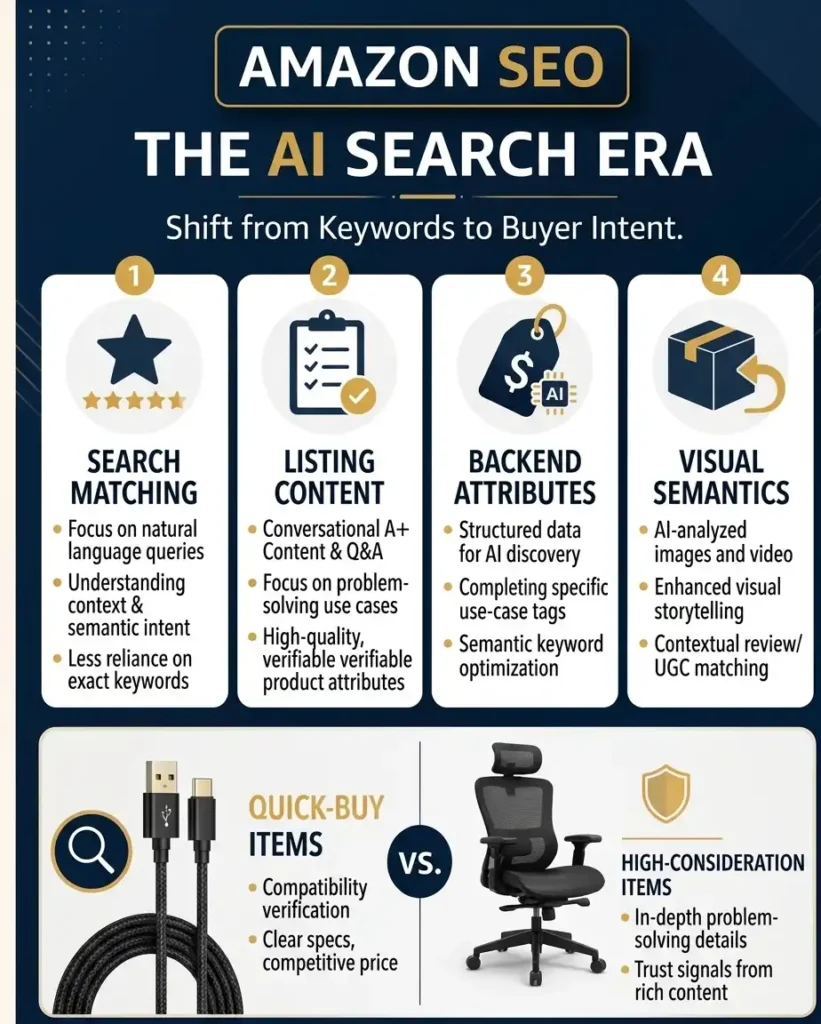
Amazon renamed Rufus to Alexa for Shopping in May 2026. The AI shopping assistant helps customers research products, compare options, get recommendations, and shop through conversational requests.
Keywords still matter, but product context matters more than it once did.
For example, a laptop stand listing should not only say “aluminum laptop stand.” If accurate, it should also state supported laptop sizes, height adjustment, desk use, portability, ventilation, and compatibility.
Amazon’s COSMO research also points toward richer ecommerce relationships. Explain what the product is, who it is for, what it works with, and what problem it solves.
Step 1: Start keyword research with the product
The best Amazon keywords accurately describe what the product is and why someone would buy it.
Start with the product type, material, size, audience, use case, key features, and differences from competing products. Then compare that language with real Amazon search behavior.
Useful sources include Amazon autocomplete, Product Opportunity Explorer, Search Query Performance, Top Search Terms, Helium 10, and Jungle Scout.
How should you use Amazon autocomplete?
Type a broad product phrase into Amazon’s search bar and study the suggestions.
Autocomplete can reveal natural shopper language, but every term still needs a relevance check. If you sell a bottle without a straw, “water bottle with straw” does not belong in the listing even if it has high search volume.
Traffic that does not match the product rarely helps.
Step 2: Prioritize buyer intent over search volume
A smaller, specific keyword can be more valuable than a broad term with high volume.
“Desk” is broad. “Standing desk converter” is better. “32 inch standing desk converter for dual monitors” describes a much clearer buying need.
Judge keywords using four questions:
- Does the product closely match the search?
- Does the phrase show clear buying intent?
- Can the product compete with current results?
- Does Amazon data show meaningful clicks, cart adds, or purchases?
This keeps your strategy focused on qualified traffic rather than vanity search volume.
Step 3: Map keywords to the right listing fields
Do not repeat every keyword everywhere.
Your primary product phrase belongs in the title. Supporting attributes and use cases can appear in Item Highlights, bullets, descriptions, and A+ Content. Relevant synonyms and alternate product names can go into backend search terms.
A keyword map gives each field a clear job.
Step 4: Optimize the title for the 75-character rule
As of July 27, 2026, Amazon requires titles in non-media categories to contain 75 characters or fewer, including spaces.
That makes older advice about filling long titles with keywords outdated.
A strong title should identify the product quickly. In most cases, include the brand, product type, and one or two important attributes.
Example:
Acme Stainless Steel Water Bottle, 32 oz, Vacuum Insulated
That communicates the key facts without reading like a keyword list.
Step 5: Use Item Highlights for searchable supporting details
Amazon’s Item Highlights field gives sellers 125 characters for added product information. Amazon says the field is searchable and can appear with the title in search results and on detail pages.
Use it for details that matter but do not fit in the shorter title, such as material, use case, compatibility, or a key differentiator.
The title identifies the product; Item Highlights adds context.
Step 6: Write bullets and descriptions around buying questions
Listing copy should answer the questions that can stop a shopper from buying.
Explain materials, dimensions, compatibility, benefits, intended use, what is included, and meaningful product limits. A feature says what exists; a benefit explains why it matters.
“Double-wall vacuum insulation” is a feature. “Helps keep drinks cold during long commutes or outdoor trips” explains its value.
Use descriptions and A+ Content for specifications, comparisons, care instructions, and deeper use cases.
Step 7: Add backend search terms carefully
Backend search terms help Amazon understand relevant language shoppers do not need to see on the page.
Use them for synonyms, abbreviations, alternate product names, and relevant terms that do not fit naturally in visible copy.
Amazon’s Seller Central guidance says the Search Terms generic_keywords field should stay below 250 bytes. If it exceeds that limit, Amazon may ignore it.
Do not waste this space on unrelated or repeated phrases.
Step 8: Improve images and conversion
Amazon SEO is not successful if a listing ranks but shoppers do not buy.
Images affect both clicks and conversion. A strong main image can improve search-result appeal, while supporting images can explain size, scale, dimensions, compatibility, features, and included parts.
For furniture, show dimensions. For a backpack, show scale on a person. For electronics, show compatible devices.
Then diagnose performance by funnel stage.
High impressions with low clicks may signal a weak title, image, price, rating, or poor search fit. Strong clicks with low purchases may point to unclear product information, weak reviews, poor pricing, or an unattractive offer.
Ask where shoppers drop out, then fix that stage.
Step 9: Write for conversational product discovery
Alexa for Shopping makes natural-language product research more visible.
Avoid vague claims such as “great for everyone.” State clear product relationships instead.
- “Supports monitors from 17 to 32 inches.”
- “Fits standard vehicle cup holders.”
- “Designed for dogs up to 70 pounds.”
- “Works with USB-C laptops that support Power Delivery.”
Specific statements clarify the product’s audience, compatibility, attributes, and use cases.
Step 10: Measure Amazon SEO with first-party data
Amazon Brand Analytics gives eligible brands data that can show where SEO performance breaks down.
Search Query Performance tracks impressions, clicks, cart adds, and purchases for search queries related to your brand. Search Catalog Performance can highlight discovery and conversion issues. Top Search Terms offers broader insight into Amazon search behavior.
Use the data to decide what to change.
If impressions are weak, revisit relevance. If clicks are weak, inspect the title, image, price, and search fit. If purchases are weak, study the detail page, reviews, offer, and delivery promise.
Where available, Manage Your Experiments can test listing elements against real customer behavior.
What are the most common Amazon SEO mistakes?
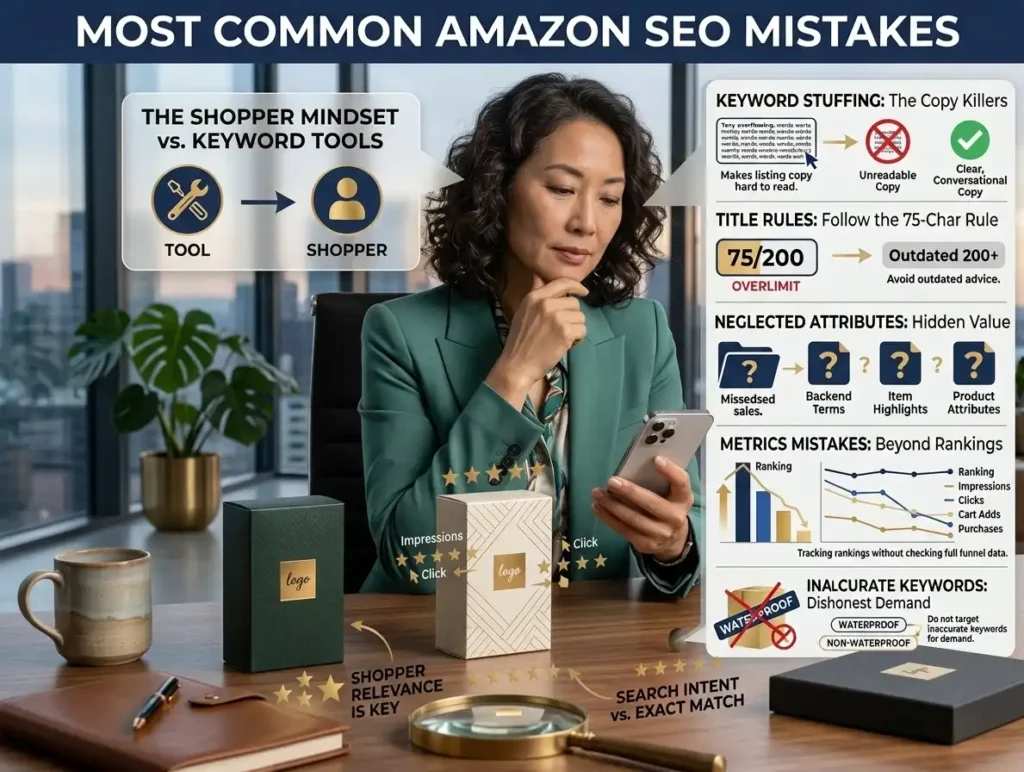
Most Amazon SEO mistakes come from optimizing for a keyword tool instead of the shopper.
Common problems include:
- Keyword stuffing that makes listing copy harder to read.
- Following outdated title advice instead of the current 75-character rule.
- Ignoring Item Highlights, backend terms, or meaningful product attributes.
- Tracking rankings without checking impressions, clicks, cart adds, and purchases.
Avoid inaccurate keywords too. If a product is not waterproof, do not target “waterproof” just because the phrase has demand.
FAQs
What is Amazon SEO?
Amazon SEO is the process of optimizing product listings to improve visibility, relevance, clicks, and sales in Amazon search.
How do I rank higher on Amazon?
Use relevant keywords, improve listing quality, strengthen images and offers, and track clicks, conversions, and sales performance.
How long can an Amazon product title be in 2026?
Amazon limits non-media product titles to 75 characters, with an additional 125-character Item Highlights field.
What are Amazon backend keywords?
Amazon backend keywords are hidden search terms used to add relevant synonyms, abbreviations, and alternate product names.
Does Amazon still use Rufus?
Rufus was renamed Alexa for Shopping in May 2026 and now supports conversational product discovery and shopping.
Does Amazon PPC improve organic SEO?
Amazon PPC does not guarantee higher organic rankings, but its search-term and conversion data can improve your SEO decisions.
How often should I update Amazon SEO?
Review Amazon SEO monthly or whenever product details, marketplace rules, keyword trends, or performance data change.
What should you do next?
The best Amazon SEO strategy in 2026 starts with one question: What is this shopper trying to buy, and does my listing make the answer obvious?
Research relevant terms, prioritize buyer intent, map keywords to the right fields, work within the 75-character title limit, use Item Highlights for supporting context, and make product attributes easy to understand.
Then measure what shoppers do.
Use impressions to judge visibility, clicks to judge search-result appeal, and cart adds and purchases to judge listing performance. Test meaningful changes when possible.
Amazon search will keep evolving, but the core strategy remains useful: give Amazon accurate product information, give shoppers clear answers, and let performance data guide your next move.