
Definition
Amazon SEO is the process of optimizing product listings so they appear for relevant shopper searches and attract more organic traffic and sales on Amazon.
A strong product can still struggle on Amazon if shoppers cannot find it.
That is where Amazon SEO comes in.
Amazon SEO helps Amazon understand what your product is, which searches it matches, and whether your listing gives shoppers enough information to consider buying it. In 2026, that means more than placing keywords in a title. Amazon search increasingly connects keywords, product attributes, customer intent, and AI-assisted shopping behavior.
The goal is simple: make the right product appear for the right shopper at the right time.
TL;DR: What Is Amazon SEO?
Amazon SEO, or Amazon search engine optimization, is the process of improving a product listing’s visibility in Amazon’s organic search results.
A strong Amazon SEO strategy focuses on four areas:
- Search relevance: Use accurate keywords, attributes, and product information.
- Listing quality: Write clear titles, bullets, descriptions, and Item Highlights.
- Shopper response: Improve images, pricing, product clarity, and buying confidence.
- Performance data: Track impressions, clicks, conversions, and search queries.
Amazon SEO works best when keyword relevance and conversion work together. Getting found matters, but getting chosen matters too.
How Does Amazon SEO Work?
Amazon SEO works by helping Amazon match customer searches with relevant products.
When someone searches for “insulated stainless steel water bottle,” Amazon first needs to understand which products fit that request. Product titles, categories, attributes, bullet points, descriptions, backend search terms, and other catalog information help provide that context.
Amazon then has to decide which relevant products deserve visibility.
This is why sellers should not think about Amazon SEO as keyword placement alone. A listing also competes through its images, price, product information, reviews, availability, delivery options, and overall offer.
The process can be viewed in three stages:
Relevance → Click → Purchase
If Amazon cannot connect your product with the query, you may receive few impressions. If shoppers see the listing but do not click, your search-result presentation may be weak. If they click but do not buy, the detail page or offer may need improvement.
That simple funnel makes Amazon SEO much easier to diagnose.
What Are the Most Important Amazon SEO Factors?
Amazon does not publish a public formula showing exactly how much weight every ranking signal receives.
Instead of chasing unofficial percentages or supposed algorithm secrets, sellers should focus on factors they can actually improve and measure.
- Keyword and product relevance
- Click-through rate
- Conversion rate
1. Keyword and product relevance
Amazon must clearly understand what you sell.
Use search terms that accurately describe the product, but also provide useful attributes such as material, size, compatibility, quantity, style, intended use, and audience where relevant.
For example, “dog bed” gives Amazon limited context.
“Orthopedic memory foam dog bed for large dogs” communicates product type, material, benefit, and target customer more clearly.
That stronger context can help Amazon match the product with more specific buyer searches.
2. Click-through rate
Once your product appears in search, shoppers decide whether it deserves a click.
The main image, visible title, price, reviews, badges, delivery information, and overall presentation influence that decision.
If impressions increase but clicks remain weak, adding more keywords may not solve the problem. Your listing probably needs a stronger search-result presentation.
3. Conversion rate
Conversion rate measures how effectively product-page visits become purchases.
A listing may attract traffic but still struggle if shoppers cannot quickly understand its benefits, dimensions, compatibility, quality, or value.
Clear images, useful bullets, accurate descriptions, competitive pricing, A+ Content, and strong product-market fit can improve buying confidence.
How Do You Do Amazon Keyword Research?
Amazon keyword research means finding the words and phrases customers use when searching for products like yours.
Start with buyer language, not industry language.
A manufacturer may call a product a “thermal hydration vessel,” while customers simply search for an “insulated water bottle.”
Both broad and long-tail keywords have value. Broad keywords can reach larger audiences, while longer searches often reveal clearer purchase intent.
A practical keyword research process is:
- Check Amazon autocomplete for common search variations.
- Study competing listings for recurring product terms and attributes.
- Use Amazon Brand Analytics or Search Query Performance when available.
- Group keywords by search intent before adding them to the listing.
Third-party tools such as Helium 10 and Jungle Scout can also help estimate search demand and analyze competing ASINs.
But search volume should not be your only filter.
A smaller keyword that perfectly matches your product can be more valuable than a broad phrase that attracts thousands of poorly matched shoppers.
How Should You Optimize an Amazon Product Listing?
Every listing field should have a specific job.
Instead of repeating the same keyword everywhere, use each field to add new product information and strengthen search relevance.
Write a focused product title
Your title should tell shoppers what the product is almost instantly.
Amazon introduced a major title change in July 2026. For non-media categories, Item Names are now limited to 75 characters including spaces, making title prioritization far more important.
Put the strongest information first. Depending on the product, that may include:
Brand + product type + major attribute + size or quantity
Avoid turning the title into a list of synonyms. A title should read naturally while communicating the product clearly.
Use Item Highlights for additional context
Amazon’s 2026 update also introduced an Item Highlights field with up to 125 characters.
This gives sellers space for information that no longer fits naturally in the shorter title, such as materials, recommended uses, features, or other important product details.
Amazon has stated that Item Name and Item Highlights can both contribute to search.
That makes Item Highlights valuable for both discoverability and customer understanding.
Write bullets around buying questions
Bullet points should answer the questions shoppers ask before purchasing.
Do not write:
“PREMIUM QUALITY MATERIAL”
Write something useful:
“Double-wall stainless steel helps keep drinks insulated during commutes, workouts, and everyday use.”
The second version explains the feature, benefit, and use case while naturally adding relevant semantic terms.
Each bullet should introduce new information rather than repeat the title.
Use backend search terms intelligently
Backend search terms help Amazon understand relevant keyword variations that may not fit naturally into visible copy.
Amazon’s Generic Keyword field currently needs to remain below 250 bytes.
Use this space for:
- Relevant synonyms
- Abbreviations
- Alternate product names
- Legitimate search variations
Do not waste space repeating the same keyword several times.
Improve images for shoppers, not algorithms
Your main image influences whether shoppers click your listing.
Secondary images should then answer questions that the main image cannot.
Show dimensions, features, materials, scale, use cases, packaging, or compatibility where appropriate.
Good images reduce uncertainty. Reduced uncertainty can improve conversion because shoppers understand exactly what they are buying.
What Is COSMO and Why Does It Matter for Amazon SEO?
COSMO is an Amazon-developed ecommerce knowledge system designed to better understand relationships between products, customer needs, and shopping situations.
This matters because Amazon search is moving beyond simple exact-keyword matching.
Suppose a shopper searches for:
“comfortable shoes for nurses standing all day.”
A semantic system can connect that request with concepts such as cushioning, support, long shifts, hospital work, slip resistance, and comfort even when the shopper does not type every product attribute.
For sellers, the practical lesson is straightforward.
Describe products naturally and specifically.
Explain what the product is, who it is for, what problem it solves, where it is used, what it contains, and how important features affect the customer.
That creates stronger product context than keyword repetition.
How Does Alexa for Shopping Affect Amazon SEO?
Amazon’s AI shopping assistant adds conversational product discovery to traditional keyword search.
The assistant was originally called Rufus, but Amazon renamed it Alexa for Shopping in May 2026.
Instead of only searching with phrases such as “carry-on backpack,” shoppers can ask detailed questions like:
“Which backpack works for a three-day business trip and has space for a 16-inch laptop?”
That means product pages need enough factual detail to answer real buying questions.
Include important information such as dimensions, compatibility, materials, use cases, capacity, included items, limitations, and customer benefits.
Do not write awkward copy for AI systems.
Write clear product information for humans. Well-structured, factual content is also easier for search and AI systems to interpret.
Is Amazon SEO Different From Google SEO?
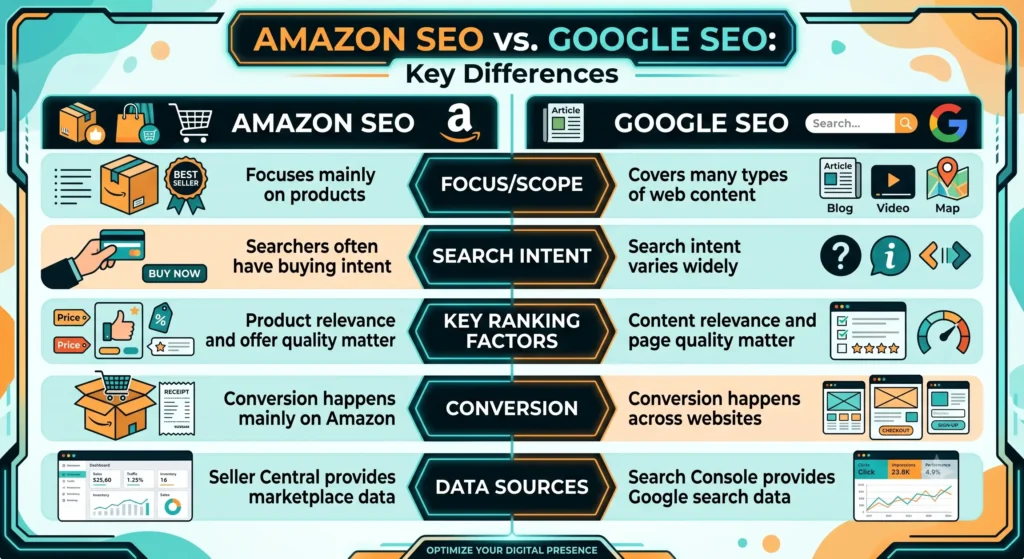
Yes. Amazon SEO and Google SEO serve different search environments.
Amazon search is mainly built around product discovery and shopping. Google handles much broader intent, including informational, navigational, local, commercial, and transactional searches.
Amazon SEO | Google SEO |
Focuses mainly on products | Covers many types of web content |
Searchers often have buying intent | Search intent varies widely |
Product relevance and offer quality matter | Content relevance and page quality matter |
Conversion happens mainly on Amazon | Conversion happens across websites |
Seller Central provides marketplace data | Search Console provides Google search data |
The shared principle is relevance.
Both platforms need to understand what your page or product represents and whether it satisfies the searcher’s intent.
Does Amazon PPC Help SEO?
Amazon PPC and Amazon SEO are different, but they can support the same growth strategy.
PPC buys sponsored visibility. SEO builds organic discoverability.
Advertising can also reveal valuable data. If a paid search term consistently produces clicks and sales, that information can help you understand which customer language and product attributes matter most.
What sellers should avoid is assuming that spending more on ads automatically buys higher organic rankings.
Instead, use PPC to test search terms and gain visibility while improving the organic listing based on real customer behavior.
How Long Does Amazon SEO Take to Work?
There is no fixed Amazon SEO timeline.
Listing edits may appear relatively quickly, but organic visibility depends on competition, product history, keyword relevance, customer response, pricing, inventory, and other factors.
Rather than waiting for a specific number of days, watch your funnel.
If impressions improve, Amazon may be understanding your relevance better.
If impressions grow but clicks do not, work on your image, title, price, and search-result appeal.
If clicks rise but purchases remain weak, improve your product page, value proposition, offer, and customer confidence.
How Do You Measure Amazon SEO Performance?
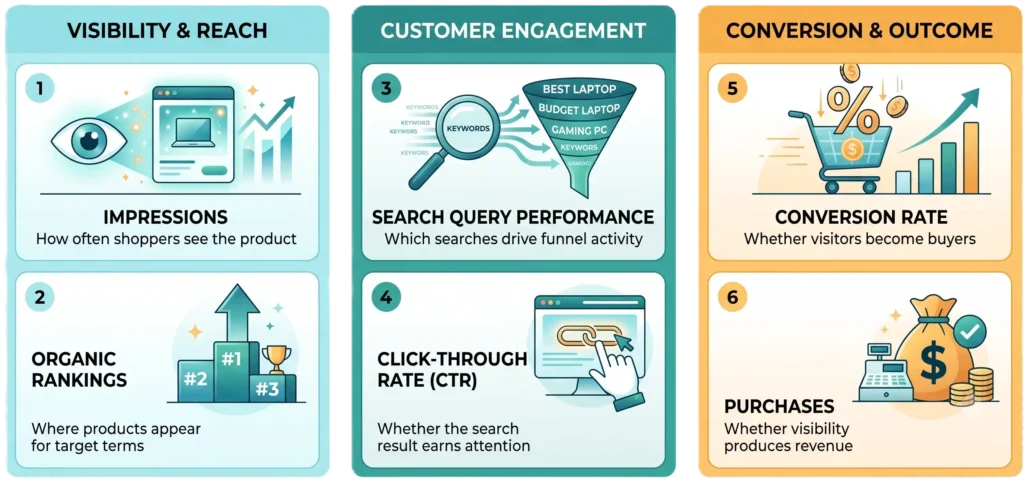
Do not measure Amazon SEO with keyword rankings alone.
Rank is useful, but it does not tell you why performance changed.
Track metrics such as:
Metric | What it shows |
Impressions | How often shoppers see the product |
Click-through rate | Whether the search result earns attention |
Conversion rate | Whether visitors become buyers |
Purchases | Whether visibility produces revenue |
Search Query Performance | Which searches drive funnel activity |
Organic rankings | Where products appear for target terms |
Brand-registered sellers can use Search Query Performance to study query-level impressions, clicks, cart adds, and purchases.
That data helps you identify the exact stage where SEO performance is breaking down.
Frequently Asked Questions About Amazon SEO
What is Amazon SEO in simple terms?
Amazon SEO is the process of improving your product listing so Amazon can understand it and show it for relevant searches.
What is the Amazon A10 algorithm?
A10 is a popular term used in the Amazon seller community to describe changes in Amazon search behavior. However, Amazon does not publicly document a ranking formula called A10 in its current SEO guidance.
How many backend keywords can you use on Amazon?
Amazon’s Generic Keyword field must currently remain below 250 bytes. There is no useful fixed number of keywords because phrase length affects the byte count.
Does Amazon SEO work without PPC?
Yes. Amazon SEO can generate organic visibility without paid advertising. Sellers can optimize titles, product attributes, bullets, descriptions, images, backend terms, and other listing elements independently.
Does A+ Content help Amazon SEO?
A+ Content mainly helps shoppers understand and compare products through richer images, text, videos, and comparison modules.
Is Amazon Rufus still used in 2026?
Amazon’s AI shopping assistant still exists, but Rufus name changed. Amazon renamed Rufus Alexa for Shopping in May 2026.
Conclusion: Build Amazon SEO Around Buyer Intent
Amazon SEO in 2026 is no longer about stuffing a listing with as many keywords as possible.
Start with buyer intent.
Find the searches customers actually use. Make your product type and strongest attributes clear. Optimize your 75-character Item Name, use Item Highlights intelligently, write useful bullets, add relevant backend terms, and build images that answer real buying questions.
Then watch the data.
If impressions are low, improve relevance. If shoppers see your listing but do not click, improve its search-result appeal. If they click but do not buy, strengthen the offer and product page.
That feedback loop is what turns Amazon SEO from keyword placement into sustainable organic product discovery.