Quick Answer
Amazon Marketing Services, often called AMS, was the old name for Amazon’s seller and vendor advertising platform. Today, AMS is officially part of Amazon Ads, also known as the Amazon Advertising Console. Sellers, vendors, brands, authors, and advertisers use it to promote products on Amazon through paid ad formats like Sponsored Products, Sponsored Brands, Sponsored Display, video ads, and Amazon DSP.
In simple words, AMS is Amazon’s paid advertising system for businesses that want more product visibility, more clicks, and more sales on Amazon. Amazon retired the older AMS, AMG, and AAP names in 2018 and brought them under one Amazon Advertising brand. Amazon DSP replaced the old Amazon Advertising Platform name, while seller-focused paid ads moved into the modern Amazon Ads console.
Today, many sellers still say “AMS” because the term is common in Amazon PPC, agency services, seller training, and older marketplace content. But if you are logging in now, building campaigns, or learning ads in 2026, the current name you will see is Amazon Ads.
TL; DR: Amazon Agency
- Amazon Marketing Services (AMS) is the old name for Amazon Ads, the platform sellers use to promote products on Amazon.
- In 2018, Amazon rebranded AMS into Amazon Advertising / Amazon Ads, but many sellers, agencies, and blogs still use the term AMS.
- AMS is mainly used for Amazon PPC ads, where sellers pay when shoppers click their ads.
- The main ad types include Sponsored Products, Sponsored Brands, Sponsored Display, video ads, and Amazon DSP.
- Sponsored Products are best for beginners because they promote one product and help increase product visibility, clicks, and sales.
- Sponsored Brands are better for brand owners who want to promote their logo, store, and multiple products. Brand Registry is usually needed for this.
- AMS is different from AWS Managed Services. AMS for sellers means Amazon advertising, while AWS AMS is for cloud infrastructure management.
- Amazon Ads works through keyword targeting, product targeting, category targeting, audience targeting, bids, and daily budgets.
- Important AMS metrics include ACoS, ROAS, CPC, CTR, impressions, clicks, conversion rate, and total sales.
- AMS does not directly improve organic ranking, but more ad-driven sales can help improve product performance over time.
- In 2026, Amazon Ads is becoming more advanced with AI-powered targeting, Rufus shopping AI, video ads, interactive pause ads, and streaming TV advertising.
- Sellers should start with a simple Sponsored Products campaign, test keywords, track results, add negative keywords, and improve campaigns step by step.
- Overall, AMS helps Amazon sellers get more visibility in front of high-intent shoppers who are already searching for products to buy.
What Does AMS Stand for in Amazon?
AMS can mean two different things, and this is where many people get confused.
In ecommerce, AMS means Amazon Marketing Services. This is the advertising platform used by Amazon sellers and brands to run sponsored ads.
In cloud computing, AMS means AWS Managed Services. This is a completely different service from Amazon Web Services. AWS says AWS Managed Services is an enterprise service that provides ongoing management of AWS infrastructure. It is made for IT teams, cloud operations, and developers, not Amazon sellers.
So the meaning depends on the context:
|
Term |
Full Name |
Used For |
Audience |
|
AMS in ecommerce |
Amazon Marketing Services |
Amazon product ads |
Sellers, vendors, brands |
|
AMS in cloud |
AWS Managed Services |
Cloud infrastructure management |
IT teams, developers, enterprises |
If you are asking “what is Amazon Marketing Services?” as a seller, you are asking about Amazon Ads, not AWS.
Is Amazon Marketing Services the Same as Amazon Advertising?
Yes, in today’s seller language, Amazon Marketing Services is commonly used to mean Amazon Advertising or Amazon Ads. The official name changed, but the old term is still popular.
Before 2018, Amazon had several advertising names. Amazon Marketing Services focused mainly on sponsored ads. Amazon Media Group handled larger media buying and brand placements. Amazon Advertising Platform handled programmatic ads. In 2018, Amazon simplified the naming and moved these ad products under Amazon Advertising.
That means “AMS Amazon” is not a separate tool in 2026. It is an older name for the ad system sellers now access through Amazon Ads.
Why Do Sellers Still Use the Term AMS in 2026?
Sellers still use AMS because the name became common before the rebrand. Many agencies, YouTube tutorials, seller courses, and old blog posts still use “AMS” when they talk about Amazon PPC.
The term remains useful because it quickly describes Amazon’s paid advertising tools. When a seller says, “I need AMS management,” they usually mean they need help with Amazon PPC campaigns, bids, keywords, ACoS, and campaign optimization.
AMS is still used to describe:
- Sponsored Products campaigns
- Sponsored Brands campaigns
- Sponsored Display ads
- Amazon PPC strategy and reporting
The official platform is Amazon Ads, but the business meaning of AMS is still clear: paid advertising on Amazon.
How Does Amazon Marketing Services Work?
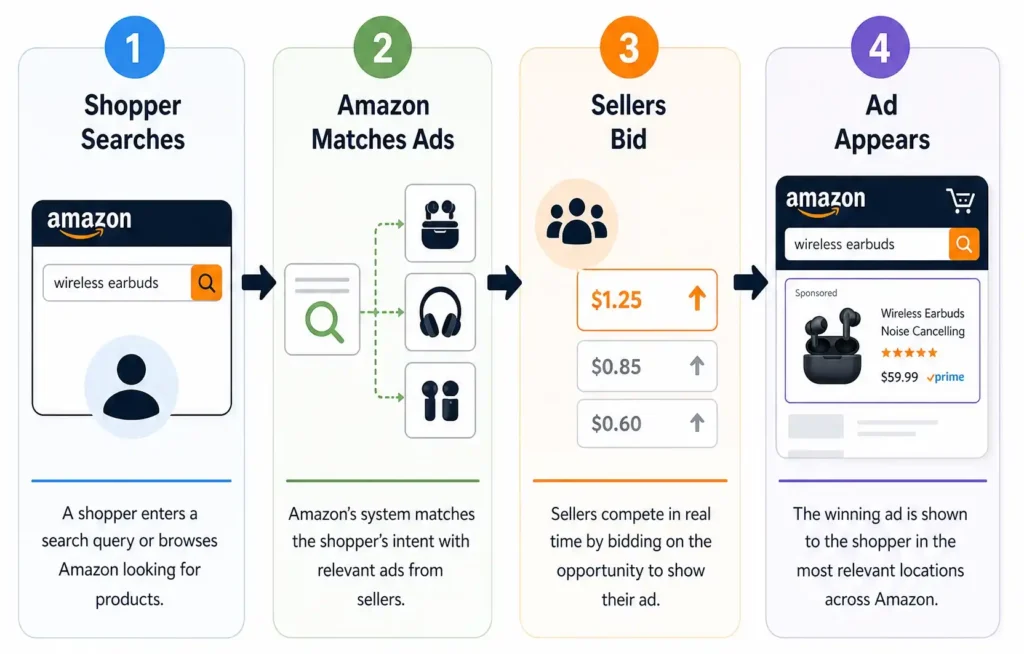
Amazon Marketing Services works by showing paid ads to shoppers while they browse or search on Amazon. Most beginner-friendly Amazon ads run on a cost-per-click model, also called CPC or PPC. This means you pay when a shopper clicks your ad, not when the ad simply appears.
Amazon officially describes Sponsored Products as cost-per-click ads that promote individual product listings on Amazon and select premium apps and websites. Amazon also explains that CPC means advertisers pay based on the number of clicks an ad receives.
Here is the simple journey:
A shopper searches for a product. Amazon checks which ads match that search. Sellers bid for placement. Amazon shows relevant ads in search results, product pages, or other placements. If the shopper clicks, the advertiser pays for that click.
The campaign result depends on listing quality, price, reviews, images, keyword targeting, bid level, budget, competition, and product demand.
What Are the Main Ad Types in Amazon Marketing Services?
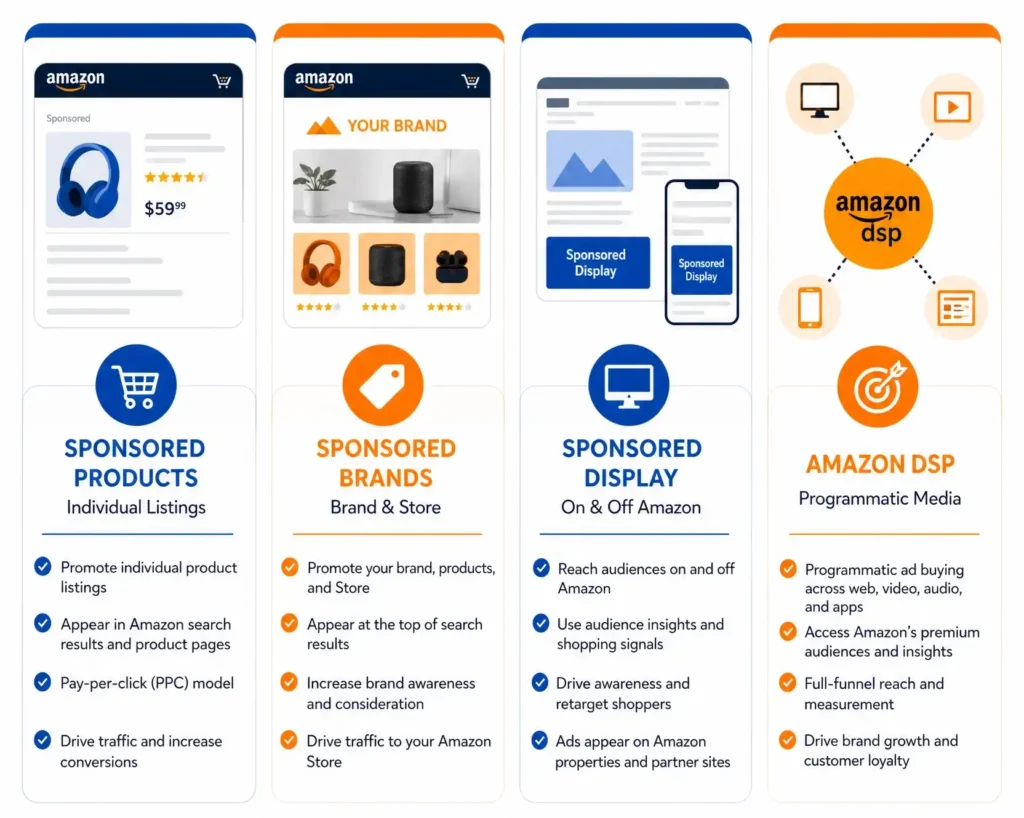
Amazon Marketing Services includes several ad formats. Each format has a different job. Some are best for direct sales. Some are better for brand awareness. Some are made for retargeting shoppers who already viewed similar products.
- Sponsored Products
- Sponsored Brands
- Sponsored Display
- Amazon DSP
1. Sponsored Products
Sponsored Products are the most common Amazon ad type for beginners. These ads promote one product listing at a time and can appear in search results and product detail pages.
Use Sponsored Products when your goal is to get more visibility and sales for a specific ASIN. This is usually the first ad type new sellers should test because it is simple, direct, and built around product-level performance.
2. Sponsored Brands
Sponsored Brands are ads that promote your brand, logo, headline, and multiple products. These ads can send shoppers to a product collection, Amazon Store, or landing page inside Amazon.
Amazon says Sponsored Brands eligibility requires an active Professional Seller account or approved Vendor account, and sellers must be registered brand owners through Amazon Brand Registry.
Use Sponsored Brands when you want to build brand recognition, promote a product line, or push shoppers toward your Amazon Store.
3. Sponsored Display
Sponsored Display helps sellers reach audiences on and off Amazon using display-style placements. It can be used for product targeting, audience targeting, and remarketing-style campaigns.
This format is useful when you want to bring back shoppers who viewed your product, reach people browsing competitor products, or increase awareness beyond search results.
4. Amazon DSP
Amazon DSP is Amazon’s demand-side platform. It helps advertisers buy display, video, and audio ads programmatically across Amazon-owned properties and third-party publishers. Amazon says DSP is available through self-service and managed-service options.
DSP is usually better for larger brands with bigger budgets, audience strategy, and full-funnel goals.
AMS vs Amazon DSP: What Is the Difference?
|
Feature |
AMS / Sponsored Ads |
Amazon DSP |
|
Main goal |
Product sales and visibility |
Full-funnel audience reach |
|
Common pricing |
CPC |
CPM or managed media buying |
|
Best for |
Sellers, vendors, brands |
Larger brands and advertisers |
|
Placement |
Amazon search and product pages |
Amazon, Prime Video, Twitch, apps, websites |
|
Budget level |
Flexible, seller-controlled |
Managed-service option often requires larger spend |
|
Beginner friendly? |
Yes |
Less beginner friendly |
Amazon says sponsored ads and Brand Stores can be used with flexible budgets, while managed-service advertising through an Amazon Ads account executive typically requires a minimum spend of $50,000.
Is Amazon Marketing Services Free?
Amazon Marketing Services is not a monthly subscription like a software tool, but ads cost money when you run campaigns. Some Amazon Ads tools, such as Brand Stores, may have no direct cost. Sponsored ads usually work on a cost-per-click basis, which means you set your own budget and pay when shoppers click.
Amazon states that its solutions range from no-cost options like Brand Stores to sponsored ads where advertisers set budgets and pay on a cost-per-click basis.
Before you launch your first campaign, check these basics:
- Your product detail page should be complete.
- Your main image should be clear and compliant.
- Your price should be competitive.
- Your reviews and rating should support conversion.
Running ads before fixing your listing is one of the fastest ways to waste money. Ads can bring traffic, but your listing must convert that traffic into sales.
Who Can Use Amazon Marketing Services?

Amazon Marketing Services can be used by different types of Amazon advertisers. The exact access depends on the ad type and account setup.
Most sellers can start with Sponsored Products if they have eligible products and an active selling account. Sponsored Brands and Stores require Brand Registry. Vendors can also access Amazon Ads through Vendor Central.
Common eligible users include:
|
User Type |
Can Use AMS/Amazon Ads? |
Notes |
|
Individual sellers |
Limited access |
Some advanced features may not be available |
|
Professional sellers |
Yes |
Better access for advertising |
|
Brand-registered sellers |
Yes |
Needed for Sponsored Brands and Stores |
|
Vendors |
Yes |
Vendor Central access |
|
Authors |
Yes |
Book advertising options |
|
Agencies |
Yes |
Can manage client accounts |
If your goal is only to promote one product, start with Sponsored Products. If your goal is to build a brand, invest in Brand Registry and build your Amazon Store.
What Metrics Matter in Amazon Marketing Services?
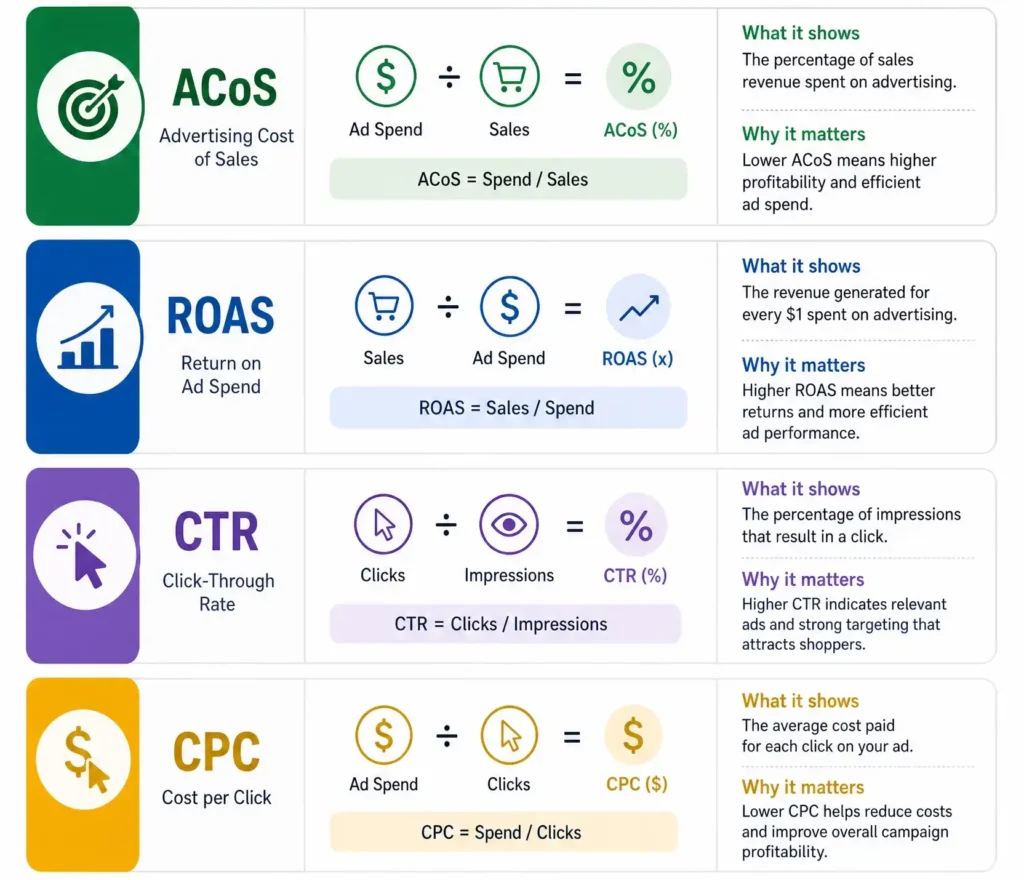
AMS is not only about launching ads. The real value comes from reading the data and improving campaigns over time.
The most important Amazon Ads metrics include ACoS, ROAS, CPC, CTR, impressions, clicks, conversion rate, and total sales. Amazon explains that ACoS represents the ratio of ad spend to sales and is calculated as ad spend divided by attributed sales.
Here is what the core metrics mean:
|
Metric |
Meaning |
Why It Matters |
|
Impressions |
How many times your ad was shown |
Measures visibility |
|
Clicks |
How many shoppers clicked |
Measures interest |
|
CTR |
Click-through rate |
Shows how attractive the ad is |
|
CPC |
Cost per click |
Shows click cost |
|
Conversion rate |
Clicks that became orders |
Shows listing strength |
|
ACoS |
Ad spend divided by ad sales |
Shows ad efficiency |
|
ROAS |
Ad sales divided by ad spend |
Shows return |
|
TACoS |
Total ad spend divided by total sales |
Shows full business impact |
A low ACoS can look good, but it does not always mean the campaign is healthy. If your ACoS is low because your bids are too low and impressions are tiny, you may not be growing. A higher ACoS can be acceptable during a launch if it helps your product collect data, sales, and visibility.
What Is a Good ACoS for Amazon Marketing Services?
There is no single “good” ACoS for every seller. ACoS depends on your profit margin, product price, category competition, launch stage, and business goal.
For a mature product, many sellers want ACoS below their break-even margin. For a new product, sellers may accept a higher ACoS during the discovery phase to learn which keywords convert.
A better question is: “Can this ACoS support my goal?”
If your goal is profit, watch ACoS closely. If your goal is launch growth, you may accept short-term loss to build sales history. If your goal is brand awareness, ROAS and ACoS may not tell the full story.
Does AMS Help Organic Ranking on Amazon?

AMS does not directly buy organic ranking. Paying for ads does not automatically push your product to the top of organic search.
But ads can support organic growth indirectly. If ads bring relevant shoppers, and those shoppers buy your product, the extra sales can help your listing build stronger sales history. That may support better organic performance over time.
The key word is “relevant.” Random clicks do not help much. A strong AMS strategy sends the right shoppers to the right product page.
To improve organic impact, focus on:
- High-intent keywords that match the product
- Strong product images and clear bullet points
- Competitive pricing and fast delivery
- Positive reviews and good conversion rate
Ads should not replace listing optimization. They should support it.
AMS vs Google Ads: Which One Is Better?
Amazon Marketing Services and Google Ads both help businesses get paid traffic, but they serve different shopper journeys.
Amazon Ads reaches people already shopping on Amazon. These users often have high purchase intent. Google Ads reaches users across search, YouTube, websites, apps, and other discovery moments. Google can be better for broader research traffic, lead generation, and off-Amazon demand creation.
|
Feature |
Amazon Marketing Services |
Google Ads |
|
Best for |
Selling products on Amazon |
Search, leads, traffic, ecommerce |
|
Shopper intent |
Often purchase-ready |
Research, comparison, purchase |
|
Main data source |
Amazon shopper behavior |
Google search and web behavior |
|
Conversion path |
Usually inside Amazon |
Website, app, store, lead form |
|
Best beginner use |
Sponsored Products |
Search campaigns |
If your product is sold on Amazon, AMS is usually the better starting point. If you want traffic to your own website or want to capture search demand outside Amazon, Google Ads can support that strategy.
What Is New in Amazon Marketing Services in 2026?
Amazon Ads are changing fast because shopping behavior is changing. In 2026, sellers should think beyond basic keyword bidding. Amazon is adding more AI, streaming TV, creative automation, and conversational shopping features.
One important update is AI-powered prompts for Sponsored Products and Sponsored Brands. Amazon says these prompts can appear in shopping results and product detail pages, and when clicked, they may open a dialog in Rufus or respond directly on the page.
Amazon Ads also introduced Creative Agent, an agentic AI tool that helps advertisers research products and audiences, brainstorm campaign ideas, create storyboards, and produce full-funnel campaign assets. Amazon says the tool is in open beta for U.S. advertisers.
For video and streaming, Amazon announced Complete TV, a capability on Amazon DSP that helps TV buyers plan, manage, and measure streaming TV buys. Amazon has also expanded interactive pause ads for Prime Video, where ads can appear when viewers pause content.
For sellers, the message is clear: Amazon Ads is moving from simple search ads to a larger retail media system. Product listings, creative assets, brand content, and shopper intent signals all matter more than before.
Which Amazon Ad Type Should Beginners Start With?
Most beginners should start with Sponsored Products. It is the simplest ad type, promotes one product at a time, and connects directly to shopper searches.
A good beginner setup includes one automatic campaign and one manual campaign. The automatic campaign helps collect keyword and ASIN data. The manual campaign gives more control over exact keywords, bids, and match types.
A smart first campaign should include:
- A small daily budget you can afford to test
- Automatic targeting for keyword discovery
- Manual exact-match keywords for control
- Negative keywords to stop wasted clicks
Do not start with too many campaigns at once. Start simple, collect data, then scale what works.
How to Get Started With Amazon Marketing Services
To start with Amazon Marketing Services, you need access to Amazon Ads. Most sellers can find it inside Seller Central. Vendors can access advertising through Vendor Central. Brands can also sign in through the Amazon Ads platform.
Here is a practical beginner path:
- Choose one product with good images, reviews, price, and stock.
- Open Amazon Ads from Seller Central or the Amazon Ads sign-in page.
- Create a Sponsored Products campaign.
- Start with automatic targeting.
- Set a daily budget you can test for at least two weeks.
- Review search term reports.
- Move converting terms into a manual campaign.
- Add negative keywords for poor matches.
- Watch ACoS, conversion rate, and total sales.
- Increase budget only when the data supports it.
Do not judge a campaign after one day. Amazon Ads needs enough clicks and orders before the data becomes useful.
Common AMS Mistakes Sellers Should Avoid
Many sellers lose money with AMS because they treat ads like a magic button. Amazon Ads can bring traffic, but it cannot fix a weak product offer.
Avoid these mistakes:
|
Mistake |
Why It Hurts |
|
Advertising a weak listing |
Clicks do not convert |
|
No keyword control |
Budget goes to poor traffic |
|
No negative keywords |
Waste increases over time |
|
Judging too early |
Data is too small |
|
Only watching ACoS |
You miss total growth |
|
Ignoring organic sales |
You miss TACoS impact |
|
No campaign structure |
Scaling becomes messy |
Good AMS management is not only about bids. It is about matching the right keyword, product, bid, budget, and listing quality.
Final Answer: What Is Amazon Marketing Services?

Amazon Marketing Services is the old name for Amazon’s advertising platform. In 2026, the official name is Amazon Ads, but many sellers still use AMS to describe Amazon PPC and sponsored ad campaigns.
AMS helps sellers and brands show products to shoppers who are already searching, comparing, and buying on Amazon. It includes Sponsored Products, Sponsored Brands, Sponsored Display, video ads, Amazon DSP, and newer AI-powered ad experiences.
For beginners, Sponsored Products are the best starting point. For brand owners, Sponsored Brands and Stores add more control. For larger advertisers, Amazon DSP and Streaming TV ads open full-funnel reach beyond standard marketplace search.
The main value of AMS is not just more traffic. The real value is better visibility in a high-intent shopping environment, campaign data you can act on, and a path to grow both paid and organic sales over time.
FAQs
What is Amazon Marketing Services?
Amazon Marketing Services, or AMS, is the old name for Amazon’s advertising platform. Today, it is part of Amazon Ads, where sellers and brands can run Sponsored Products, Sponsored Brands, Sponsored Display, video ads, and DSP campaigns.
Is AMS the same as Amazon Ads?
Yes. In seller language, AMS usually means Amazon Ads. Amazon rebranded its older advertising products under Amazon Advertising in 2018, but many sellers still use the term AMS.
What is the best Amazon ad type for beginners?
Sponsored Products are usually the best ad type for beginners because they promote individual listings and are easy to set up. Amazon says Sponsored Products are CPC ads that promote individual product listings.
What is ACoS in Amazon Marketing Services?
ACoS means Advertising Cost of Sales. It is calculated as ad spend divided by attributed ad sales. It helps sellers understand how much they spend on ads compared with the sales those ads generate.
What is the difference between AMS and Amazon DSP?
AMS usually refers to sponsored ads in the Amazon Ads console. Amazon DSP is a demand-side platform used for programmatic display, video, and audience advertising across Amazon and other publisher inventory.
Can AMS improve organic ranking?
AMS does not directly buy organic ranking. But if ads bring relevant shoppers and those shoppers buy, the added sales activity may support stronger organic performance over time.
Is AMS better than Google Ads?
AMS is usually better when your main goal is selling products on Amazon. Google Ads is better when you want to drive traffic to your own website, collect leads, or reach people outside Amazon.