Defination
Amazon’s Choice is an automatically assigned product recommendation badge that Amazon uses to highlight highly rated, well-priced, readily available products for selected customer searches.
Seeing an Amazon’s Choice badge can make a product look like Amazon has personally tested it, ranked it above every alternative, or certified it as the best item you can buy.
That is not what the badge means.
Amazon describes Amazon’s Choice as a way to help shoppers quickly find products that fit similar shopping needs. The company says selected products tend to be highly rated, well-priced, available to ship immediately, delivered faster, and returned less often than alternatives. Amazon also considers factors such as popularity, reviews, availability, price, and shipping speed.
For shoppers, the badge is a useful shortcut, but it is not a quality guarantee.
For sellers, it is an algorithmic recommendation that can improve how a listing stands out, but you cannot buy it, request it, or permanently lock it in place.
TL;DR
Amazon’s Choice means Amazon’s recommendation system has selected a product as a strong option for a particular shopping need or search. It does not mean Amazon has declared the product objectively best in its category.
The main facts are:
- Amazon assigns the badge automatically; sellers cannot apply or pay for it.
- Amazon considers ratings, reviews, price, popularity, availability, delivery speed, returns, and other signals.
- Amazon’s Choice can be connected to particular searches rather than every search for the product.
- The badge can appear or disappear as product performance and customer preferences change.
That distinction matters because shoppers and sellers often read more into the badge than Amazon itself claims.
What is the Amazon's Choice badge?
The Amazon’s Choice badge is a customer-facing recommendation marker that Amazon places on selected products when its systems believe shoppers may want help choosing among competing options.
Amazon says Amazon’s Choice products are generally highly rated, competitively priced, ready to ship, faster to deliver on average, and returned less frequently than alternatives. Its published guidance also names popularity, ratings, reviews, availability, and delivery speed among the factors it considers.
The important word is recommendation.
Does Amazon's Choice mean it is the best product?
No. Amazon’s Choice does not mean a product is objectively the best product available.
A better way to read the badge is: “Amazon currently considers this a strong option for this shopping need.”
Amazon’s own explanation focuses on factors such as customer ratings, price, popularity, product availability, delivery, and returns. Those signals can tell Amazon whether an item performs well in its marketplace, but they cannot determine whether it is personally best for your budget, body type, technical requirements, taste, or intended use.
Imagine you search for a “wireless mouse for laptop.”
One mouse may earn Amazon’s Choice because it sells consistently, has good reviews, ships quickly, stays in stock, and has a competitive price.
Another mouse may have a better sensor, longer battery life, or ergonomics that suit your hand better.
The badge helps narrow the field. It does not replace comparison.
Is Amazon's Choice reliable for shoppers?
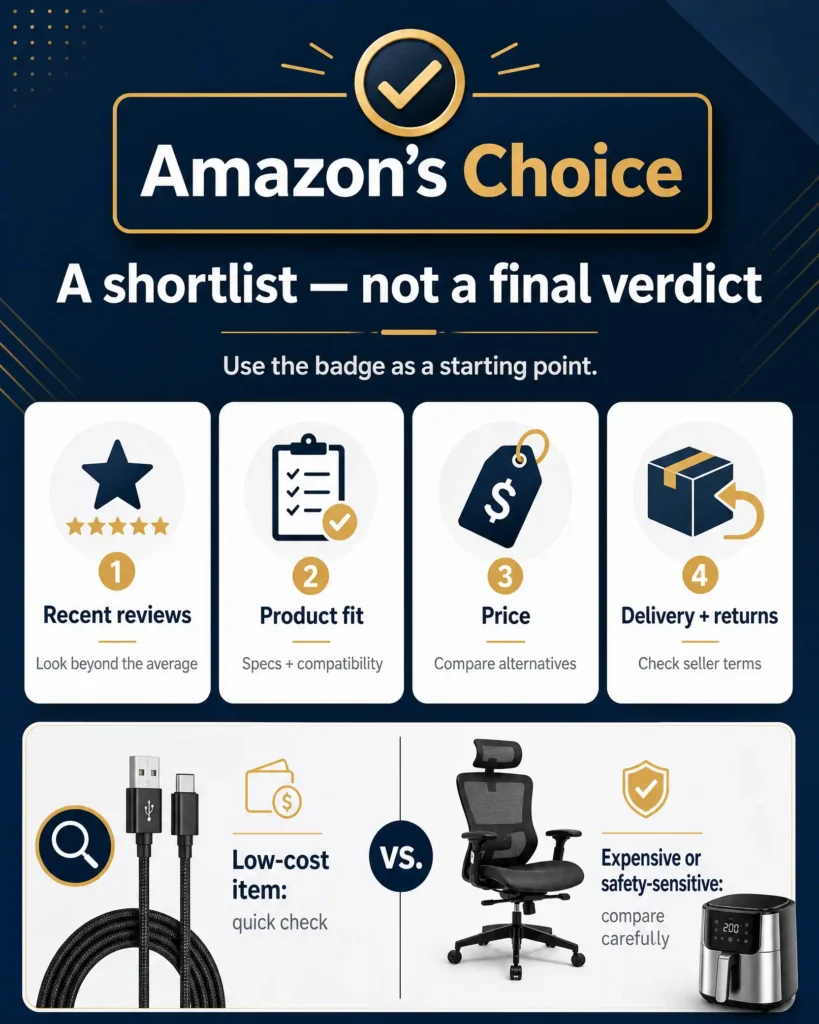
Amazon’s Choice is useful as a screening signal, but shoppers should not treat it as a final buying decision.
The badge tells you that Amazon sees positive marketplace signals around the product.
Before buying, look at:
- Recent reviews, not only the overall star average
- Product specifications and compatibility
- Current price compared with close alternatives
- Return warnings, seller information, and delivery terms
This becomes more important for expensive, safety-related, technical, or size-sensitive purchases.
A $15 USB cable may not require 30 minutes of research. A $700 office chair, child safety product, computer component, or appliance deserves more scrutiny even if Amazon displays a recommendation badge.
How does a product get Amazon's Choice?

A product gets Amazon’s Choice automatically when Amazon’s systems decide it is a strong recommendation for an eligible shopping need or search.
Amazon does not publish the exact weighting of its badge-assignment system. That means nobody outside Amazon can give you a legitimate formula such as “40% reviews + 30% sales + 20% price + 10% shipping.”
Amazon does publicly identify several factors associated with the badge:
- Ratings and reviews matter because they reflect customer satisfaction. A product with repeated negative feedback gives Amazon less reason to recommend it.
- Competitive pricing matters because Amazon wants its recommendations to represent good purchase options. A listing that becomes badly overpriced relative to similar products may become less attractive.
- Availability matters because recommending an item that repeatedly goes out of stock creates a poor shopping experience.
- Shipping speed matters because customers generally value faster delivery. Amazon specifically says Amazon’s Choice products are available to ship immediately and are delivered faster on average than alternatives.
Is there a minimum star rating for Amazon's Choice?
Amazon does not publicly state a fixed minimum star rating for earning Amazon’s Choice.
You may see seller guides claim that a product needs at least 4.0 stars. That can be a useful operating target, but it should not be presented as an official Amazon rule unless Amazon publishes such a threshold.
Focus on improving the customer experience that produces better ratings naturally. Fix repeated product complaints, inaccurate listing claims, packaging problems, sizing confusion, missing instructions, and other causes of dissatisfaction.
Is Amazon's Choice based on reviews alone?
No. Reviews are only one part of Amazon’s Choice selection.
Amazon explicitly names ratings, price, popularity, availability, fast delivery, and other customer-preference signals. It also says highlighted items are returned less frequently on average than alternative products.
This explains why a product with fewer reviews can sometimes receive Amazon’s Choice while a competitor with thousands of reviews does not.
The entire purchase experience matters.
Is Amazon's Choice keyword-specific?
Amazon’s Choice can be search-specific, which means the same product may appear as Amazon’s Choice for one customer search and not for another.
Amazon staff have explained that Amazon’s Choice is not offered for every search and that recommendations are made for searches where Amazon believes customers would benefit from help finding a high-quality product. Amazon has also previously stated that a product may qualify for certain search terms but not others.
This is one of the most important concepts for sellers.
Suppose you sell an insulated stainless-steel bottle.
You might not earn Amazon’s Choice for the broad query:
“water bottle”
But your listing could be a stronger match for:
“32 oz insulated water bottle with straw”
The second query expresses a more specific purchase need. If your product strongly matches that need and performs well with customers searching for it, your opportunity may be different.
What is the difference between Amazon's Choice and Best Seller?

Amazon’s Choice and Best Seller measure different things.
Amazon’s Choice is a recommendation signal. Best Seller is primarily a sales-ranking signal.
Amazon says Best Sellers Rank, or BSR, compares a product’s sales performance with similar products. Recent and historical sales volume contribute to BSR, with recent sales carrying more weight. Amazon also says page views and customer reviews do not directly determine BSR.
For the Best Seller badge, Amazon states that the badge can appear on products that meet an ordering threshold and rank #1 in a category containing at least 100 products.
Amazon’s Choice works differently.
It considers a wider set of customer-experience and recommendation signals such as price, ratings, popularity, availability, delivery speed, and returns.
A product could therefore perform strongly enough to earn Amazon’s Choice without being the #1 seller in its category.
Likewise, the #1-selling item in a category is not automatically guaranteed Amazon’s Choice for every relevant search.
Can a product have both Amazon's Choice and Best Seller?
A product can potentially qualify for different Amazon badges because those badges represent different signals.
Best Seller relates closely to category sales ranking, while Amazon’s Choice reflects Amazon’s recommendation criteria for selected shopping needs. Amazon’s official materials discuss the badges separately and describe different qualification logic for each.
That means the two ideas are not mutually exclusive.
Sellers sometimes call the presence of several badges or promotional markers badge stacking. The visual effect can make a listing stand out, but Amazon does not publish a guaranteed conversion percentage for stacking Amazon badges.
Treat any exact “35% higher conversion” or similar claim as third-party data unless the study clearly explains its sample, date, category, and method.
Does FBA help you get Amazon's Choice?
Amazon does not state that Fulfillment by Amazon is required for Amazon’s Choice.
FBA can still help with factors that Amazon says matter because FBA handles storage, fulfillment, customer service, and returns, and qualifying FBA inventory displays the Prime badge with fast delivery benefits.
But the fulfillment method and Amazon’s Choice eligibility are not the same question.
Can sellers apply or pay for Amazon's Choice?
No. Sellers cannot apply for Amazon’s Choice, enroll in it, or pay Amazon to award the badge.
Amazon explicitly states that brands and selling partners cannot pay to have products highlighted as Amazon’s Choice and cannot apply to be considered. Third-party seller products can receive the badge, but Amazon assigns it automatically.
What should sellers work on to improve their chances?
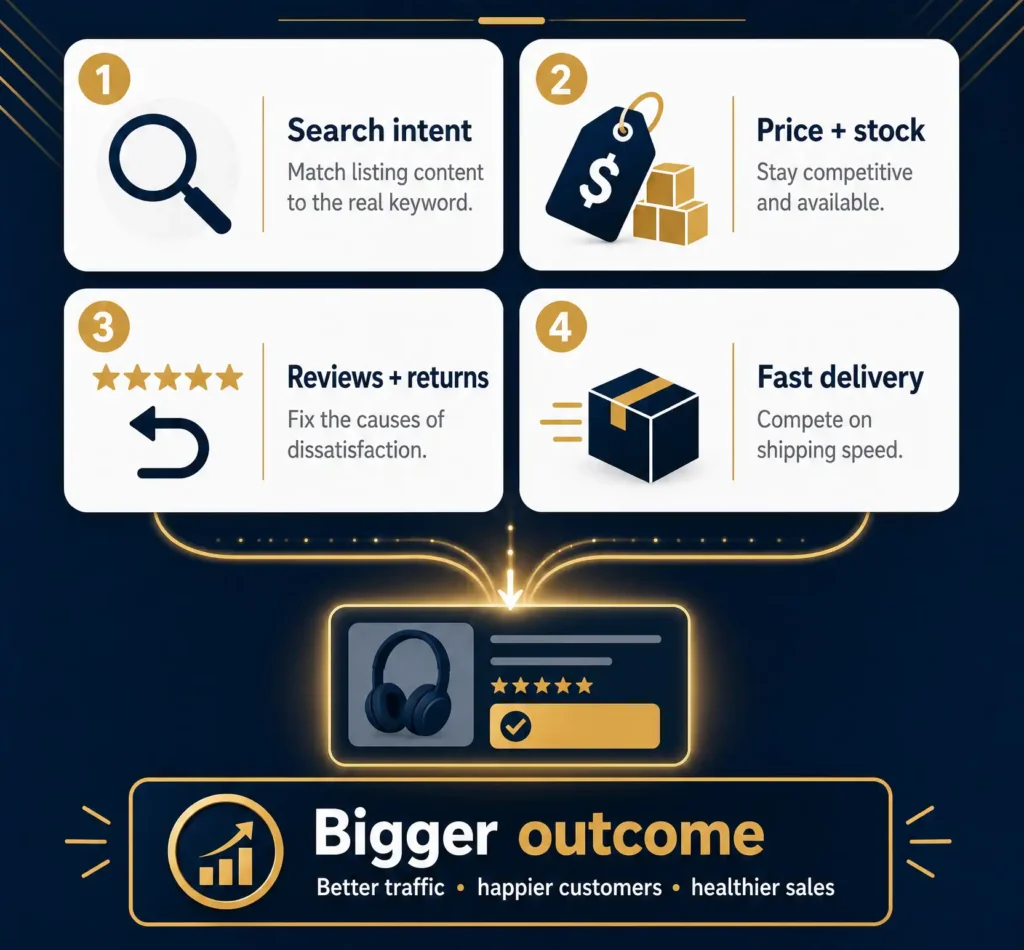
Sellers should optimize the factors Amazon publicly associates with strong Amazon’s Choice products rather than chasing the badge directly.
Start with four areas:
- Match listing content closely to the real search intent of target keywords.
- Maintain competitive pricing and dependable stock availability.
- Reduce reasons for negative reviews and product returns.
- Offer delivery speeds that compare well with competing listings.
Each area affects something larger than the badge.
Why did my Amazon's Choice badge disappear?
An Amazon’s Choice badge can disappear because Amazon continuously reevaluates the products it highlights.
Amazon says customer preferences and feedback change over time, and the products it recommends can change with them. Older Amazon policy language also states that the badge may appear or disappear and that products can qualify for some searches but not others.
If a badge disappears, review what changed around the same period.
Look at price, inventory, delivery promise, customer feedback, recent returns, listing changes, and competitor activity.
Do not assume that losing the badge means Amazon has penalized your account. A competitor may simply have become a stronger recommendation for that particular query.
How should sellers monitor Amazon's Choice?

Amazon staff have stated that Seller Central provides Amazon’s Choice Badge Data through Brand Analytics under the Build Your Brand area.
A useful review process is to compare:
- Your target search term
- Your badge status
- Organic position
- Price
- Delivery promise
- Stock level
- Rating trend
- Return or customer-experience issues
The goal is to understand why the listing remains competitive for the shopper behind that query.
Does Amazon's Choice increase sales or conversion rate?
Amazon’s Choice may help a product stand out and build shopper confidence, but Amazon does not publish a universal percentage by which the badge increases click-through rate, conversion rate, or sales.
A badge on a $12 household item may affect behavior differently from a badge on a $1,000 electronics purchase.
Product price, category, brand recognition, review count, competitive set, advertising position, device type, and shopper intent can all change the result.
Does Amazon's Choice still matter for Alexa and voice shopping?
Amazon’s shopping experience has changed significantly in 2026, so sellers should be careful with old claims about Amazon’s Choice and Alexa.
On May 13, 2026, Amazon renamed its Rufus shopping assistant Alexa for Shopping. Amazon says the assistant now works across the Amazon Shopping app, website, and Echo Show and can help customers research, compare, and buy products using conversational shopping tools. Amazon reported that Rufus had helped more than 300 million customers during 2025 before the rename.
What Amazon does not currently state in its public Amazon’s Choice guidance is that holding the badge automatically guarantees priority in Alexa for Shopping recommendations.
That distinction should stop sellers from repeating an old assumption as a current ranking rule.
What should shoppers do when they see Amazon's Choice?
Use Amazon’s Choice as the beginning of your evaluation, not the end.
If you are buying a simple, inexpensive product and the recommended item has strong recent reviews, the right specifications, competitive pricing, and a sensible return policy, the badge may save you time.
If the purchase is expensive or important, compare two or three alternatives.
Ask: Does the product solve my exact problem? Are complaints recent or recurring? Is a competing product materially better for a small price difference? Are the specifications actually right for me?
That approach gives the badge the weight it deserves without treating an algorithmic recommendation as an expert certification.
Frequently Asked Questions
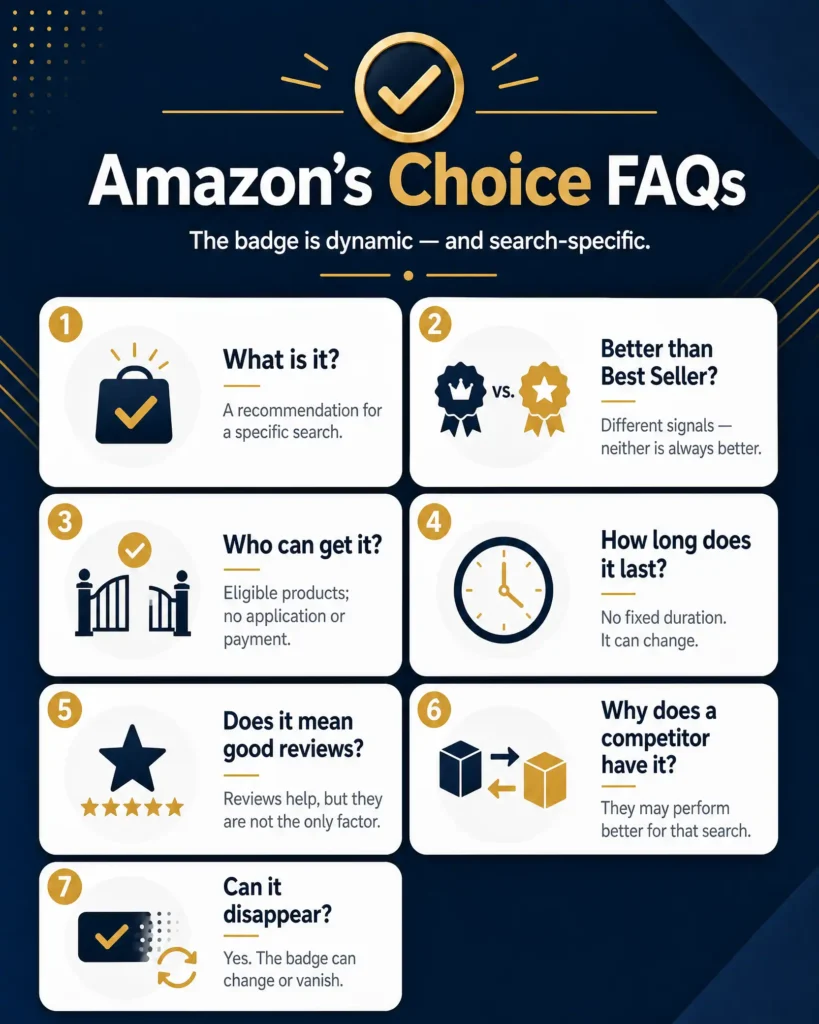
What does Amazon's Choice mean?
Amazon’s Choice means Amazon has automatically highlighted a product as a strong recommendation for a particular shopping need or search.
Is Amazon's Choice better than Best Seller?
Neither badge is automatically “better” because they represent different things. Amazon’s Choice reflects recommendation signals such as ratings, price, availability, delivery, and popularity.
Can anyone get the Amazon's Choice badge?
Any qualifying product can potentially receive Amazon’s Choice, including products sold by third-party sellers. Sellers cannot submit an application or pay for the badge.
How long does Amazon's Choice last?
Amazon does not give Amazon’s Choice a fixed public duration. Badge status can change as customer preferences, product performance, availability, pricing, delivery, and competing offers change.
Does Amazon's Choice mean a product has good reviews?
Amazon says ratings and reviews are among the signals considered for Amazon’s Choice, so positive customer feedback matters. However, the badge is not based on reviews alone.
Why does my competitor have Amazon's Choice and I don't?
Your competitor may currently perform better for the specific search on signals Amazon considers, including relevance, ratings, pricing, popularity, availability, delivery speed, or customer satisfaction.
Can Amazon's Choice disappear overnight?
Yes. Amazon’s Choice is dynamic rather than permanent. Amazon says the products it highlights change as customer preferences and feedback change, and its published guidance has noted that badge visibility can differ between searches.
What should you do next?
Amazon’s Choice is best understood as an algorithmic product recommendation, not an award for being objectively best.
Shoppers should use it as a shortcut for finding credible options, then check the details that matter for the purchase.
Sellers should work backward from the same customer experience Amazon says it values: strong product-market fit, accurate listings, good customer feedback, competitive pricing, dependable inventory, fast delivery, and low reasons for return.
Do those things well and the listing becomes healthier whether Amazon awards a badge or not.
That is the right way to think about Amazon’s Choice in 2026: the badge is an outcome worth earning, but the customer experience that produces it is the real asset.