Defination
Amazon product marketing is the process of improving a product’s visibility, conversion rate, sales velocity, and brand demand through listing optimization, advertising, pricing, reviews, promotions, and external traffic.
TL;DR
- Fix the product offer and listing before spending heavily on ads.
- Calculate contribution margin, break-even ACoS, and TACoS to avoid unprofitable growth.
- Improve titles, images, bullets, backend keywords, pricing, and product details for both Amazon search and Rufus.
- Start PPC with Sponsored Products, then move proven terms into exact-match campaigns.
- Use Brand Registry, A+ Content, Brand Stores, and Vine when eligible.
- Track external traffic with Amazon Attribution instead of guessing which channels drive sales.
- Focus a limited budget on one or two strong ASINs rather than spreading it across many weak products.
- Review conversion rate, ACoS, TACoS, organic sales, and contribution profit together.
- Treat reviews as product feedback; fix repeated complaints instead of relying only on more marketing.
- Build a repeatable system that improves listings, campaigns, and profitability each month.
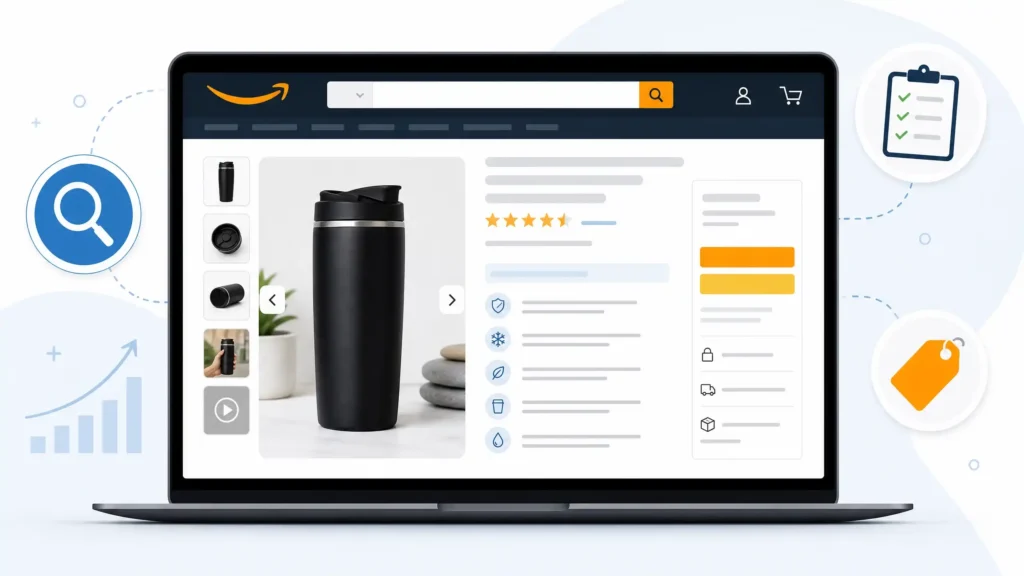
Getting a product listed on Amazon does not mean shoppers will find it. Even when a listing earns impressions, weak images, unclear copy, poor pricing, or missing reviews can stop those impressions from becoming sales.
This creates a costly problem. Sellers often spend more on advertising before fixing the product page receiving the traffic. The campaign may generate clicks, but the listing cannot convert those clicks efficiently.
A better Amazon marketing strategy follows a clear order: build a profitable offer, improve the listing, collect trustworthy reviews, start controlled advertising, measure total sales growth, and expand only after the numbers support it.
How should Amazon product marketing work in 2026?
Amazon product marketing should connect discoverability, conversion, profitability, and repeat demand. A seller cannot treat Amazon SEO, PPC advertising, reviews, pricing, and outside traffic as separate projects because each one affects the performance of the others.
For example, advertising can increase product visibility, but a weak main image may produce a low click-through rate. A competitive image may win the click, but vague bullet points can reduce the conversion rate. A strong listing may still struggle when the price sits far above comparable products without a clear reason.
Your strategy should move through four stages:
- Make the offer profitable before paying for traffic.
- Build a listing that answers buying questions quickly.
- Generate sales through controlled Amazon PPC campaigns.
- Expand into promotions, creators, Google, email, and other channels.
What should you calculate before spending money on Amazon marketing?
Calculate your contribution margin and break-even advertising cost of sales before starting a campaign. These numbers show how much you can pay to generate an order without losing money.
Begin with the selling price, then subtract product cost, shipping, Amazon referral fees, fulfillment fees, storage costs, returns, discounts, and other variable expenses.
Suppose you sell a product for $40. After all non-advertising costs, you keep $12 before advertising. Your pre-advertising margin equals 30%.
That means your approximate break-even ACoS is also 30%. Spending $12 in advertising to generate one $40 attributed sale would leave no profit but would not create a loss before overhead.
What is ACoS?
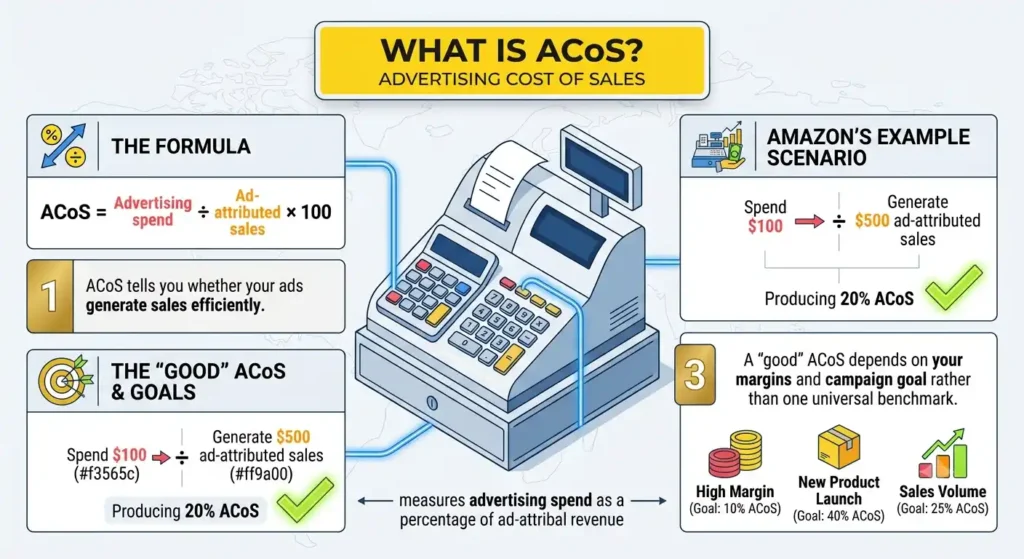
Advertising cost of sales, or ACoS, measures advertising spend as a percentage of ad-attributed revenue.
The formula is:
ACoS = Advertising spend ÷ Ad-attributed sales × 100
Amazon gives the example of spending $100 to generate $500 in ad-attributed sales, which produces a 20% ACoS. Amazon also notes that a “good” ACoS depends on your margins and campaign goal rather than one universal benchmark.
What is TACoS?
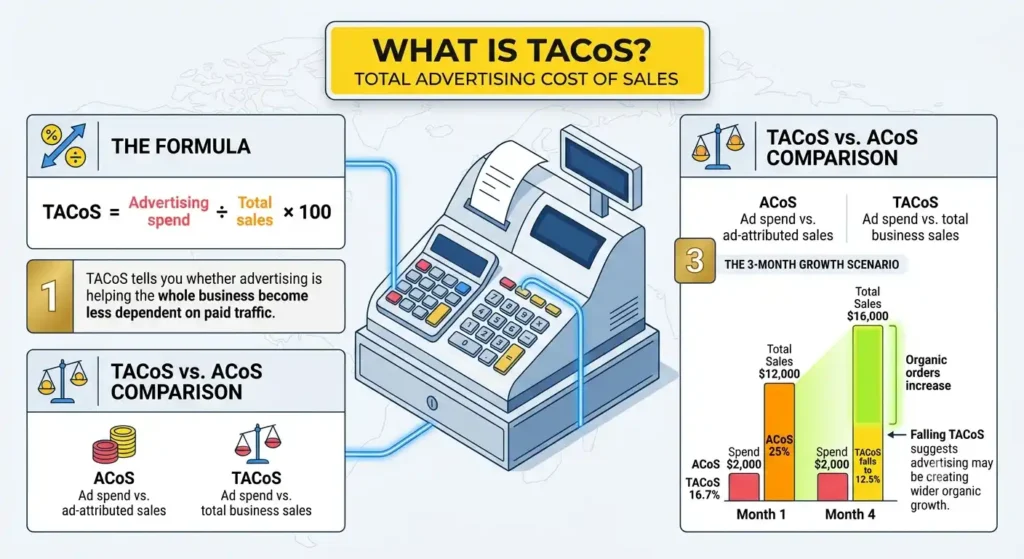
Total advertising cost of sales, or TACoS, measures advertising spend against total Amazon sales, including both paid and organic orders.
The formula is:
TACoS = Advertising spend ÷ Total sales × 100
ACoS tells you whether your ads generate sales efficiently. TACoS tells you whether advertising is helping the whole Amazon business become less dependent on paid traffic.
For example, imagine you spend $2,000 on ads and generate $8,000 in ad-attributed sales. Your ACoS is 25%. If total sales equal $12,000, your TACoS is 16.7%.
Three months later, you still spend $2,000, but total sales grow to $16,000 because organic orders have increased. Your TACoS falls to 12.5%. That falling TACoS suggests your advertising may be creating wider organic growth.
How do you optimize an Amazon listing for search and conversion?
Optimize the listing around the shopper’s query, buying problem, product attributes, objections, and intended use. Keywords create relevance, but the page must also persuade the shopper to purchase.
Sellers often call Amazon’s search-ranking system the “A10 algorithm.” Amazon does not publish a fixed public formula under that name. Its official seller guidance focuses on query relevance, accurate listing information, useful keywords, strong images, competitive offers, and content that helps customers make a decision.
A listing should answer five questions within seconds:
- What exactly is the product?
- Who is it designed for?
- What problem does it solve?
- Why should the shopper choose it over similar products?
- What could make the shopper hesitate?
Start with the main image because it controls whether many shoppers click. Use the remaining images to show scale, use cases, materials, instructions, package contents, comparisons, and answers to common objections.
How should you write the product title?
Write the title for identification and relevance, not maximum keyword volume. Include the brand, product type, major differentiating attribute, size or quantity, and primary use when those details help shoppers compare options.
For example, a clear title might read:
NorthPeak Insulated Water Bottle, 32 oz Stainless Steel Bottle with Straw Lid, Leak-Resistant Sports Bottle for Hiking and Gym
This structure tells Amazon and the shopper what the product is, its capacity, its material, an important feature, and its intended situations. Repeating “water bottle” several more times would add clutter without adding meaning.
How should you write Amazon bullet points?
Each bullet should answer one buying question rather than list disconnected features. Lead with the outcome, explain the feature that creates it, and add a specific detail that supports the claim.
A weak bullet says:
DURABLE MATERIAL: Made from good-quality stainless steel.
A stronger bullet says:
KEEPS DRINKS COLD DURING LONG DAYS: Double-wall stainless steel insulation helps maintain temperature during commutes, workouts, and day trips without leaving condensation on your bag or desk.
The second version connects the material to a result and gives the shopper real situations in which the result matters.
Do backend search terms still matter?
Backend search terms still help Amazon understand relevant wording that may not fit naturally in the visible listing. Use them for close synonyms, alternate spellings, abbreviations, regional terms, and secondary use cases.
Do not repeat the same words already used several times in the title and bullets. Do not add unrelated popular keywords. Irrelevant terms may attract poor-quality impressions, which can produce clicks without purchases and weaken campaign efficiency.
How do you optimize a product listing for Rufus and AI shopping?
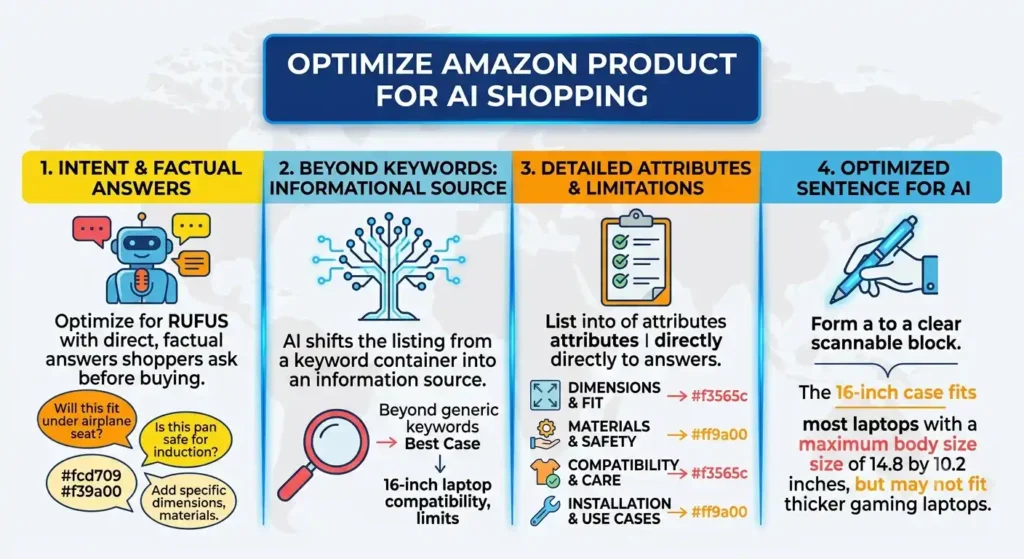
Optimize for Rufus by writing direct, factual answers to the questions shoppers ask before buying. Rufus is Amazon’s AI-powered shopping assistant, and Amazon states that more than 300 million customers used it during 2025.
AI shopping changes the listing from a keyword container into an information source. A shopper may ask Rufus, “Will this fit under an airplane seat?” or “Is this pan safe for an induction stove?” Your content must contain a clear answer for Rufus to retrieve.
Add specific attributes such as dimensions, compatibility, materials, age range, care instructions, installation requirements, included accessories, limitations, safety information, and ideal use cases.
Avoid vague claims such as “perfect for everyone” or “the best choice.” Those statements do not help an AI system match the product to a specific need.
A Rufus-friendly sentence sounds like this:
The 16-inch case fits most laptops with a maximum body size of 14.8 by 10.2 inches, but it may not fit thicker gaming laptops.
That sentence states the entity, dimensions, compatibility relationship, and limitation in one answer.
Does A+ Content improve Amazon product marketing?
A+ Content adds enhanced images, text layouts, video, comparison charts, and brand content to eligible product detail pages. It helps shoppers understand products that need more explanation than the standard title, bullets, and images can provide.
Amazon reports that Basic A+ Content can increase sales by up to 8% on average. Treat that figure as an Amazon-wide directional benchmark rather than a guaranteed result for every ASIN.
A+ Content works best when it adds new information. Repeating the same five bullet points in a larger graphic wastes the space.
Use A+ Content to compare models, show product construction, explain a process, answer compatibility questions, demonstrate use cases, and guide shoppers toward the correct item in your catalog.
When should you enroll in Amazon Brand Registry?
Enroll in Amazon Brand Registry when you own an eligible brand and want access to stronger brand-building, analytics, content, and intellectual-property tools.
Amazon Brand Registry is a free program, but the brand generally needs an active registered trademark or an eligible pending trademark. Enrollment can open access to A+ Content, Brand Stores, Brand Analytics, Vine, and additional advertising options.
Brand Registry does not fix a weak product. It gives a legitimate brand more control over how products appear, how performance gets measured, and how suspected infringement gets reported.
For sellers planning several related products, the Brand Store also creates a central destination where shoppers can explore the full catalog instead of leaving after viewing one ASIN.
How should Amazon sellers use PPC advertising?
Start with Sponsored Products because these cost-per-click ads promote individual listings in shopping results, product pages, and other eligible placements. They usually provide the fastest path to keyword, click, order, and conversion data.
A basic campaign structure can include:
- An automatic campaign for search-term discovery.
- A manual broad or phrase campaign for controlled exploration.
- A manual exact campaign for proven buyer queries.
- A product-targeting campaign for competitor and category pages.
Move converting search terms into exact-match campaigns rather than leaving all traffic inside the automatic campaign. Add poor or irrelevant terms as negatives when the data shows they consume budget without producing orders.
Do not judge a keyword after one or two clicks. Give it enough traffic to produce a meaningful decision, but set limits based on your expected conversion rate.
If a product normally converts at 10%, it may need about 10 clicks to produce one order. A term that spends more than your acceptable cost per order without converting deserves a bid reduction, negative match, or closer review.
What is a Single Product Ad Group?
A Single Product Ad Group, often shortened to SPAG, contains one advertised ASIN rather than several products. This structure keeps search-term, bid, placement, and conversion data tied to one SKU.
Use SPAGs when products have different margins, conversion rates, prices, seasonality, or keyword intent. Putting a $20 item and a $70 item in the same ad group can make performance harder to interpret because one bid strategy may not fit both products.
SPAGs require more campaign management, so they may not suit a catalog with hundreds of low-volume ASINs. Use them first for launches, best sellers, high-margin products, and items receiving a large share of the ad budget.
When should you use Sponsored Brands?
Use Sponsored Brands when you want shoppers to discover the wider brand, watch a product video, compare several items, or visit a Brand Store.
Sponsored Brands can display video, images, product collections, a logo, and branded messaging in high-visibility placements such as search results and product pages.
They make more sense after the seller has a clear brand identity and more than one strong destination. Sending shoppers to an unfinished Brand Store or a weak collection page can reduce the value of the traffic.
How do you market a new Amazon product from launch?
A new product launch should create enough qualified traffic to collect conversion data without letting broad advertising consume the full budget.
Before launch, complete the listing, confirm inventory, enroll the brand when eligible, prepare A+ Content, test images, calculate the break-even ACoS, and consider Vine enrollment.
During the first four weeks, focus on relevance and learning rather than ranking for every large keyword. Start with precise long-tail searches that closely match the product.
A new 24-ounce insulated kids bottle may convert better for “leak resistant water bottle for elementary school” than for the broad term “water bottle.” The long-tail term has lower reach, but the shopper’s need matches the product more closely.
Use external traffic only when the listing is ready. Sending creator or Google traffic to a page with no reviews, weak images, unclear delivery dates, or incomplete product information can waste the launch opportunity.
How do you drive external traffic to an Amazon listing?

Drive external traffic from channels where the audience already has a reason to care about the product. Possible sources include Google Ads, creator videos, social media, affiliate content, email, brand websites, YouTube reviews, and niche publications.
Match each channel to the buying journey. A short TikTok demonstration may introduce a visually interesting product. A YouTube comparison may help with a higher-priced decision. Google Search ads can capture people already looking for a specific solution.
Do not send every visitor directly to one product detail page. A Brand Store may work better when the visitor needs to compare models, sizes, flavors, or bundles.
How does Amazon Attribution measure outside traffic?
Sellers can create separate Attribution tags for search, social, email, video, and influencer campaigns. This makes it possible to compare sources instead of treating all outside traffic as one group.
Which Amazon reports should sellers review?
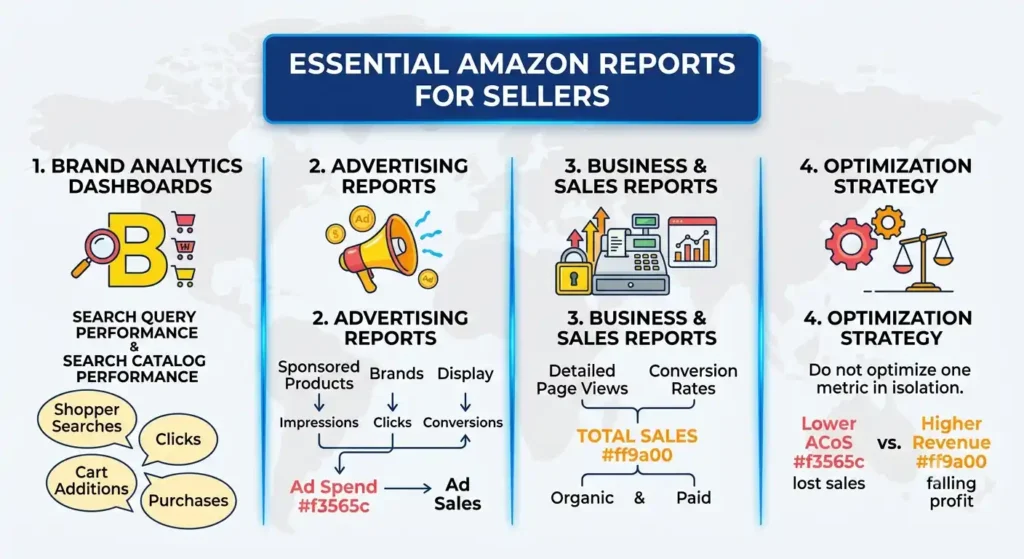
Use reports that connect shopper searches to impressions, clicks, cart additions, purchases, advertising spend, and total sales.
The Search Query Performance dashboard in Brand Analytics shows how customers search for a brand and how queries perform across the shopping funnel. The Search Catalog Performance dashboard shows how ASINs perform through that funnel.
Review these core measures:
- Impressions: Show whether Amazon is displaying the product.
- Click-through rate: Shows whether the search placement, image, title, price, and review profile attract attention.
- Conversion rate: Shows whether product-page visitors purchase.
- ACoS: Shows ad spend compared with ad-attributed sales.
- TACoS: Shows ad spend compared with total sales.
- Contribution profit: Shows what remains after product costs, Amazon fees, shipping, discounts, advertising, and other variable costs.
- Organic sales share: Shows whether the business is building demand beyond paid placements.
Do not optimize one metric in isolation. A lower ACoS may look good, but it can hide lost sales when bids become too low. Higher revenue may look good, but it can hide falling profit when discounts and advertising costs rise faster than sales.
What is the best Amazon marketing strategy for a limited budget?
With a limited budget, concentrate spending on one or two products with good margins, reliable inventory, strong reviews, and clear demand.
Do not spread $1,000 across 30 weak listings. Ten dollars per ASIN will rarely produce enough data to improve the account.
Start with the product most likely to convert. Improve its listing, run focused Sponsored Products campaigns, collect search-term data, and reinvest part of the contribution profit.
After one product develops stable traffic and orders, use its data to support related variations, bundles, accessories, or follow-up products. This approach builds a catalog around proven customer demand instead of guessing across many unrelated items.
Build an Amazon marketing system that improves each month
The best Amazon marketing strategy does not depend on one campaign, keyword, deal, or traffic source. It creates a repeatable system in which each month produces better information than the month before.
Begin with product economics. Improve the listing until it answers the shopper’s main questions. Use advertising to find converting searches, not to hide a weak offer. Watch TACoS and contribute profit alongside ACoS. Track outside campaigns separately. Fix product problems when reviews reveal them.
Your next step is to choose one priority ASIN and audit its margin, title, images, bullets, reviews, price, conversion rate, advertising search terms, and total sales trend. That audit will show whether the product needs better traffic, a stronger product page, a different offer, or a product-level fix before more money is spent.
Also Read: What Is Amazon Marketing Services?
Frequently Asked Questions
How do I market my product on Amazon?
Start by calculating your margin, improving the product listing, setting a competitive price, and collecting reviews through approved methods.
What is a good ACoS for Amazon advertising?
A good ACoS is lower than the percentage you can afford based on product margin and campaign goals.
Does external traffic help an Amazon product rank?
External traffic can generate additional visits and sales, but Amazon does not promise a ranking increase simply because visitors came from another platform.
How much should a new seller spend on Amazon PPC?
The right budget depends on click prices, conversion rate, margin, and the amount of data needed.
Related Posts