
An Amazon advertising agency is a specialist firm that manages paid and organic marketing on Amazon’s marketplace, covering Sponsored Products, Sponsored Brands, Sponsored Display, Amazon DSP, listing optimization, and account performance on behalf of brand owners.
An Amazon advertising agency is a specialist firm that manages paid and organic marketing on Amazon’s marketplace, covering Sponsored Products, Sponsored Brands, Sponsored Display, Amazon DSP, listing optimization, and account performance on behalf of brand owners.
The distinction matters because Amazon advertising does not work like Google Ads or Meta advertising. On Amazon, every ad click feeds data back into the algorithm. A Sponsored Products campaign that drives conversions also signals to Amazon’s A10 algorithm that this product is relevant and purchases-worthy for that search term. Run it poorly and you waste the budget. Run it well and you build organic ranking momentum that pays dividends long after the ad spend stops.
That is the core reason brands hire Amazon advertising agencies: the system is too interconnected for siloed management to work.
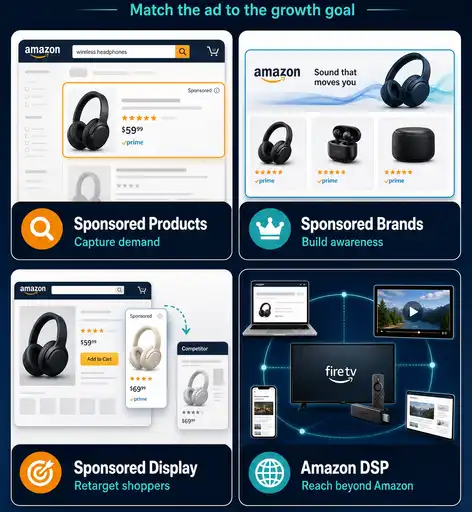
Most people assume an Amazon advertising agency just runs PPC campaigns. In practice, the scope is wider, because Amazon’s performance is a system where ads, listings, creative, and account health all affect each other.
Here is what a full-service Amazon advertising agency manages:
Beyond those four ad formats, agencies also manage campaign architecture, keyword strategy, negative keyword lists, bid management, budget pacing, placement modifiers, and search term analysis. None of those tasks are set-and-forget. They require weekly attention at minimum and daily attention for high-spend accounts.
The agencies worth hiring go beyond ad management. They connect advertising to the full account: listing copy, image stack, A+ Content, account health monitoring, and inventory levels. Sending traffic to a listing with a 5% conversion rate while competitors convert at 12% is a fast way to burn a budget with nothing to show for it.
Amazon’s advertising landscape in 2026 is materially different from what it was in 2023. Three shifts define the current environment, and they all have direct implications for how agencies should operate.
The first shift is AI-driven campaign management. Amazon launched its Full-Funnel Campaigns feature in Q1 2026, allowing awareness-to-conversion ad flows through natural language inputs. Amazon’s own Ads Agent, introduced at unBoxed 2025, automates basic bid optimization natively inside the Advertising Console. The implication is that the basic mechanical tasks agencies used to charge for — auto campaign setup, broad match harvesting, routine bid adjustments — are being automated. What separates good agencies now is strategic judgment, not campaign mechanics.
The second shift is creative, becoming a ranking signal. In 2026, Amazon evaluates ad relevance through three layers simultaneously: keyword and product relevance for eligibility, creative quality (main image, video) driving click-through behavior, and post-click conversion rate feeding future visibility. A brand with a weak main image or no video content is losing ground in the auction before the bid is even evaluated.
The third shift is the rise of Amazon DSP as a standard tool. DSP, which stands for Demand-Side Platform, allows programmatic advertising across Amazon-owned properties and third-party sites. It previously required minimum budgets of $50,000 or more per month. In 2026, DSP costs less per click than Sponsored Products for the first time, and interactive video placements on Prime Video are delivering 3 to 4 point lifts in brand awareness metrics. Agencies that only manage Sponsored Ads are now behind agencies that integrate DSP into the same strategy.
This single distinction separates a tactical ad manager from a strategic Amazon advertising agency.
ACoS, or Advertising Cost of Sale, measures ad spend as a percentage of ad-attributed sales. If you spend $100 on ads and those ads generate $400 in sales, your ACoS is 25%. It is a useful metric for measuring individual campaign efficiency.
TACoS, or Total Advertising Cost of Sale, measures ad spend as a percentage of total revenue including organic sales. If you spend $100 on ads and your total revenue that week is $1,000 including both ad-driven and organic sales, your TACoS is 10%.
The difference matters because ACoS can look healthy while the business is quietly getting worse. If your organic rank is declining because PPC is the only thing driving sales, your ACoS stays flat but your TACoS rises as organic revenue falls. A falling TACoS alongside growing revenue is the signal that PPC is building compounding organic momentum. A rising TACoS with flat revenue means ads are buying sales that should be coming organically.
Any Amazon advertising agency worth hiring tracks TACoS and connects it to the organic ranking movement. If an agency reports only ACoS, ask why.
The best Amazon advertising agencies in 2026 share a few operational characteristics that separate them from average providers.
The agencies with the strongest results review campaigns daily, not weekly. Amazon’s auction changes every day. A keyword that converts well on Tuesday can bleed budget on Wednesday if a competitor enters the auction or a seasonal search pattern shifts. Weekly review cycles miss those changes and let wasted spend accumulate for days before anyone catches it.
Sending paid traffic to a listing that is not optimized is a documented budget drain. Before increasing ad spend, quality agencies audit the listing for title compliance, bullet point conversion strength, image stack quality, and A+ Content presence. The current average conversion rate on Amazon runs between 9.5 and 12.3%. If your listing converts at 5%, tripling your ad budget triples your losses.
As discussed above, agencies focused on the right metrics track total advertising cost of sale and connect it to organic rank movement, not just campaign-level ACoS.
The agencies worth avoiding share the opposite pattern: monthly reporting, no listing audit before scaling, and dashboards full of impressions and click data without a clear connection to revenue or margin.
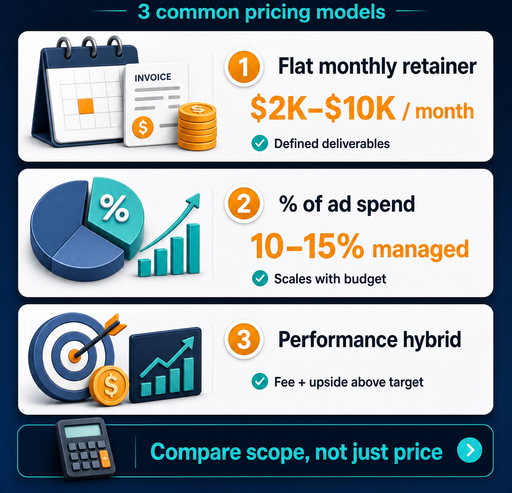
Pricing models vary, but the main structures are:
At $1.12 average CPC and a 9% to 12% conversion rate, a $5,000 monthly ad budget on Amazon generates roughly 4,464 clicks and between 400 and 535 orders, depending on product and category. Whether an agency’s fee makes financial sense depends on how much of that budget they recover through waste reduction and how much additional organic rank they build through sales velocity improvement.
The honest way to evaluate agency ROI is not comparing the retainer to revenue. It is comparing the cost of the agency to the cost of the budget wasted without them, plus the value of the organic ranking improvement they generate.
Ask for the name and experience level of the person who will run your campaigns day-to-day, not the senior team member who pitches you. Olifant Digital requires a minimum of seven years of experience from every account manager. That floor matters because an experienced account manager has already made the costly mistakes somewhere else.
Daily is the standard for active brands. Weekly is the minimum. Monthly is not sufficient. Anything less than weekly review means budget is leaking between check-ins.
In 2026, Amazon’s ad formats — Sponsored Brands video, Premium A+ Content, AI-generated imagery — require creative infrastructure running in parallel with media buying. Agencies that subcontract creative add delays and dilute the feedback loop between ad performance and creative iteration.
ACoS alone is the wrong answer. TACoS connected to organic rank movement is the right one.
Generic case studies with no category or revenue context tell you nothing. Results for a $2M health supplement brand do not predict results for a $200K home goods brand.
An agency that increases PPC budget without first checking listing conversion rate is optimizing the wrong variable.
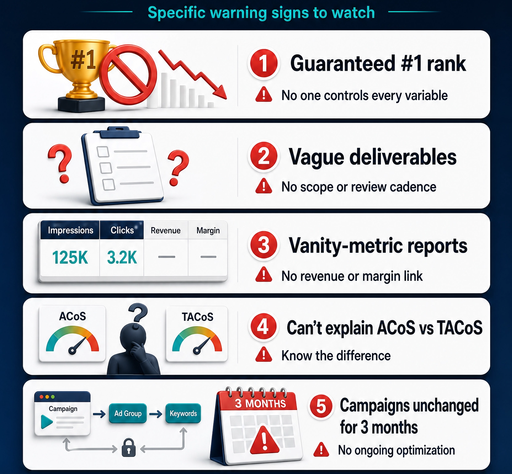
These are specific warning signs, not vague cautions.
For most brands doing $30,000 or more in monthly Amazon revenue, yes.
If the agency is the right one. The average US account carries an ACoS of 28 to 32%. Top-managed accounts run at 23 to 26%. That difference, on $100,000 monthly ad spend, is $5,000 to $9,000 per month in recovered budget. A competent agency typically costs less than the waste it eliminates in the first 60 days.
For brands under $30,000 monthly revenue, the math is tighter. At lower revenue levels, a flat monthly retainer may consume a disproportionate share of margin. In those cases, a one-time audit and coaching engagement often delivers better ROI than ongoing management until revenue supports the retainer.
The question is not whether an agency adds value in the abstract. It is whether the specific agency you are evaluating can demonstrate that value with real numbers from accounts at your stage and in your category.
An Amazon advertising agency manages paid campaigns (Sponsored Products, Sponsored Brands, Sponsored Display, DSP), listing optimization, creative strategy, and account health on behalf of brand owners. The best agencies connect advertising to organic ranking by tracking TACoS and making listing improvements before scaling ad spend.
Most Amazon advertising agencies charge between $2,000 and $10,000 per month on a flat retainer, or 10 to 15% of ad spend managed. Performance-based hybrid models add a percentage of revenue above a set target. Cost depends on catalog size, ad spend volume, and services included.
Brands doing under $30,000 monthly can often manage Sponsored Products themselves with basic tool support. Above $30,000, the complexity of campaign structure, keyword management, and the interaction between ads and organic rank typically means agency management recovers more budget than it costs.
ACoS measures ad spend as a percentage of ad-attributed sales only. TACoS measures ad spend as a percentage of total revenue including organic sales. TACoS is the more useful health metric because it shows whether PPC is building organic momentum or subsidizing sales that should be happening organically.
Amazon DSP, or Demand-Side Platform, is Amazon’s programmatic advertising system that reaches buyers on Amazon-owned properties (Fire TV, Twitch) and third-party websites. In 2026, DSP costs less per click than Sponsored Products for the first time. Full-service agencies manage DSP alongside Sponsored Ads as part of a unified full-funnel strategy.
Guaranteed keyword ranking promises, vague deliverables labeled “full management” without detail, reporting that shows impressions without connecting to revenue or organic rank change, inability to explain TACoS, and campaign structures that have not been updated in months are all signals that an agency is managing by autopilot rather than by strategy.
Most brands see measurable ACoS improvement within 30 to 60 days of campaign restructuring. Organic rank improvement from TACoS management and listing optimization compounds over 60 to 90 days. Full flywheel results — where PPC and organic reinforce each other — typically show clearly at the 90-day mark.
If you are evaluating Amazon advertising agencies, start with the six questions above before looking at case studies or pricing. The answers reveal more about how an agency actually operates than any pitch deck.
If you are not yet at the stage where ongoing agency management makes financial sense, a structured account audit and a clear action plan on what to fix first will move the metrics faster than more ad spend will.
Either way, the starting point is understanding what your current account is doing right, what it is doing wrong, and what the gap between your ACoS and where it should be is costing you every month. That number is usually larger than it looks.
Alpha Spikes manages Amazon Seller Central and Vendor Central accounts for brands across the USA, covering:
If you want a second set of eyes on your current ad account before committing to anything, the audit is free and you will leave with a clear picture of where the waste is.