
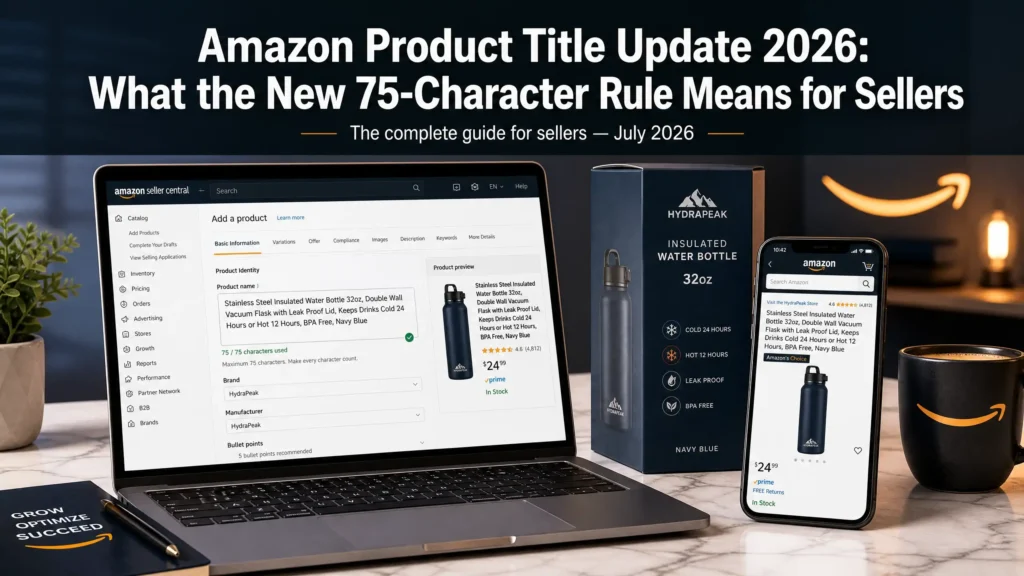
The Amazon product title update that took effect on July 27, 2026, limits most non-media product titles to 75 characters and introduces a separate 125-character Item Highlights field.
Amazon sellers have spent years fitting product names, features, materials, sizes, use cases, and keywords into long titles. That strategy now needs a full reset.
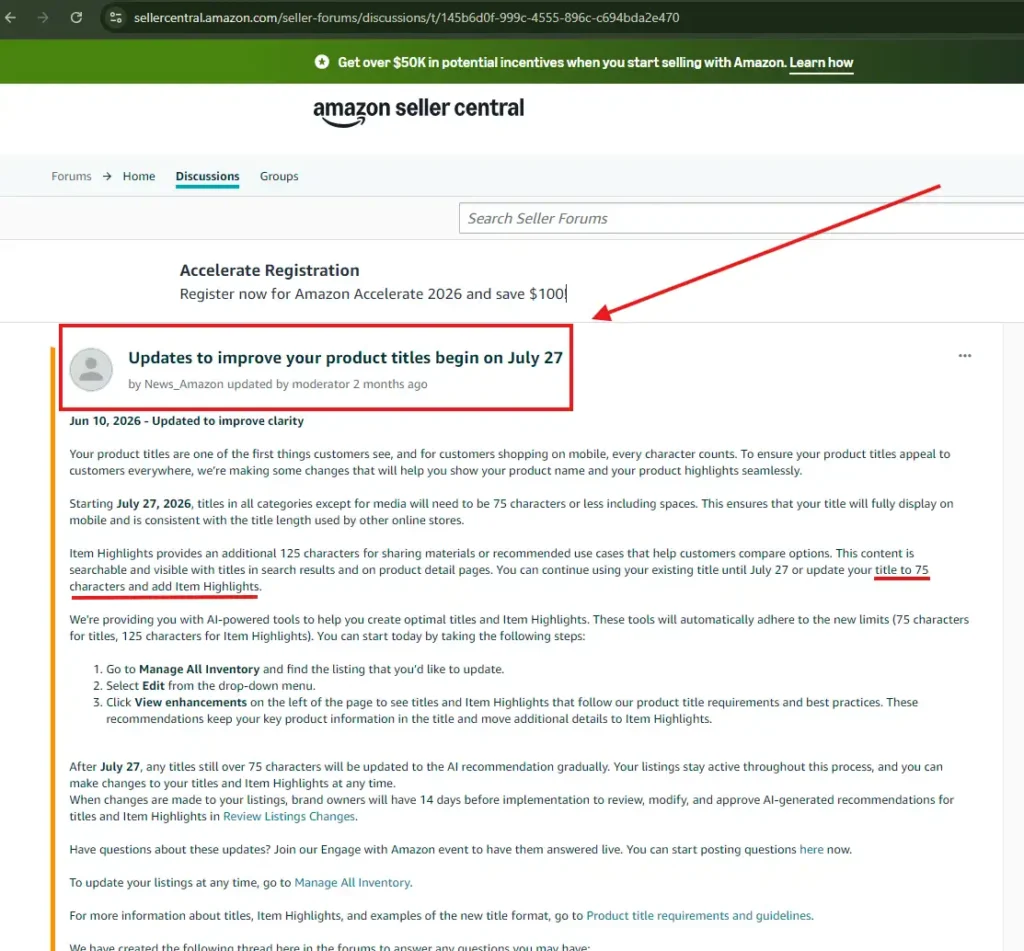
Starting July 27, 2026, product titles in all categories except media must contain no more than 75 characters, including spaces. Amazon is also introducing Item Highlights, a searchable field that gives sellers another 125 characters for materials, use cases, and details that help shoppers compare products.
This is more than a shorter character limit. Amazon is splitting product information into two separate jobs.
The title must quickly identify the product. Item Highlights must explain the extra detail that helps a shopper decide whether the product fits their needs.
Sellers who simply cut the last half of an existing title may remove the wrong information. Sellers who ignore the update may eventually see Amazon’s AI rewrite noncompliant titles for them.
Source: Amazon Seller Central
Amazon now requires product titles in non-media categories to contain 75 characters or fewer, including spaces. Before this change, most categories operated under a broader 200-character limit introduced in January 2025.
The July 2026 update introduces four main changes:
Amazon says the shorter format is designed to help titles display fully on mobile devices and match the title length shoppers commonly see on other online stores.
The update does not mean every listing changed at once on July 27. Amazon described the enforcement process as gradual. Some sellers may see recommendations or title changes earlier than others.
The 75-character limit applies to all Amazon categories except media on Amazon.com.
Amazon has specifically confirmed that books and DVDs are not affected because they fall within the excluded media categories. Amazon had not announced plans to extend the rule to media when it answered seller questions about the exemption.
The rule affects common categories such as Home and Kitchen, Beauty, Grocery, Pet Supplies, Electronics, Clothing, Sports and Outdoors, Health and Household, Automotive, Toys, and Tools and Home Improvement.
It also applies to variation listings. Amazon clarified that child ASIN and sub-SKU titles must follow the 75-character limit, not only the parent product name.
For a variation, the title usually needs enough room for the core product name and the defining variation attributes.
For example:
Parent title: NorthPeak Cotton Sheet Set
Child title: NorthPeak Cotton Sheet Set, Queen, Sage Green
The child title above contains the brand, product type, size, and color in 45 characters. Less useful details can move into Item Highlights or other listing fields.

The field allows up to 125 characters. Amazon recommends using it for information such as materials, recommended uses, or details that help customers compare one option with another.
Item Highlights are not the same as bullet points. They sit closer to the title in the shopping journey and may appear before a customer opens or fully reads the product detail page.
This gives sellers a new way to separate product identity from product persuasion.
The title should answer:
What is this product?
The Item Highlight should answer:
What makes it relevant to this shopper?
Consider a Home and Kitchen listing.
Old title:
Acme 2-Tier Under Sink Organizer for Kitchen and Bathroom, Sliding Drawers, Adjustable Height, Black Metal Storage Rack
New title:
Acme 2-Tier Under-Sink Organizer, Adjustable, Black
Item Highlight:
Sliding drawers fit kitchens and bathrooms; adjustable height stores bottles and cleaning supplies.
The shorter title still identifies the brand, product, main feature, and color. The Item Highlight carries the room use, drawer function, and storage purpose.
Yes. Amazon states that Item Highlights are searchable and visible with product titles in search results and on product detail pages.
That makes the field useful for relevant secondary terms that no longer fit inside the 75-character title.
However, Amazon has not publicly stated that a keyword inside Item Highlights receives the same search weight as a keyword inside the product title. Sellers should not assume the two fields are equal simply because both are searchable.
A safer decision rule is:
Place the product’s most important identifying search phrase in the title. Place supporting uses, materials, benefits, audiences, and comparison details in Item Highlights.
For example, a water bottle title may contain “insulated water bottle,” “32 oz,” and “stainless steel.” The Item Highlight can explain that it suits travel, work, workouts, or long periods away from home.
The 75-character limit changes the length requirement, but sellers still need to follow Amazon’s current product title policies and category-specific formatting rules.
In January 2025, Amazon introduced a 200-character cap for most categories, restricted several special characters, and stated that most words could not appear more than twice in the same title.
The July 2026 update creates a much tighter length limit for non-media listings. It does not give sellers permission to repeat keywords, add promotional language, use restricted symbols, or ignore category style rules.
A title can contain fewer than 75 characters and still be poor quality.
For example, this title is short but weak:
Kitchen Organizer Best Kitchen Organizer Storage Organizer Black
It repeats terms, reads unnaturally, and does not clearly describe the product’s construction, size, or format.
A better version is:
Acme 2-Tier Under-Sink Organizer, Black Metal
The second title tells shoppers what the product is without wasting space on repeated wording.
Amazon says it will gradually update titles that remain over 75 characters using AI-generated recommendations. Listings are expected to remain active while this process happens, and sellers can continue editing their titles and Item Highlights.
This means a long title may not immediately cause a listing to disappear on the effective date. It also means sellers should not wait for Amazon to make the decision.
An automated recommendation may remove a feature your customers consider important. It may also choose a less valuable keyword, omit a compatibility detail, or describe a product in a way that does not match your positioning.
The seller usually knows whether size, material, model, pack count, fit, scent, color, or intended use matters most. Amazon’s system must make that judgment from the catalog data it can read.
Better catalog inputs can support better recommendations, but sellers should still review the final wording.
Amazon provides AI-powered listing tools that suggest titles and Item Highlights within the new character limits.
Sellers should review recommendations using four checks:
Do not approve a recommendation only because it fits the character limit.
An AI-generated title can be grammatically clean and still be commercially weak. It may also produce a factual problem when the product data contains outdated, incomplete, or conflicting attributes.
Brand owners receive 14 days before implementation to review, modify, or approve certain AI-generated title and Item Highlight recommendations through Review Listings Changes.
This review period gives enrolled brand owners more control, but it still requires active monitoring.
The title should contain the information a shopper needs to identify the exact product within one quick scan.
A useful 75-character title formula is:
Not every product needs all four elements. The order depends on how customers compare products in that category.
A replacement part may need the model number near the beginning. Apparel may need gender, style, size, and color. Grocery products may need flavor and pack count. Home products often need dimensions or material. Electronics may need compatibility, capacity, or generation.
Item Highlights should carry secondary details that support comparison without overloading the title.
Good candidates include:
Material details: Stainless steel, organic cotton, recycled plastic, solid wood, or silicone construction.
Recommended use: Suitable for travel, small kitchens, apartments, offices, gifting, outdoor use, or daily storage.
Performance detail: Keeps drinks cold, folds for storage, fits standard shelving, or supports a stated weight.
Included items: Comes with lids, attachments, pillowcases, filters, replacement parts, or accessories.
Choose one clear sentence or short phrase rather than a second keyword list.
For example:
Title:
Luma Vitamin C Face Serum, 1 fl oz
Item Highlight:
Fragrance-free serum with vitamin C and hyaluronic acid for dull, dry-looking skin.
The title identifies the product and size. The Item Highlight explains the formulation and intended skin concern.
Any cosmetic, health, safety, or performance statement must match the product, packaging, documentation, and applicable Amazon policies.
Variation titles need enough detail to separate one child ASIN from another while staying within 75 characters.
Amazon recommends keeping the core product name and adding the defining variation attributes, such as size or color. The same limit applies to child and sub-SKU titles.
For example:
Parent: NorthPeak Cotton Sheet Set
Child: NorthPeak Cotton Sheet Set, Queen, Sage Green
Item Highlight: Four-piece breathable cotton set includes a fitted sheet, flat sheet, and two pillowcases.
Avoid filling every child title with identical secondary benefits. That uses space without helping shoppers distinguish the variation.
Variation details should also match the child ASIN’s actual attributes. A title that says “Queen, Sage Green” must not point to a full-size gray product because catalog conflicts can confuse shoppers and Amazon’s systems.
Sellers can update a product through Manage All Inventory.
Amazon’s announced workflow is to locate the listing, select Edit, and open View enhancements to review the recommended title and Item Highlights. Sellers can also edit listings through their usual inventory tools, as long as the final title follows the current rules.
For a large catalog, use a controlled audit process rather than rewriting titles randomly.
Start with ASINs that have:
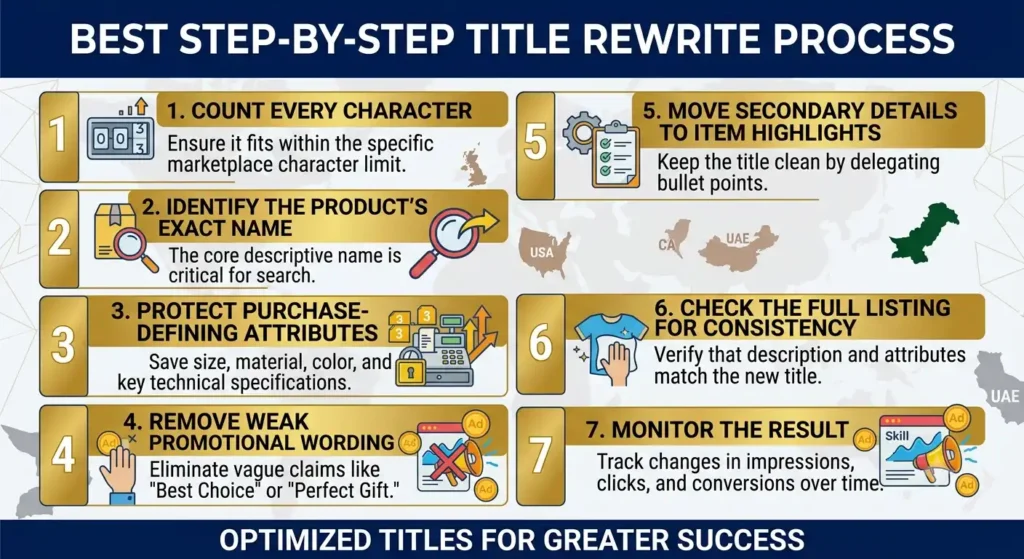
A strong rewrite process protects both search relevance and customer clarity.
The 75-character limit includes spaces. Do not rely on visual length because punctuation, model numbers, and variation details can consume space quickly.
Write the plain product type a shopper would use. Examples include insulated water bottle, king sheet set, under-sink organizer, USB-C charger, or dog grooming brush.
Keep details that prevent the wrong purchase, such as size, count, model, compatibility, color, flavor, or material.
Words such as premium, amazing, best, perfect, and superior often take space without identifying the product. Some promotional terms may also conflict with Amazon’s style rules.
Use the extra 125 characters for materials, recommended uses, included parts, or comparison information.
The title, Item Highlight, bullet points, images, attributes, packaging, and variation labels should describe the same product.
After the change, track click-through rate, conversion rate, organic query performance, advertising search terms, return reasons, and customer questions.
Amazon’s 75-character product title rule began on July 27, 2026. It applies to non-media categories and counts spaces within the limit.
Books and DVDs are not currently covered by the 75-character limit because Amazon excluded media categories from the July 2026 update.
Yes. Spaces count toward the 75-character product title limit. Punctuation, numbers, brand names, sizes, colors, and model details also consume characters.
The Item Highlights limit is 125 characters. Amazon describes the field as a place for materials, recommended uses, and comparison details.
Amazon says affected listings will remain active while long titles are gradually updated through AI recommendations.
Yes. Amazon states that sellers can continue editing titles and Item Highlights, provided the updated title follows the requirements.
Yes. Amazon has confirmed that the limit applies to child ASIN and sub-SKU titles.
Amazon confirms that Item Highlights are searchable, but it has not published evidence that keywords in this field carry the same weight as title keywords.