Definition
Driving traffic to your Amazon product means directing shoppers, through Amazon’s own search and ads or through outside channels like Google, social media, and email, to your product detail page so they can buy.
TL;DR
Amazon traffic comes from two places: inside Amazon (search, browse, Sponsored Products) and outside Amazon (Google, social media, email, influencers). For years, sellers focused almost entirely on internal PPC. That’s no longer enough. Amazon’s ranking system now rewards listings that bring in outside traffic that converts, through programs like Amazon Attribution and the Brand Referral Bonus. The fastest path to page one combines three things: a listing that converts well, PPC that supports launch and testing, and external traffic from at least one owned channel, whether that’s email, a blog, or a creator partnership. Below is the full breakdown, with real numbers, common mistakes, and an FAQ section covering what people actually ask about this topic.
What Does "Driving Traffic to Your Amazon Product" Actually Mean?
Driving traffic means getting more shoppers to click through to your product detail page, whether they come from inside Amazon’s own search results or from an outside source like a blog post, an Instagram ad, or an email newsletter. Traffic by itself isn’t the goal; converting traffic is. Ten thousand clicks from people who never buy will hurt your listing more than five hundred clicks from buyers who are already primed to purchase.
Amazon separates traffic into two categories, and each one plays a different role in your ranking.
Internal Traffic vs. External Traffic: What's the Difference?
Internal traffic comes from inside Amazon: shoppers who find you through Amazon’s search bar, category browsing, “customers also bought” strips, or Sponsored Ads. External traffic comes from outside Amazon and lands on your product page through a link, such as a Google ad, a social media post, an email, or a blog article like this one.
Internal traffic is what most sellers focus on by default because Amazon’s own ad system (Sponsored Products, Sponsored Brands, Sponsored Display) sits right inside Seller Central. External traffic takes more deliberate effort, but it’s the piece most sellers are underusing in 2026.
Why External Traffic Matters More Than It Used To
Amazon’s ranking system, commonly called “A10” by sellers, agencies, and SEO tools, though Amazon has never officially confirmed that name, has shifted its weighting over the past several years. The earlier system, often called A9, leaned heavily on keyword matching and PPC-driven sales velocity. The current system puts more weight on conversion rate, review quality, return rate, and where your sales are coming from.
That last point is the important one for this article: sales driven by external, converting traffic now carry more ranking signal than sales driven purely by internal ads. If you send a buyer from your email list or a blog post and they purchase, Amazon reads that as proof of real demand for your product, demand that exists independently of Amazon’s own advertising.
Does External Traffic Still Help Amazon SEO in 2026?
Yes, but only when it converts. Quality traffic from a blog post, an email list, or a creator partnership raises your conversion rate, and Amazon’s algorithm treats a rising conversion rate as a relevance signal. Low-quality traffic that bounces without buying does the opposite: it drags your conversion rate down and can hurt your ranking instead of helping it.
This is why “more traffic” is the wrong goal on its own. The right goal is more converting traffic, from sources where the audience already wants what you’re selling.
Internal Traffic: What You Can Control Inside Amazon
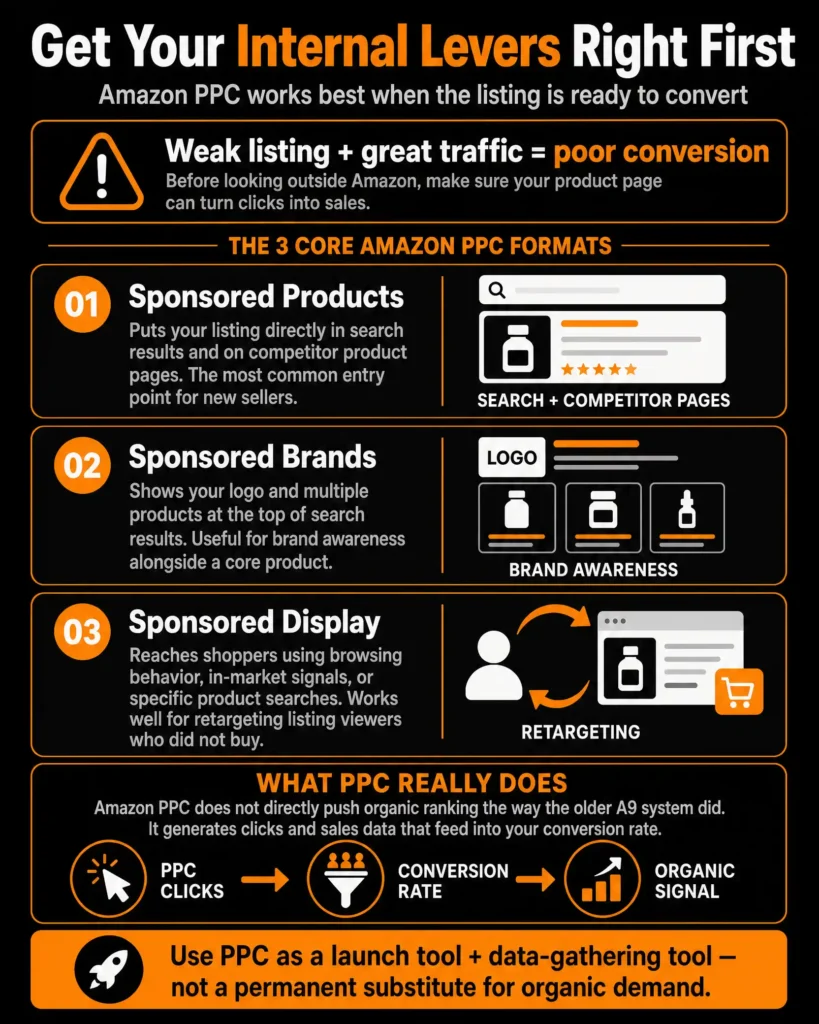
Before looking outside Amazon, get the internal levers right. External traffic sent to a weak listing will convert poorly no matter how good the source is.
- Sponsored Products puts your listing directly in search results and on competitor product pages. It’s the most common entry point for new sellers.
- Sponsored Brands (formerly Headline Search) shows your logo and multiple products at the top of search results, useful for brand awareness alongside a core product.
- Sponsored Display follows shoppers based on browsing behavior, in-market signals, or specific product searches, and works well for retargeting people who viewed your listing but didn’t buy.
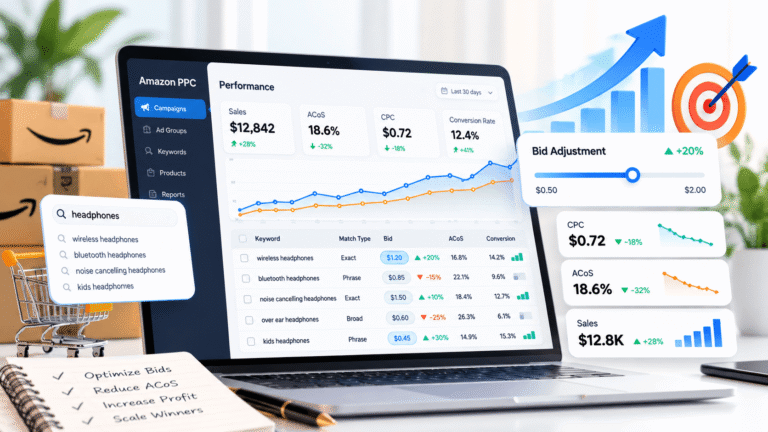
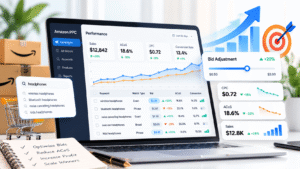
Amazon PPC does not directly push your organic ranking the way it did under the older A9 system. What it does is generate the clicks and sales data that feed into your conversion rate, and a strong conversion rate is one of the clearest signals the algorithm rewards. In practice, that means PPC works best as a launch tool and a data-gathering tool, not as a permanent substitute for organic demand.
What Conversion Rate Should You Be Aiming For?
Most competitive categories see a benchmark conversion rate somewhere between 10% and 15%. Listings that consistently beat that range tend to reach page one for a moderately competitive keyword faster than listings that don’t, often within four to twelve weeks, and sometimes as fast as eight weeks when strong external traffic is feeding both conversion rate and review velocity at the same time.
External Traffic: The Channels That Actually Move the Needle
External traffic isn’t one tactic. It’s a set of channels, each suited to a different stage of your product’s life.
- Social media (organic and paid): Facebook, Instagram, TikTok, and Pinterest work well for both brand awareness and direct-response ads pointed at your listing. Retargeting through a tool like Facebook Pixel keeps your product visible to people who already showed interest.
- Email marketing: Announcing a launch or a promotion to an existing list creates an immediate, trackable sales spike, and it’s one of the highest-converting traffic sources because the audience already knows your brand.
- Influencer and affiliate partnerships: A creator with a smaller, highly engaged audience in your niche often converts better than a large, generic one, because their followers trust the recommendation.
- Google Ads and Google Shopping: These reach people already searching for what you sell, which tends to produce higher-intent clicks than cold social traffic.
- Blog content and SEO: Articles like this one, written around the exact questions your buyers are typing into Google, build long-term, compounding traffic that doesn’t disappear when an ad budget runs out.
A seller who is only using PPC inside Amazon is competing in what’s become one of the most expensive ad auctions on the internet, with cost-per-click regularly eating 30% to 50% of margin in competitive categories. Every one of the channels above gives you a way to acquire a customer without paying that premium every time.
How to Track External Traffic: Amazon Attribution and the Brand Referral Bonus
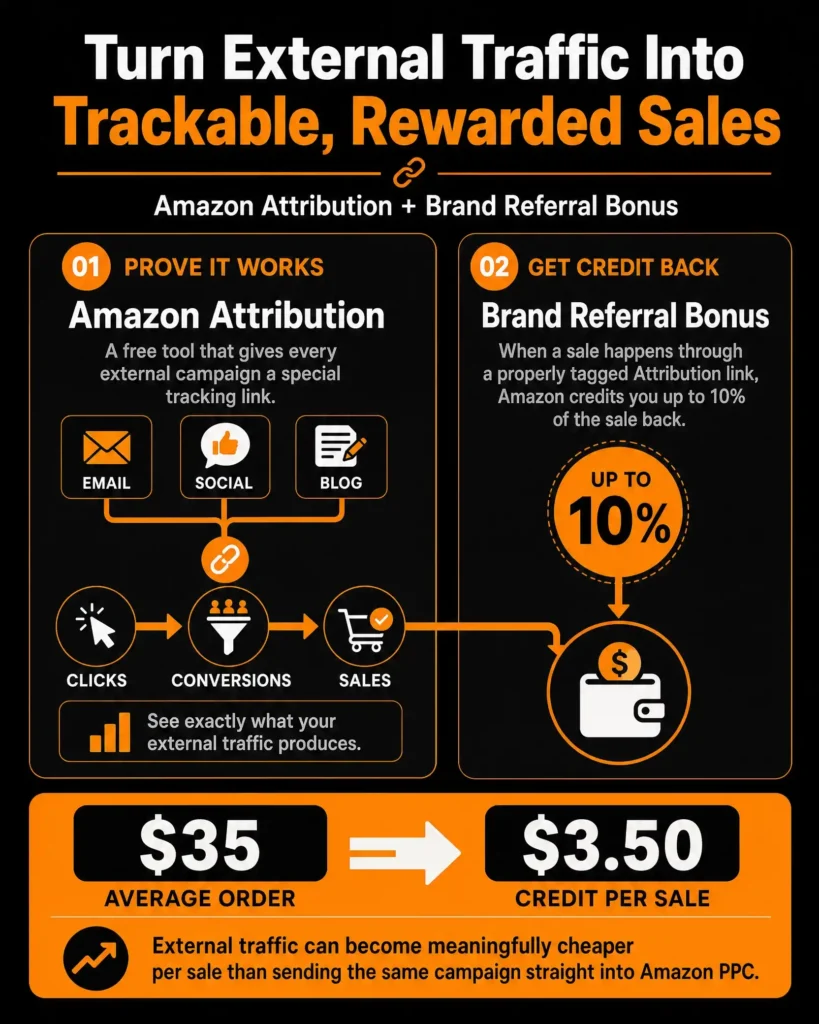
For years, the biggest problem with external traffic was that sellers couldn’t prove it worked. That changed with the Amazon Attribution Program, a free tool that lets you generate a special tracking link for any external campaign (email, social, a blog post) and see exactly how many clicks, conversions, and sales it produced.
The Brand Referral Bonus Program goes a step further. If a sale happens through a properly tagged Attribution link, Amazon credits you up to 10% of that sale back. On a $35 average order value, that’s roughly a $3.50 credit per sale, which can make external traffic meaningfully cheaper per sale than running the same campaign straight into Amazon PPC.
Common Mistakes Sellers Make Driving Traffic to Amazon
- Spending aggressively on PPC at launch with no external traffic plan, so ranking collapses the moment ad spend stops
- Sending external traffic to a raw, untagged ASIN link instead of an Amazon Attribution link, losing the bonus and the tracking data
- Chasing broad, low-intent social traffic that bounces instead of a smaller, more targeted audience that actually buys
- Treating A+ Content as decoration instead of substance, which gives shoppers, and AI-driven answer engines, little reason to trust the listing
- Ignoring return rate and review quality while focusing only on traffic volume, which drags down the exact conversion signal the algorithm rewards
A Simple Starting Plan
If you’re starting from zero, the order that tends to work best is: fix the listing first (images, title, A+ Content, and pricing), launch PPC to gather early sales data and reviews, then layer in one external channel, usually email if you have a list, or a small influencer partnership if you don’t, and track every external click through Amazon Attribution from day one. Adding channels one at a time makes it much easier to see which one is actually driving converting traffic, rather than guessing after the fact.
FAQs
How do I get more traffic to my Amazon listing?
Combine Amazon PPC with at least one external channel, like email, social media, or a blog. Track links through Amazon Attribution and double down on whatever converts best.
What is external traffic on Amazon?
External traffic is any visitor who reaches your product page from outside Amazon, such as a Google ad, social post, or email link. It’s now a meaningful factor in Amazon’s ranking system.
Is Amazon PPC still worth it in 2026?
Yes, mainly for launches and data collection rather than as a standalone ranking strategy. Use it to gather early sales and reviews, then build external traffic alongside it.
What is Amazon Attribution and how does it work?
Amazon Attribution is a free tool that generates trackable links for external campaigns, showing clicks, conversions, and sales per source. It also qualifies sales for the Brand Referral Bonus.
How long does it take a new Amazon listing to rank on page one?
Most moderately competitive keywords take four to twelve weeks. Strong external traffic can push that closer to eight weeks.
Does social media traffic actually increase Amazon sales?
It can, but only when the audience is targeted and matches buyer intent. A smaller, engaged audience usually outperforms a large, generic one.
What is the Brand Referral Bonus program?
It’s an Amazon program that credits sellers up to 10% of a sale’s value when it comes through a properly tagged Attribution link. That makes external traffic cheaper per sale than PPC.
What should you do next?
Start by tagging every external link you already send to Amazon with an Attribution link. That single change gives you the data to know what’s actually working. From there, fix any obvious gaps in your listing, keep PPC running to support launch-stage sales, and pick one external channel to build consistently rather than spreading thin across five. Traffic compounds when it’s tracked, targeted, and tied back to a listing that’s ready to convert it.