
Amazon PPC is Amazon’s pay-per-click advertising system, where sellers bid for ad placements and pay when shoppers click Sponsored Products, Sponsored Brands, or Sponsored Display ads.
Amazon PPC can generate sales quickly, but a poor setup can waste your budget just as fast. The biggest mistake is treating campaign creation as the starting point. Your listing, inventory, keyword plan, bid math, and campaign structure should be ready before you spend the first advertising dollar.
Amazon has more than 600 million listed products, while average CPC across Amazon categories was about $1.12 in 2025–2026. That means every irrelevant click has a real cost. Your goal is not simply to buy traffic. It is to attract shoppers who are likely to convert and turn their search behavior into data you can use to improve future campaigns.
A good Amazon PPC setup starts with a retail-ready listing, Sponsored Products campaigns, controlled bids, and a clear process for moving successful search terms from discovery campaigns into manual campaigns.
This creates a simple cycle: PPC generates data, the data identifies stronger search terms, manual campaigns give you more control, and stronger targeting can improve advertising efficiency.
A retail-ready listing is a product page that gives paid traffic a realistic chance to convert. PPC cannot fix weak images, unclear copy, poor reviews, an uncompetitive offer, or inventory shortages.
Before launch, check four areas:
The inventory calculation is simple: projected daily sales × 60 = approximate units required. If PPC could increase sales to 10 units per day, plan around 600 units. This reduces the risk of losing momentum because a successful campaign caused a stockout.
Most people assume an Amazon advertising agency just runs PPC campaigns. In practice, the scope is wider, because Amazon’s performance is a system where ads, listings, creative, and account health all affect each other.
Here is what a full-service Amazon advertising agency manages:
Beyond those four ad formats, agencies also manage campaign architecture, keyword strategy, negative keyword lists, bid management, budget pacing, placement modifiers, and search term analysis. None of those tasks are set-and-forget. They require weekly attention at minimum and daily attention for high-spend accounts.
Your ad controls the click, but your listing controls the conversion. If shoppers click and do not buy, CPC continues to accumulate while ACoS rises.
If click volume looks healthy but conversion rate is weak, review your price, images, reviews, copy, offer, and product-market fit before raising bids.
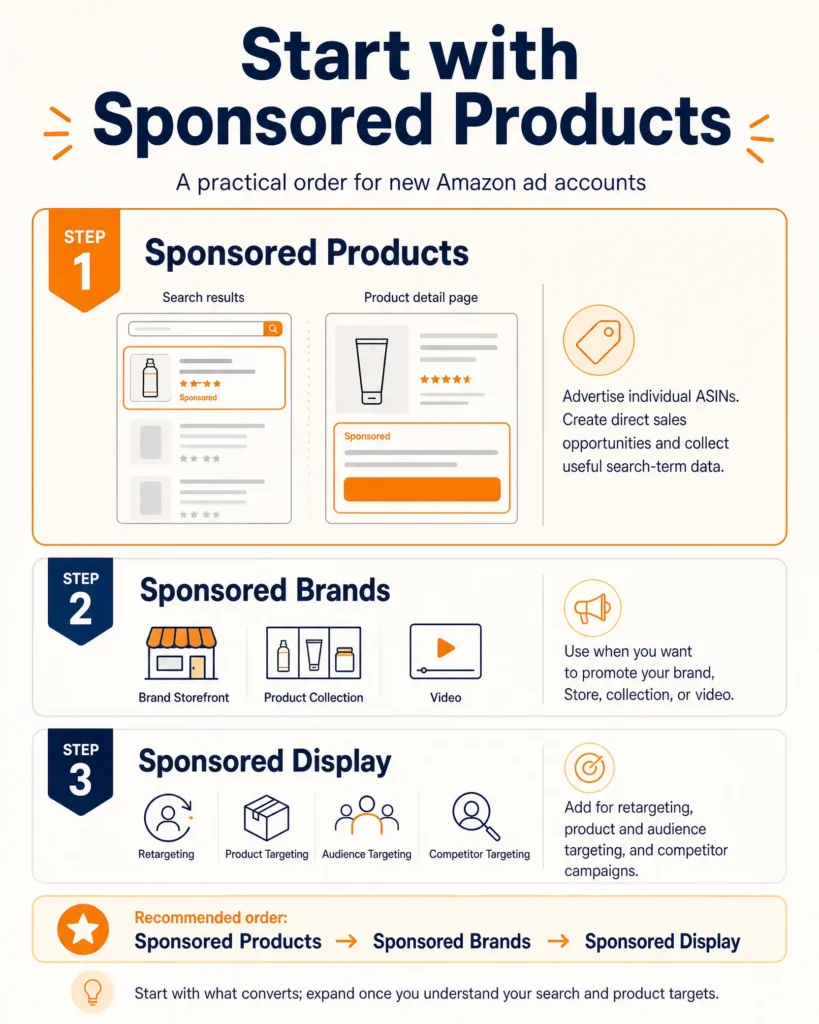
Sponsored Products advertise individual ASINs in Amazon search results and product detail pages. They are usually the best starting point because they create direct sales opportunities while generating useful search-term data.
Sponsored Brands become more useful when you want to promote your brand, Brand Store, product collection, or video. Sponsored Display can support retargeting, product targeting, audience targeting, and competitor campaigns.
For most new accounts, the logical order is Sponsored Products first, followed by other ad formats once you understand which searches and product targets already convert.
An automatic campaign lets Amazon decide which shopper searches and product pages relate to your ASIN. Its main role is discovery.
A manual campaign gives you direct control over keywords, match types, product targets, and bids. Its main role is performance management.
Use both together. Automatic campaigns identify opportunities; manual campaigns give proven opportunities their own bids and budgets.
Broad match gives Amazon the most flexibility to connect your keyword with related searches. Phrase match keeps the shopper query closer to your keyword phrase. Exact match gives you tighter control over a specific search.
Exact match remains useful for strong converting terms and brand defense. Broad match can work well for discovery when it is paired with a disciplined negative keyword list rather than left open without regular optimization.
Amazon PPC keyword research is the process of finding shopper searches worth paying to appear for. High search volume can create traffic, but buyer intent determines whether that traffic has a realistic chance of producing sales.
Start with keywords that directly describe the product. Then expand through competitor ASIN research, long-tail terms, related searches, and product targeting.
Tools listed in the supplied research include Helium 10 Cerebro, Helium 10 Magnet, Jungle Scout Keyword Scout, SellerApp, Ad Badger, Pacvue, Perpetua, and other Amazon PPC platforms.
Long-tail keywords are more specific phrases that usually represent narrower shopper intent. They may have less search volume, but the traffic can be more qualified.
If a broad keyword produces expensive clicks but weak conversion, test more specific variations. When a long-tail search term converts consistently, move it into an exact-match manual campaign for tighter control.
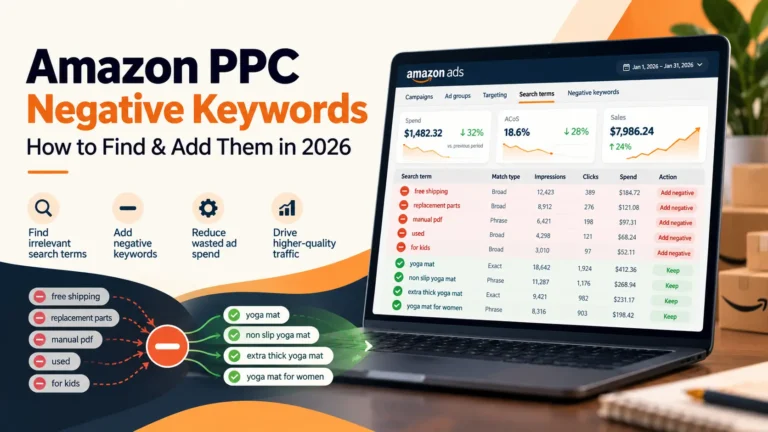
Negative keywords stop your ads from appearing for searches you do not want to pay for. They help reduce wasted clicks and keep discovery campaigns focused.
Review the search term report regularly and add irrelevant or consistently unprofitable searches as negatives.
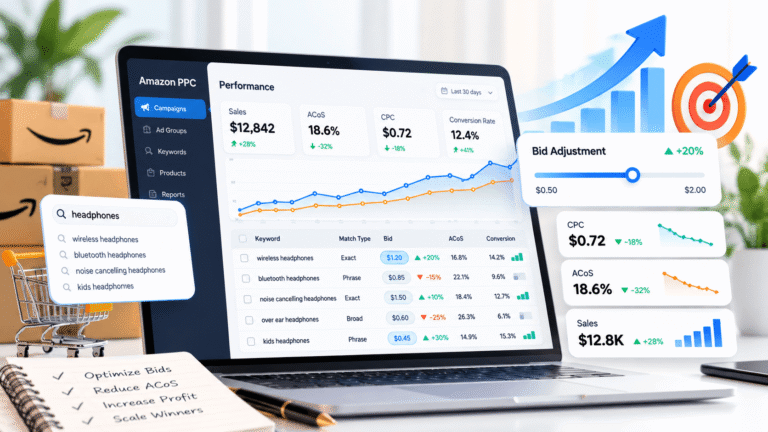
Amazon provides dynamic bids down only, dynamic bids up and down, and fixed bids. The right option depends on how much freedom you want Amazon to have when adjusting your bid during the auction.
Placement performance also matters. Top of Search, product pages, and rest-of-search placements can produce different CTR and conversion rates.
The supplied research notes that increasing Top of Search placement bids by 50% to 100% can produce materially stronger CTR and conversion results in some campaigns. That does not mean every account should make the same adjustment; check your placement report before increasing modifiers.
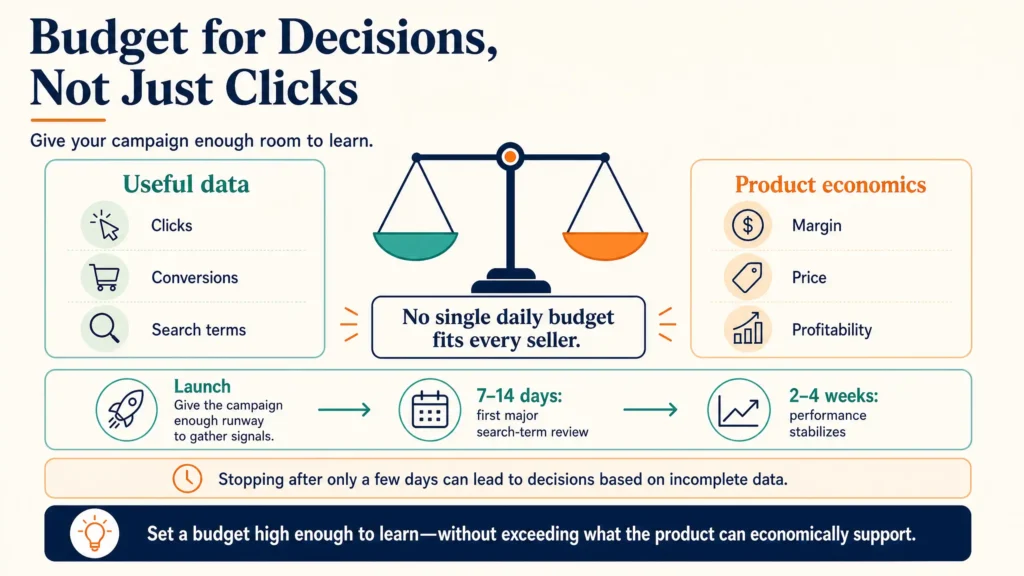
There is no single daily Amazon PPC budget that fits every seller. Your budget should be high enough to collect useful click and conversion data without exceeding what the product can economically support.
Automatic campaigns should generally run for about 7 to 14 days before the first major search-term review. Campaign performance may take roughly 2 to 4 weeks to stabilize, so stopping after only a few days can produce decisions based on incomplete data.
Watch for budget saturation as you scale. If spend and impressions rise but conversions do not improve proportionally, more budget may simply be buying weaker traffic.
Keyword harvesting means finding successful shopper search terms in discovery campaigns and moving them into manual campaigns where you have more control.
Use this workflow:
The supplied research does not provide one universal click or conversion threshold that fits every ASIN, so judge performance against your own target ACoS, CPC, conversion rate, and margins.
The research describes Amazon advertising as moving from a keyword-matching model toward richer customer, product, and semantic matching. Entities tied to this shift include Amazon Rufus, Amazon COSMO, Amazon Ads Agent, and Amazon Shopping Agents.
Keywords still matter, but they are no longer the only signal worth thinking about. Product relevance, ASIN relationships, shopper behavior, audience context, and product attributes can influence how ads connect with shoppers.
The research also reports growing strength from ASIN and product targeting compared with keyword-only acquisition strategies in recent years. Test competitor ASINs, complementary products, categories, and brand-defense targets once your keyword data becomes stable.
ACoS, or Advertising Cost of Sale, measures advertising spend against ad-attributed sales. If you spend $30 to generate $100 in advertising sales, your ACoS is 30%.
TACoS, or Total Advertising Cost of Sale, measures advertising spend against total Amazon sales, including organic revenue.
That difference matters. ACoS tells you how efficiently a campaign produces attributed sales, while TACoS gives you a broader view of how advertising relates to the entire business.
Regular optimization should move money toward better traffic while reducing spend on weaker searches, targets, and placements.
Dayparting means adjusting advertising around the times when conversion performance is strongest. Amazon Marketing Stream can provide hourly data for this type of analysis.
After the first month, identify keywords, ASIN targets, placements, and campaigns that repeatedly meet your goals.
Give proven targets their own manual structure so you can control bids and budgets without mixing them with discovery traffic. You can then add branded defense campaigns, product targeting, and competitor conquesting where the data supports them.
If a profitable campaign repeatedly runs out of budget, increasing the budget may make sense. If additional spend simply lowers conversion quality, focus on better targeting rather than buying more traffic.
Start with a retail-ready listing, launch a Sponsored Products auto campaign, collect data for 7 to 14 days, then move converting search terms into manual campaigns.
Sponsored Products automatic targeting is usually the best starting point because it generates sales opportunities while discovering useful shopper search terms.
Initial results can appear quickly, but the supplied research suggests allowing roughly 2 to 4 weeks for campaign data to stabilize.
The supplied benchmark recommends around 15 to 20 reviews before aggressively scaling PPC on a new ASIN.
Plan for about 60 days of projected sales inventory, calculated as expected daily unit sales multiplied by 60.
ACoS compares ad spend with ad-attributed sales, while TACoS compares ad spend with total Amazon sales.
Multiply Average Order Value × Conversion Rate × Target ACoS; for example, $35 × 10% × 30% equals a $1.05 target CPC.
Amazon PPC performs best when listing quality, campaign structure, keyword discovery, bid math, and measurement work together.
Start by checking listing readiness and inventory. Calculate your target CPC and breakeven ACoS. Launch Sponsored Products for discovery, review search-term data after 7 to 14 days, and move proven terms into manual campaigns.
Then track ACoS and TACoS, review placements, remove wasted traffic, and scale only where the numbers support more spend.