

Your Amazon sales can rise while your profit falls. More advertising cannot fix unclear product listings, missing inventory, or invoices that never reconcile.
That is the real hiring question: do you need someone to run ads, or someone to manage the business behind those ads?
An Amazon brand agency can connect brand presentation, advertising, and daily operations. But “full service” means little until a proposal names the work, the owner, and the measures of success. This guide explains what to expect, what costs to question, and how to choose support that fits your brand.
An Amazon brand agency helps brands manage how they appear, sell, and operate on Amazon. The right scope depends on your account model, internal team, and product economics.
Before comparing proposals, keep four points in mind:
Start by naming the problem you need solved. That makes competing proposals easier to compare and helps you avoid paying for services your team already handles.
An Amazon brand agency is a service business that helps product brands manage their identity, product content, advertising, protection activities, and marketplace operations on Amazon.
Amazon brand management is the ongoing coordination of those activities. The agency supplies the people and processes; the brand supplies product knowledge, business goals, approvals, and funding.
An Amazon branding agency may focus mainly on positioning and creative work. An Amazon brand management agency usually offers broader account support. These labels do not define a standard service package, so compare the actual scope.
For example, a team that creates a Brand Store but does not monitor unavailable listings may improve your brand’s presence without managing the causes of lost sales.
An Amazon brand management agency turns commercial goals into coordinated work across product pages, marketing, and account operations. Its job should include deciding what to fix first not simply completing disconnected tasks.
If a product attracts shoppers but converts poorly, the team should investigate price, content, reviews, and delivery conditions before raising advertising spend. If inventory cannot support a promotion, the agency should adjust the plan with your operations team.
An Amazon brand manager owns the account plan and coordinates the specialists responsible for delivering it. This person should connect advertising decisions with inventory, creative, and financial results.
Ask for a weekly priority log that records the issue, business impact, owner, deadline, and status. For a listing problem, “case opened” describes activity. “Product available again, with the cause documented” describes a useful outcome.
The manager also needs an escalation path. A listing outage cannot wait for the next monthly presentation.
Advertising management focuses on paid campaigns. Full Amazon brand management adds the product content and operating work that support those campaigns.
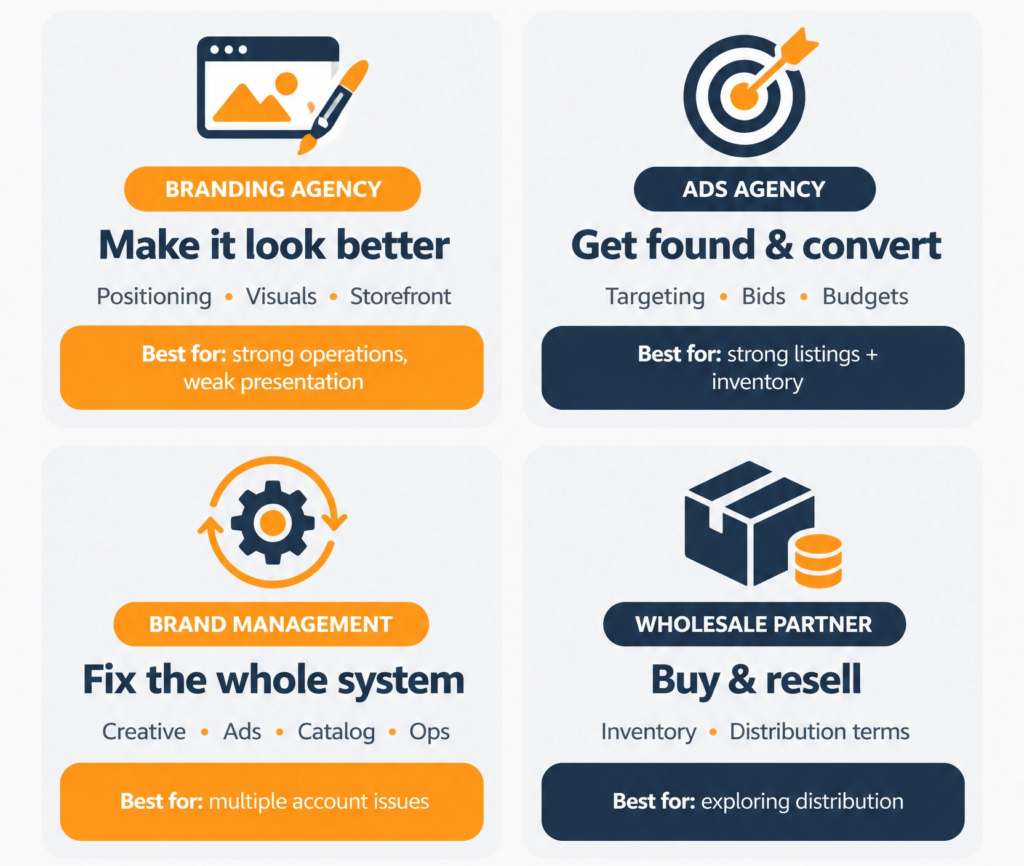
Service model | Main responsibility | Best fit |
Amazon branding agency | Brand positioning, imagery, messaging, and storefront design | Brands with strong operations but weak presentation |
Amazon ads agency | Campaign targeting, bids, budgets, and advertising reports | Brands with reliable listings and inventory |
Amazon brand management agency | Coordination across creative, ads, catalog, and operations | Brands with several connected account problems |
Wholesale partner | Buys inventory and resells under agreed terms | Brands considering a distribution relationship |
The last model changes the commercial relationship. For example, Witz Group describes purchasing inventory from its brand partners. That differs from paying an agency to manage your own selling account.

End-to-end service should cover the work your Amazon business needs, with clear exclusions. Request a scope that names deliverables, frequency, approval rights, and extra charges.
Agencies create Amazon product listings by turning verified product information and shopper research into clear copy, images, and catalog attributes.
The process should begin with a product facts sheet. Record dimensions, materials, compatibility, package contents, care instructions, and evidence supporting product claims. Then compare those facts with the questions shoppers need answered.
For a hypothetical insulated bottle, “24-ounce capacity” and “fits holders at least 3 inches wide” explain more than “perfect for every adventure.” Specific information helps shoppers judge fit before purchasing.
A useful listing workflow has four parts:
A+ Content is Amazon’s enhanced product-detail content, which supports richer images, text, and comparison modules. An agency should use it to explain the product, not repeat the same sales message in a larger format.
Amazon Brand Store creation means planning and building a dedicated, multipage shopping destination for your brand within Amazon. The work should cover navigation, page layouts, creative assets, product selection, and maintenance.
Amazon provides Brand Stores without a creation or maintenance platform fee to eligible users. An agency’s charge pays for its strategy, design, production, and upkeep—not an Amazon storefront license.
For a skincare brand, navigation might group products by routine step or product type. The choice should reflect how customers shop.
Brand consistency also matters. Packaging, listings, and Store pages should describe the same benefits and product facts. A consistent brand experience helps shoppers recognize the product they saw on your website or in a retail store.
Amazon advertising management should connect campaign spending to product readiness and business goals. Request a plan that explains what the team will advertise, which shoppers it wants to reach, and how it will evaluate results.
Sponsored Products promotes individual products. Sponsored Brands supports brand discovery through formats featuring brand identity and products. Eligibility and available formats vary, so the agency should verify what your account can access.
The best Amazon ads agency for product brands is not necessarily the one offering the most formats. It is the one that can explain why a campaign deserves funding.
For example, separate searches containing your brand name from broader category searches. Those groups reflect different shopper intent, so combining them can hide how well advertising reaches unfamiliar customers.
Inventory management should connect sales forecasts, replenishment timing, and planned promotions. Define whether the agency only recommends orders or also coordinates shipments and receiving issues.
Fulfillment by Amazon, or FBA, is Amazon’s service for storing products and handling fulfillment and related customer service. Using FBA does not remove the brand’s need to plan replenishment.
Consider a simplified example: a product sells 10 units daily, replenishment takes 45 days, and the brand wants 15 days of safety stock. That suggests a reorder trigger of 600 units of inventory position—usable stock plus confirmed inbound supply, minus commitments.
The agency should adjust that calculation for seasonality, demand changes, and receiving delays. A forecast without lead-time assumptions cannot guide purchasing reliably.
Purchase order and invoice management depend on whether you sell to shoppers or wholesale to Amazon.
Seller Central supports third-party sellers selling through Amazon’s marketplace. Vendor Central supports first-party suppliers selling wholesale to Amazon. This distinction changes who places purchase orders and what the agency needs to reconcile.
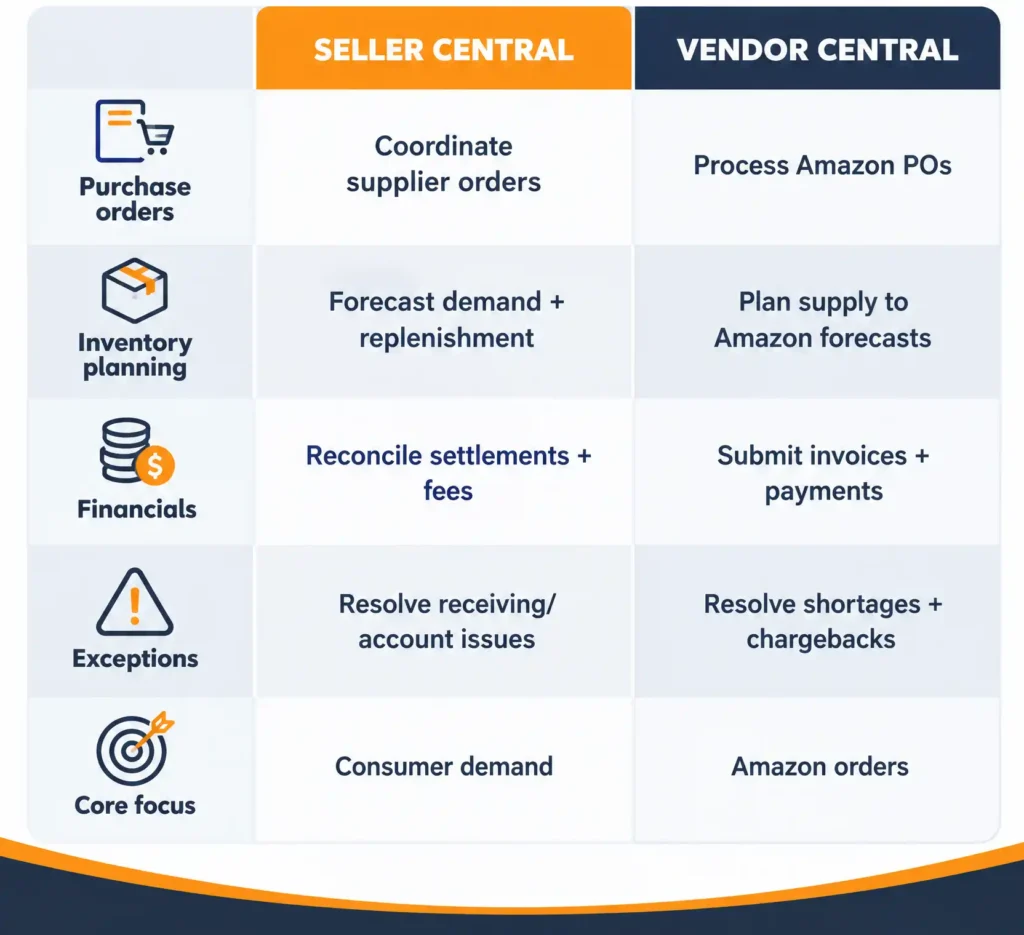
Operating task | Seller Central scope | Vendor Central scope |
Purchase orders | Coordinate supplier orders if included | Monitor and process Amazon purchase orders |
Inventory planning | Forecast consumer demand and replenishment | Plan supply against Amazon orders and forecasts |
Financial administration | Reconcile settlements, fees, and adjustments | Submit and reconcile invoices and payments |
Exception handling | Investigate receiving or account discrepancies | Investigate shortages, deductions, and chargebacks |
Vendor-focused agencies such as VASO explicitly describe purchase order, forecasting, and shortage-dispute services. Ask a prospective partner to demonstrate that workflow if those tasks matter to your business.
For invoice management, request an exception report showing the invoice number, disputed amount, supporting documents, owner, and next action. Clarify whether accounting entries and tax work remain with your finance team.

Agencies can coordinate enrollment, monitor problems, and document complaints. They should distinguish administrative support from legal advice and avoid promising outcomes Amazon controls.
“Amazon trademark registration” usually describes trademark support connected to selling on Amazon. Amazon does not issue U.S. federal trademarks; the United States Patent and Trademark Office, or USPTO, handles that process.
An agency may coordinate with qualified trademark counsel. Amazon’s IP Accelerator connects businesses with vetted legal service providers and can support earlier Brand Registry access while a trademark application remains pending.
The USPTO lists a $350 base application fee per class for qualifying applications. Additional government fees and professional fees may apply, so trademark costs should appear separately from marketplace management fees.
Amazon Brand Registry is a free program that gives eligible brands access to protection and brand-building tools. Enrollment requires qualifying trademark information and other evidence under Amazon’s current requirements.
Brand protection should include evidence collection, accurate reporting, and follow-up. It should not mean filing intellectual property complaints whenever another seller appears.
Amazon distinguishes distribution disputes from intellectual property infringement. A seller’s lack of authorization alone does not establish an infringement claim. Ask how the agency determines which reporting route fits the facts.
Amazon brand reputation management means monitoring customer feedback and addressing the product, content, or service problems behind it.
For example, repeated complaints about unexpected dimensions should trigger a review of measurement images and packaging—not a campaign to remove criticism.
Reject promises to buy reviews or reward customers for changing negative feedback. Amazon prohibits review manipulation. A responsible agency should help investigate valid issues and report content that violates policy without promising removal.
Amazon brand agency pricing varies by service scope, catalog complexity, account model, and staffing. Published agency estimates provide planning context, not a verified market average.
Marknology publishes monthly estimates of $2,000–$4,000 for limited starter support, $4,000–$8,000 for growth-stage service, and $8,000–$15,000 for broader management. Its enterprise estimates run higher. Brand Focus Digital publishes a different tier structure, illustrating why labels alone do not make quotes comparable.
Common fee structures create different incentives:
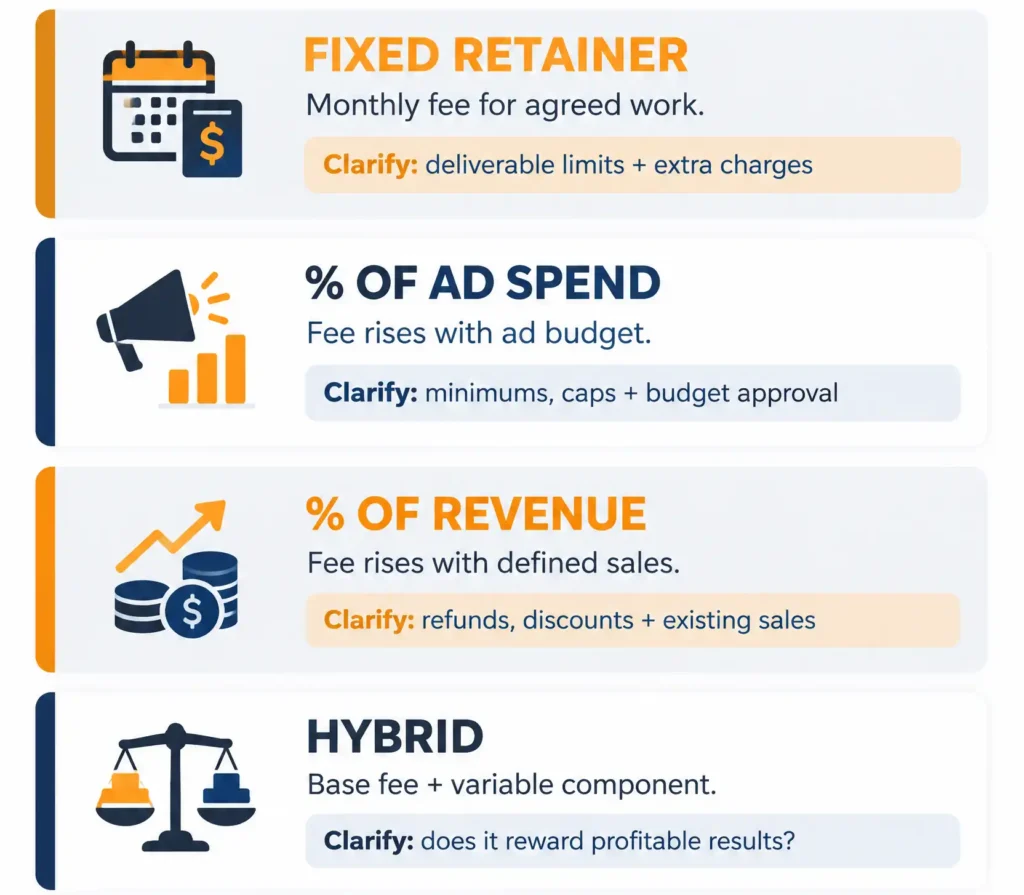
Pricing model | How it works | What to clarify |
Fixed retainer | Monthly fee for agreed work | Deliverable limits and extra charges |
Percentage of ad spend | Fee changes with advertising budget | Minimums, caps, and budget approval |
Percentage of revenue | Fee changes with defined sales | Treatment of refunds, discounts, and existing sales |
Hybrid | Base fee plus a variable component | Whether the variable fee rewards profitable results |
Request a total-cost view that separates management, advertising, creative projects, software, Amazon fees, inventory, freight, and legal support.
Compare the fee with the additional contribution profit the engagement could reasonably produce.
Contribution profit is sales revenue minus the variable costs included in your calculation. For this decision, include product costs, Amazon fees, fulfillment, returns, promotions, and advertising before assessing the fixed agency fee.
In a hypothetical example, a brand retains 20% of additional sales after those costs. A $4,000 monthly retainer requires $20,000 in additional monthly sales to cover the fee:
That is break-even math, not a forecast. Higher advertising costs or returns would increase the sales required. Measurable cost savings could reduce it.
Your brand may need an agency when recurring problems span more functions than your internal team can manage.
Look for patterns rather than one disappointing week:
If only one area needs help, start there. A limited creative project or advertising engagement may fit better than full account management.
Pre-launch brands should first confirm product economics, supply readiness, and available working capital. Established brands should identify whether the bottleneck involves execution capacity, strategy, or operational complexity.
Category experience matters when it changes the work an agency must perform. Ask candidates to explain relevant decisions, not simply show familiar logos.
Direct-to-consumer brands sell directly to shoppers through channels such as their own websites. Their Amazon strategy should preserve product facts and brand positioning while adapting content to marketplace shopping.
Retail brands may need more coordination across distribution, packaging, and wholesale operations. Pre-launch brands need setup and launch planning; established brands may need catalog repair or deeper financial reporting.
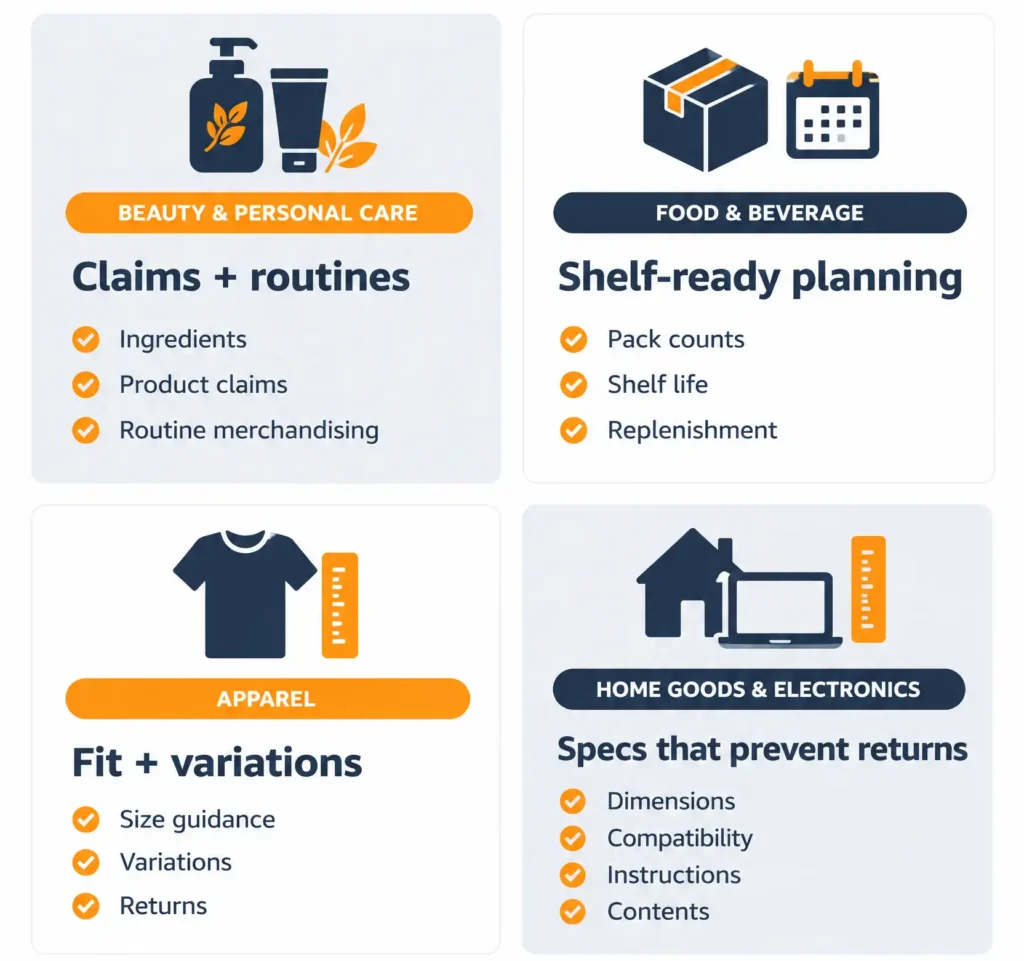
Brand category | Example of expertise to test |
Beauty and personal care | Ingredient information, product claims, and routine-based merchandising |
Food and beverage | Pack counts, shelf life, and replenishment planning |
Apparel | Size guidance, variation structure, and return analysis |
Home goods and electronics | Dimensions, compatibility, instructions, and package contents |
An agency should explain how it protects a consistent brand presentation while solving these category-specific problems.
Choose the agency that demonstrates relevant execution, clear accountability, and sound commercial judgment.
Shortlist three candidates and give each the same brief: account type, product count, revenue range, advertising spend, internal resources, and top problems. Ask them to explain their first priorities.
Request a relevant case study, a sample report, and a meeting with the person who will manage your account.
A useful case study names the starting point, timeframe, work performed, and business result. A sales increase without advertising costs or margin context cannot show whether the brand benefited.
Ask the prospective manager a practical question: “Our advertising looks efficient, but total profit is falling. What would you investigate first?” Their answer should connect campaigns with pricing, fees, returns, product mix, and inventory.
The contract should identify responsibilities, access rights, fees, approvals, reporting, and the exit process.
For a managed-account engagement, retain control of your selling account and brand credentials. Grant appropriate permissions instead of sharing your primary login.
Specify ownership and handoff of creative files, campaign records, and reports. Define response expectations for urgent issues, but distinguish response time from resolution time: an agency can control when it investigates, not when Amazon decides a case.
The first 90 days should establish an accurate baseline, address priority problems, and produce evidence for the next decisions.
The following is a suggested onboarding framework, not a guaranteed performance timeline.
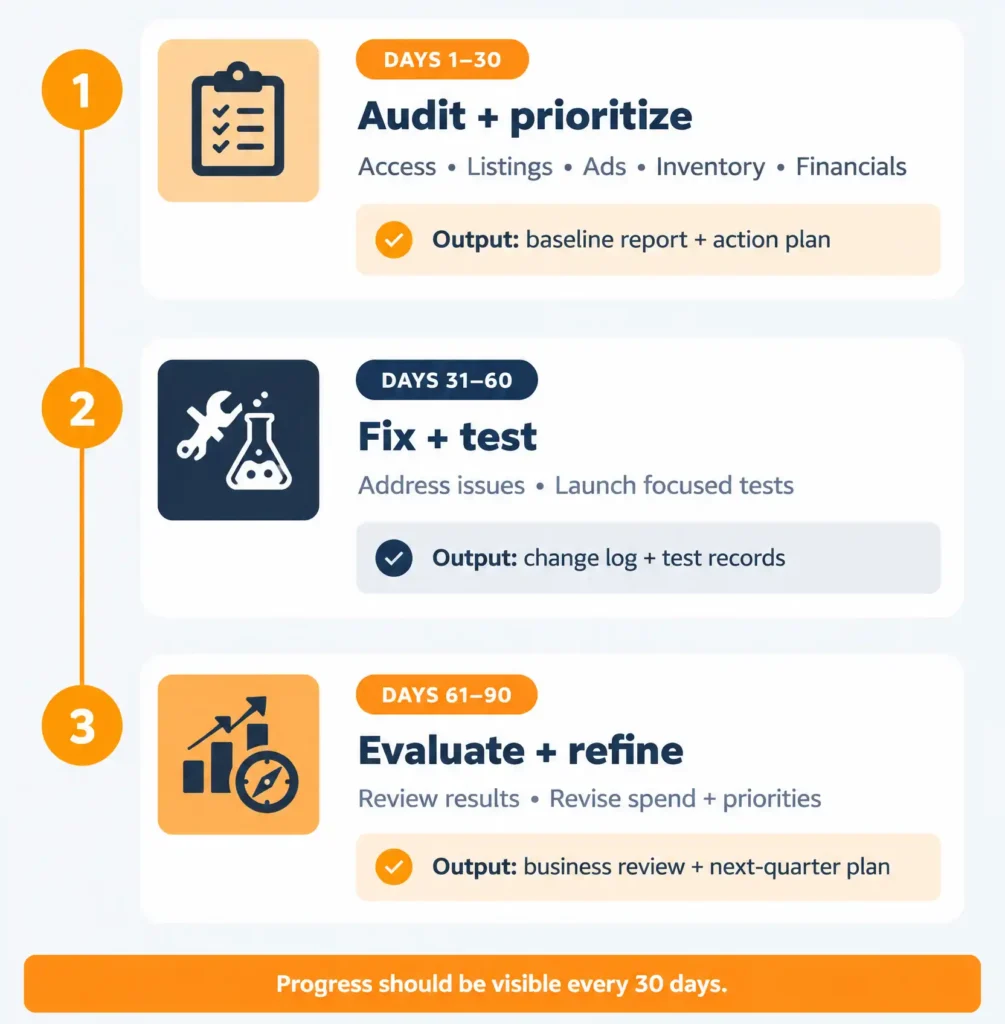
Period | Main work | Expected output |
Days 1–30 | Audit access, listings, ads, inventory, and financial inputs | Baseline report and prioritized action plan |
Days 31–60 | Address agreed issues and launch focused tests | Change log, published updates, and test records |
Days 61–90 | Evaluate results and revise spending and priorities | Business review and next-quarter plan |
Measure work completed alongside business outcomes. A missed launch caused by unavailable stock requires a different response from a failed creative test.
Track profit, advertising efficiency, conversion, and operating reliability together.
Advertising cost of sales, or ACoS, equals ad spend divided by ad-attributed sales. Return on ad spend, or ROAS, reverses that relationship. Neither metric alone proves profitability.
Total advertising cost of sales, or TACoS, compares advertising spend with total sales. Use consistent periods and sales definitions when calculating it.
A practical brand health report should connect those measures with contribution profit, stock availability, returns, and unresolved account issues. Compare performance with your own baseline and seasonal context rather than expecting one target to fit every product.
An Amazon brand agency can be worth it when the expected profit improvement or workload reduction justifies its cost. Small brands should compare a limited project with a monthly retainer. If product margins or demand remain unproven, fixing those problems first may offer more value than outsourcing the whole account.
You can hire an agency before launch for account planning, listings, creative, and inventory coordination. Start with a defined project and clear acceptance criteria. The agency should verify product readiness and budget assumptions before recommending ongoing advertising. A launch date alone does not justify a full management retainer.
You do not need Brand Registry simply to hire an agency. A team can help prepare content and coordinate enrollment beforehand. However, access to certain brand-building features depends on eligibility. Ask the agency to separate work it can complete immediately from work that requires Amazon approval.
An Amazon agency cannot credibly guarantee a specific sales increase or search position. Competitor activity, customer demand, inventory, pricing, and Amazon decisions affect results. It can agree to deliverables, testing plans, spending limits, and reporting standards. Evaluate whether its forecast states assumptions and explains what could prevent the expected outcome.
An agency cannot promise to remove negative reviews simply because they hurt sales. It can investigate whether content violates Amazon’s rules and report qualifying issues. Its more useful role is often finding repeated product or listing problems and helping correct them without pressuring customers to change honest feedback.
One agency can simplify coordination when advertising, content, and inventory problems overlap. Separate specialists can work well when your internal team owns the overall plan. The deciding factor is accountability: someone must connect spending decisions with product availability, listing quality, and profit, regardless of how many providers you hire.