An Amazon growth plan is a structured process for increasing profitable sales by improving visibility, conversion, unit economics and operations at the ASIN level. It identifies the main sales barrier, fixes it and tests each change before scaling, helping US sellers avoid wasting money on extra traffic when their listings, margins or inventory cannot support growth.
A profitable Amazon growth plan follows four stages: diagnose the account, repair the foundation, test controlled changes and scale the results that remain profitable.
Use the first 30 days to calculate contribution margin, review listings and cut wasted advertising spend. During days 31 to 60, test changes on selected ASINs. Use days 61 to 90 to scale repeatable winners while monitoring inventory and cash flow.
Track these four numbers for each ASIN:
This approach separates real business growth from a short sales spike created by discounts or unprofitable advertising.
Most stalled Amazon accounts face one main bottleneck: visibility, conversion, unit economics or operations. Low impressions and weak keyword rankings indicate a visibility problem, while strong traffic with few purchases points to poor conversion caused by weak images, pricing, reviews or product positioning.
Sales may also remain unprofitable because of high FBA fees, returns, product costs or wasted ad spend. Low inventory, delayed replenishment and suppressed listings can further limit growth. Export 60 to 90 days of data and compare each ASIN with its previous performance to identify the main issue.
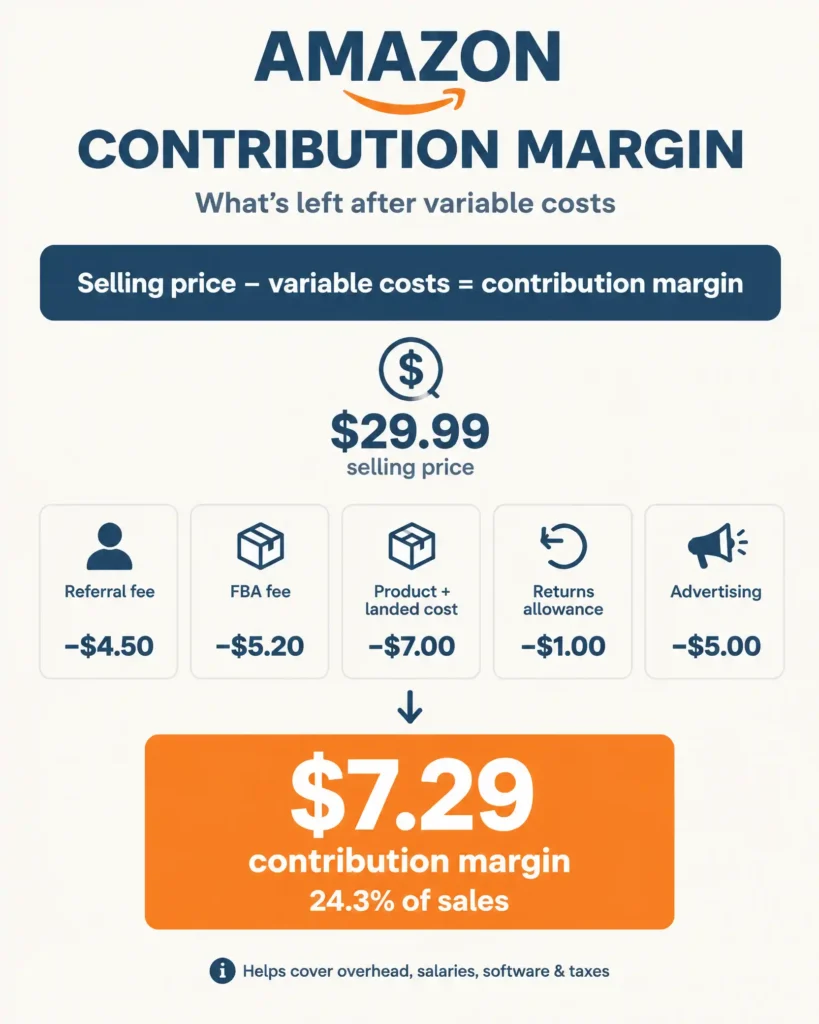
Amazon contribution margin is the amount left from each sale after subtracting variable costs. It shows whether an ASIN produces enough money to support advertising and growth.
Use this formula:
Contribution margin = Selling price − referral fee − FBA or fulfilment fee − cost of goods − returns allowance − advertising cost
Consider a US product selling for $29.99. Assume it has a $4.50 referral fee, a $5.20 FBA fee, $7.00 in product and landed costs, a $1.00 returns allowance and $5.00 in advertising cost.
The calculation is:
$29.99 − $4.50 − $5.20 − $7.00 − $1.00 − $5.00 = $7.29
The ASIN produces a $7.29 contribution margin after advertising, equal to about 24.3% of the selling price. That amount still needs to help cover overhead, salaries, software and taxes.
Make the product detail page retail-ready before sending more paid traffic to it. Review the title, images, bullet points, A+ Content, price, reviews, Featured Offer status and keyword indexing. As of September 2026, Amazon’s US title policy limits product titles to 75 characters, including spaces, so use that space for the brand, product type and strongest differentiating attribute.
Images should clearly explain the product’s size, use, benefits and main features. Brand-registered sellers can add A+ Content, which Amazon reports may increase sales by up to 8% for Basic A+ and up to 20% for Premium A+. Sellers can then use Manage Your Experiments to test different titles, images, bullet points, descriptions and A+ Content.
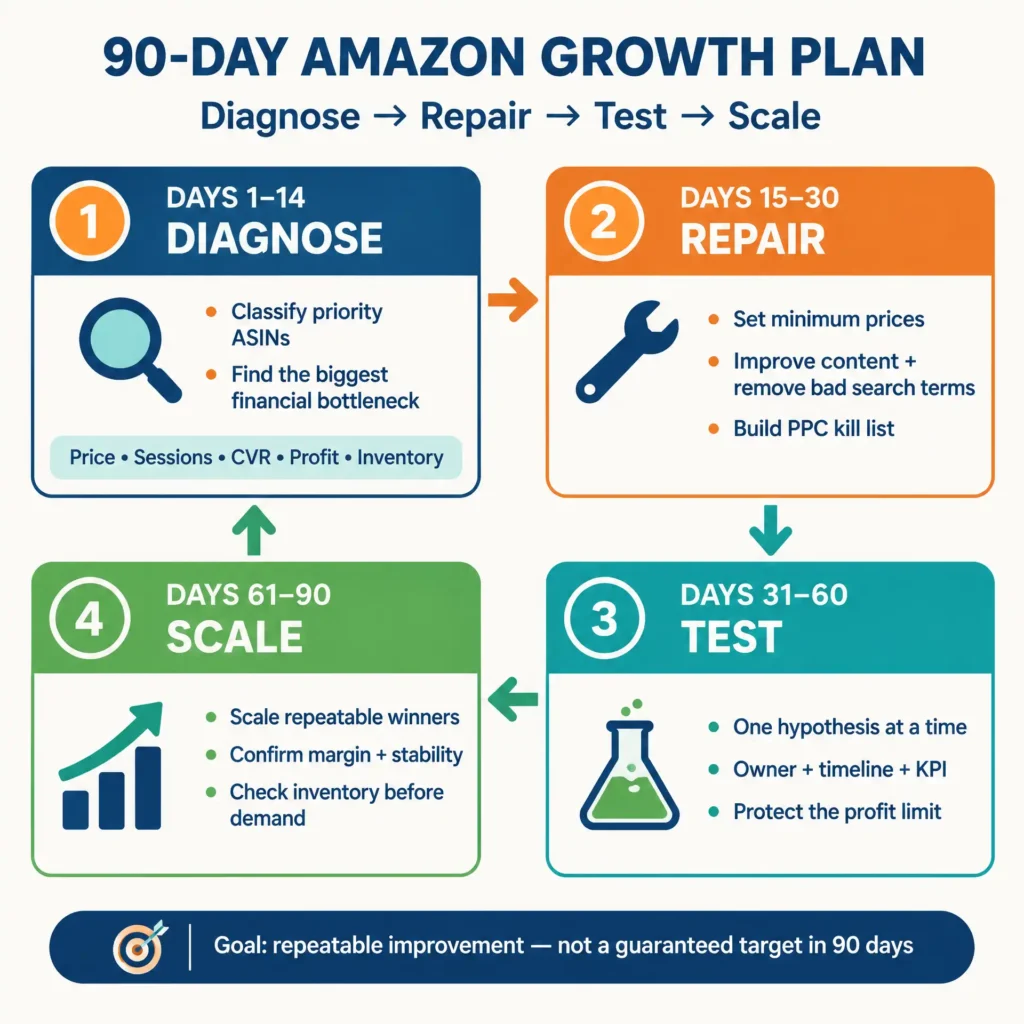
A 90-day Amazon growth plan gives US sellers enough time to establish a baseline, run controlled tests and check whether the improvement can be repeated. It does not promise that every ASIN will reach its target within three months.
During the first 14 days, classify each priority ASIN by visibility, conversion, profitability and operational health. Identify the bottleneck with the greatest financial effect and record selling price, sessions, conversion rate, organic sales, ad sales, ad spend, ACoS, TACoS, contribution margin, return rate, Featured Offer share and inventory cover.
During days 15 to 30, set minimum prices, improve product content, remove irrelevant search terms and address stock risks. Build a weekly PPC kill list, lower bids on expensive converting terms, add negatives for irrelevant queries and pause targets only when repeated data shows no realistic route to profit.
During days 31 to 60, test one major hypothesis at a time, such as whether a new main image improves Unit Session Percentage. Give each test an owner, timeline, primary KPI and profitability limit, and avoid changing the title, price, images and PPC structure at the same time.
During days 61 to 90, scale changes that improve the main KPI, maintain an acceptable contribution margin and remain stable beyond a short sales spike. Increase bids, extend proven campaigns or apply successful content to related ASINs only after confirming that inventory can support the expected demand.
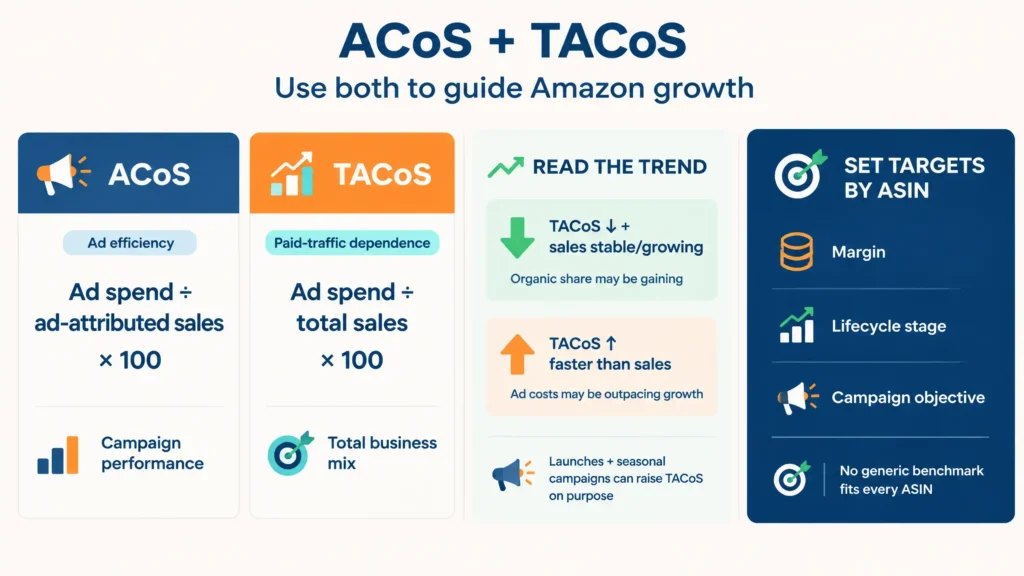
ACoS measures ad spend against ad-attributed sales, while TACoS measures ad spend against total sales. ACoS judges campaign efficiency; TACoS shows how dependent an ASIN is on paid traffic.
The formulas are:
ACoS = Ad spend ÷ Ad-attributed sales × 100
TACoS = Ad spend ÷ Total sales × 100
A falling TACoS alongside stable or growing sales may show that organic sales are gaining share, while a rising TACoS can mean advertising costs are increasing faster than total sales. However, product launches and seasonal campaigns may cause planned short-term increases. ACoS measures ad spend against ad-attributed sales, while TACoS compares ad spend with total organic and paid sales. Generic benchmarks should not act as fixed rules, so set targets according to each ASIN’s margin, lifecycle stage and campaign objective. A launch campaign may accept a higher ACoS when the product has enough margin and advertising builds measurable organic ranking momentum.
External traffic belongs in the test phase after the listing and unit economics can support more visitors. Sending TikTok, Google, influencer or email traffic to a weak detail page makes attribution harder and wastes budget.
Amazon Attribution measures how non-Amazon channels affect activity inside Amazon. Sellers can attach attribution tags to social, search, display, email and influencer campaigns, then compare clicks and conversions with on-Amazon outcomes.
Start with one audience, one channel and a limited budget. Track cost per attributed purchase, contribution margin after the external traffic cost and any change in branded search or organic sales. Scale the test only when results remain profitable across a meaningful period.
Inventory and reviews act as growth multipliers because both influence conversion and the seller’s ability to maintain sales velocity. A growth plan can fail even when its PPC and listing changes work.
Forecast inventory before increasing traffic. Use expected daily sales, supplier lead time, inbound processing time and safety stock to calculate the reorder point. Include Amazon placement costs, storage fees and cash tied up in stock when assessing the financial impact.
For eligible products, Amazon Vine can help brand-registered sellers obtain early reviews from selected Vine Voices. Sellers must follow Amazon’s review policies and should never offer compensation or incentives for positive reviews.
Early results may appear within 30 days, but 60 to 90 days gives you enough time to test changes, measure performance and confirm that growth is sustainable.
Start with one or two profitable products, calculate ASIN-level margins, improve the listings and build a controlled PPC structure before expanding the catalogue.
Amazon sellers should prioritise profit because revenue can increase while margins and cash flow decline. Track contribution margin after advertising for every ASIN.
A good TACoS fits the ASIN’s profit margin, lifecycle stage and growth goal. Review it alongside contribution margin, organic sales and total sales trends.
Increase advertising spend when the listing converts, campaigns remain within profitability limits and available inventory can support the expected increase in sales.
Grow profitable existing ASINs before launching new products. Add new ASINs when current products approach their market limit and cash flow can support expansion.
A profitable Amazon Growth Plan starts with diagnosis, not ad spend. Identify the main bottleneck, calculate contribution margin by ASIN and repair the retail foundation before running new growth tests.
Alpha Spikes helps US Amazon brands connect listing content, PPC, profitability and operations within one measurable growth plan. The next step is to audit the last 90 days of ASIN-level data, select the highest-impact constraint and build the first test around that finding.